


ABNB: Blowout beat, no weak links — but is growth pulled forward?


Overseas alt-stays leader Airbnb ($Airbnb(ABNB.US)) released Q3 results early on Nov 6. Results beat by a wide margin, with strong growth and profitability: core metrics GBV and nights booked both accelerated noticeably, with no regional weak spots. On profitability, management had guided a slight YoY margin decline, but margins rose modestly instead, sending the stock up ~10% after hours. Details below:
1) Nights sharply accelerated; GBV growth hit a multi-year high
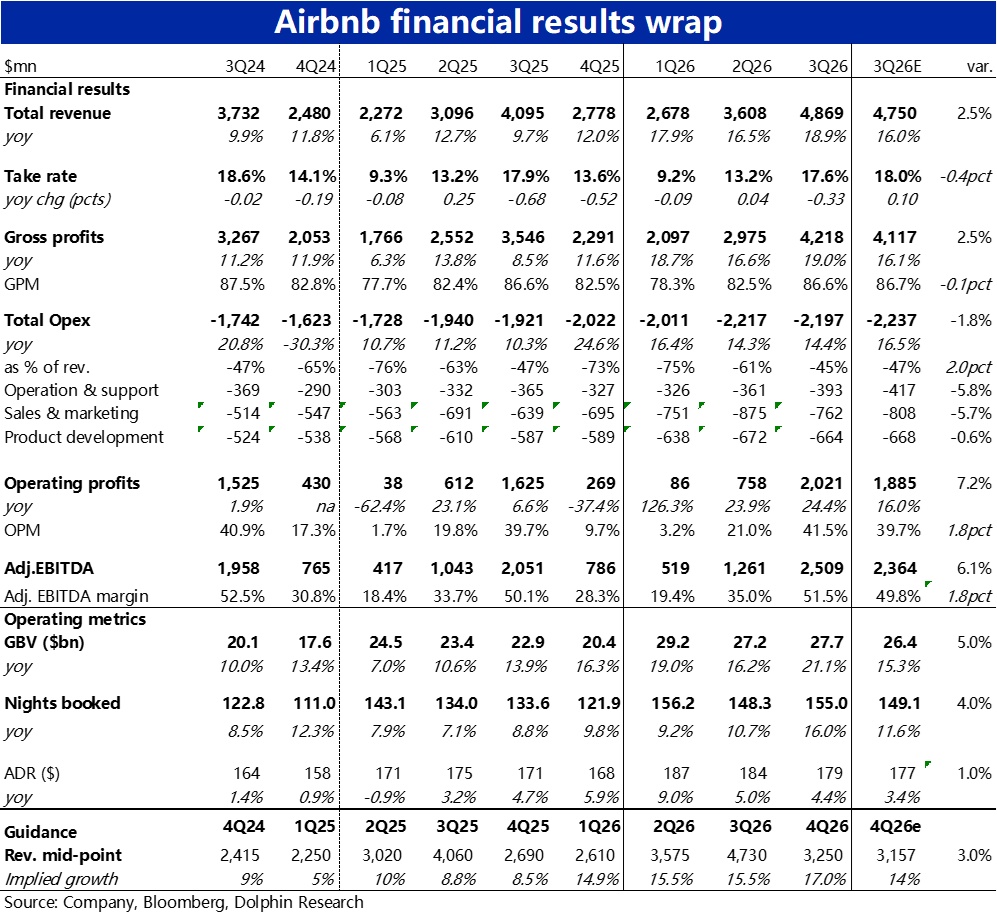
On core operating metrics, Q3 gross booking value (GBV) was $27.7bn, +21% YoY, a ~5pt acceleration vs. last quarter and far above Street estimates. More importantly, nights booked rose 16% YoY, accelerating by 6pt vs. last quarter, the largest upside surprise among key metrics. Therefore, the beat was primarily demand-driven rather than pricing-led. Average daily rate (ADR) was $179, +4% YoY, supported by price increases and mix, and while growth was solid, ADR change vs. last quarter was modest.
Management noted the acceleration in bookings did not come from a single product, but from layered improvements in search and recommendations, pricing tools, flexible payments, and sign-up/login flows. They said the search booking and pricing teams each contributed several hundred million dollars in incremental revenue. Reserve Now, Pay Later (RNPL) was a particularly visible contributor: per management, RNPL added ~3pt to nights growth in Q3 on a net basis, implying nights growth of ~13% excluding RNPL, still accelerating. RNPL users tend to book earlier and choose pricier listings, lifting ADR, but the cancellation rate rose from ~16% to ~19% as a result.
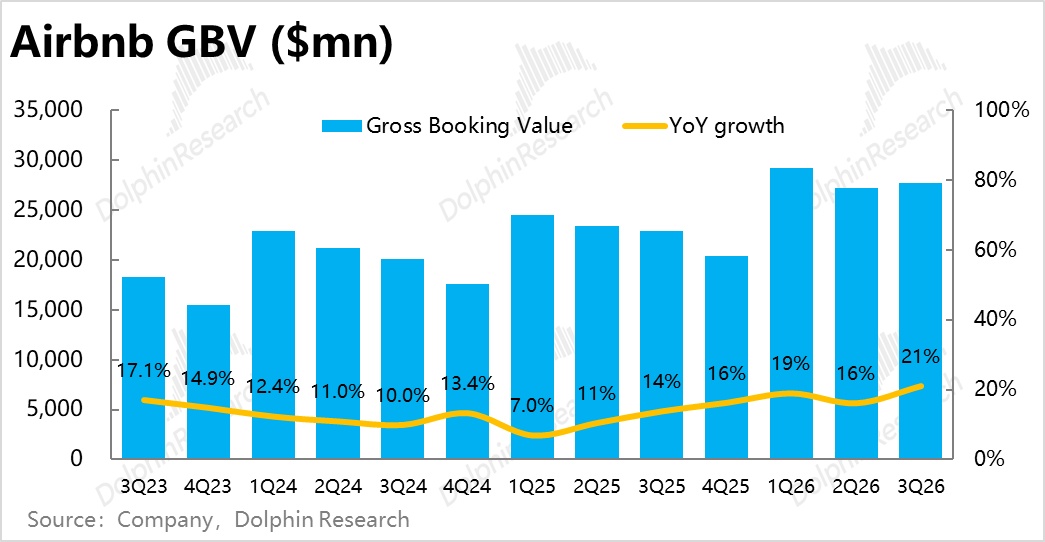
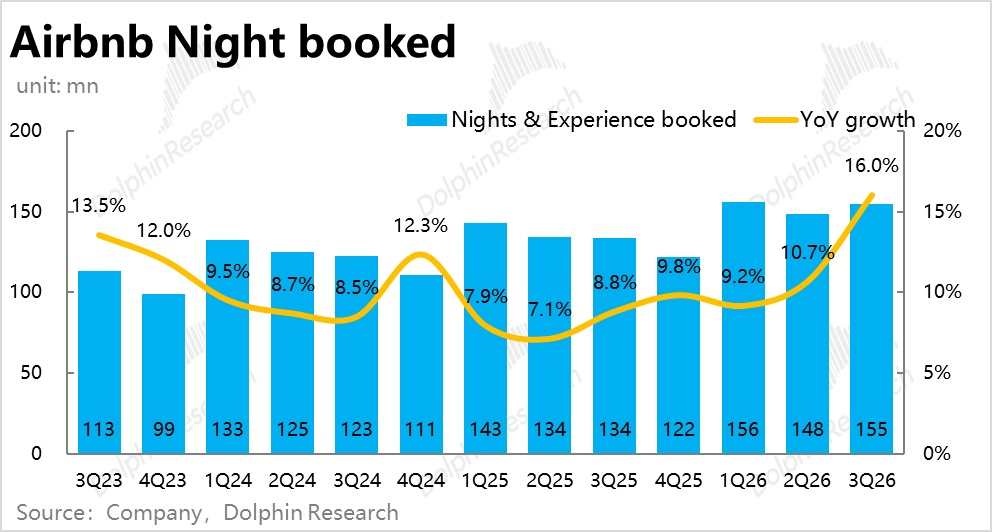
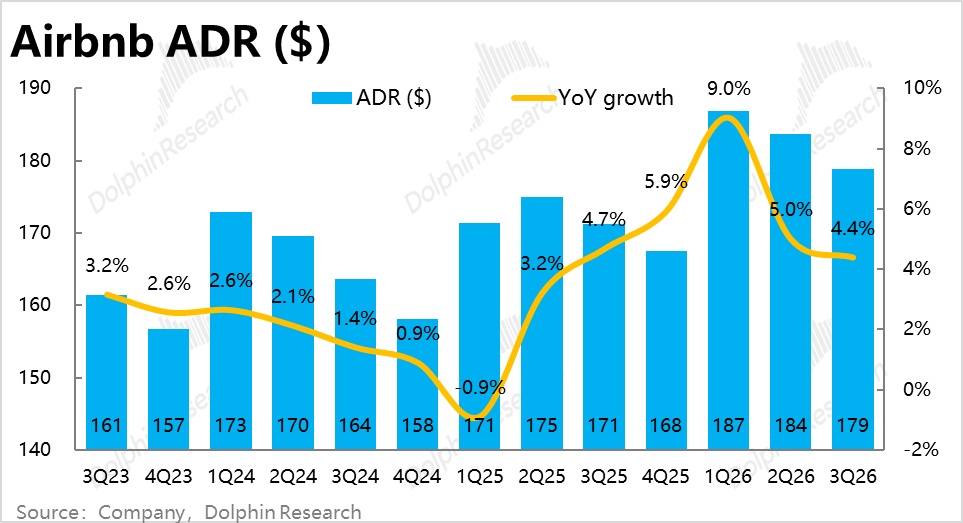
2) All regions accelerated together; North America improved markedly
By region, all geographies saw double-digit nights growth in Q3, with acceleration across the four major markets and no laggards. The largest market, North America, finally re-accelerated to low-teens nights growth, a four-year high.
EMEA also accelerated from high single digits last quarter to ~15%, with the UK, France, Germany, Spain and Italy all showing QoQ acceleration in nights. The Middle East conflict did not drag EMEA. Emerging markets—LatAm and APAC—continued to grow >20%, with new user growth particularly strong in expansion markets such as Brazil, Japan and India.
Peer check: Booking's alt-stays nights growth rose from +4% in Q2 to +7% in Q3, indicating the entire alt-stays category is strengthening. Airbnb's 16% growth is still well above peers, implying share gains.
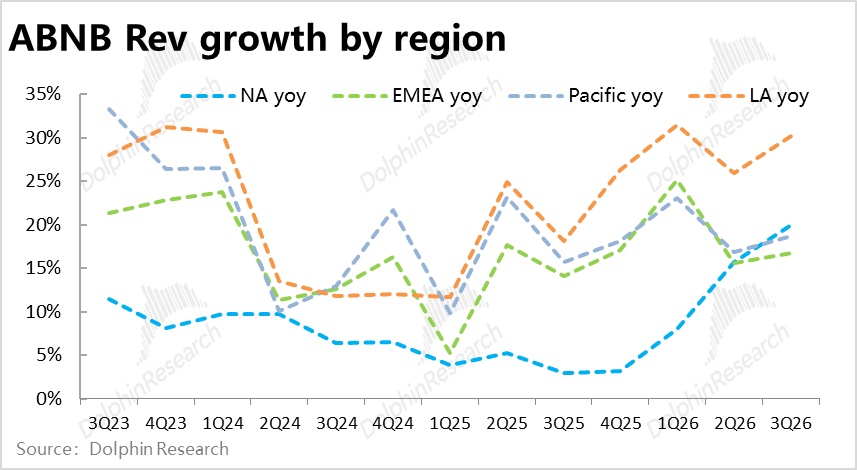
3) Revenue accelerated and beat, but take rate fell on RNPL
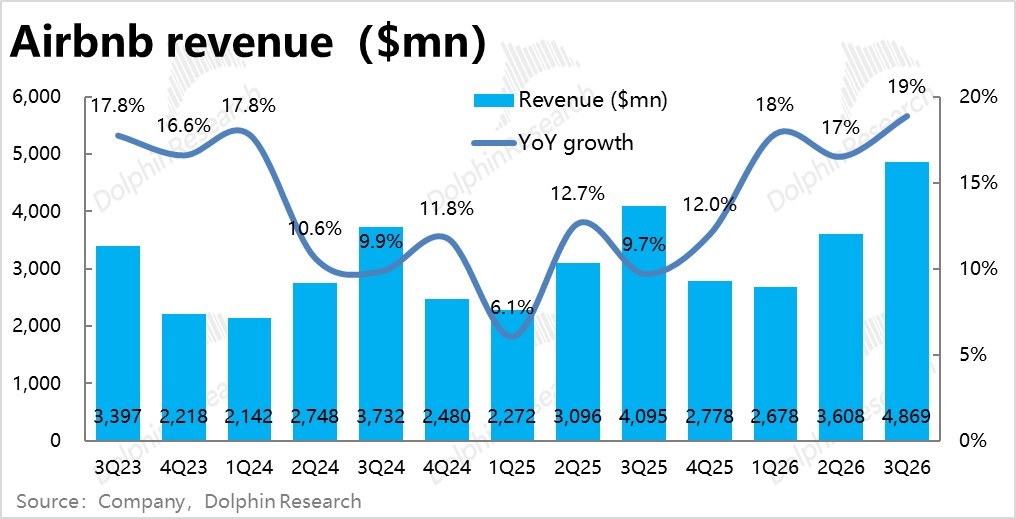
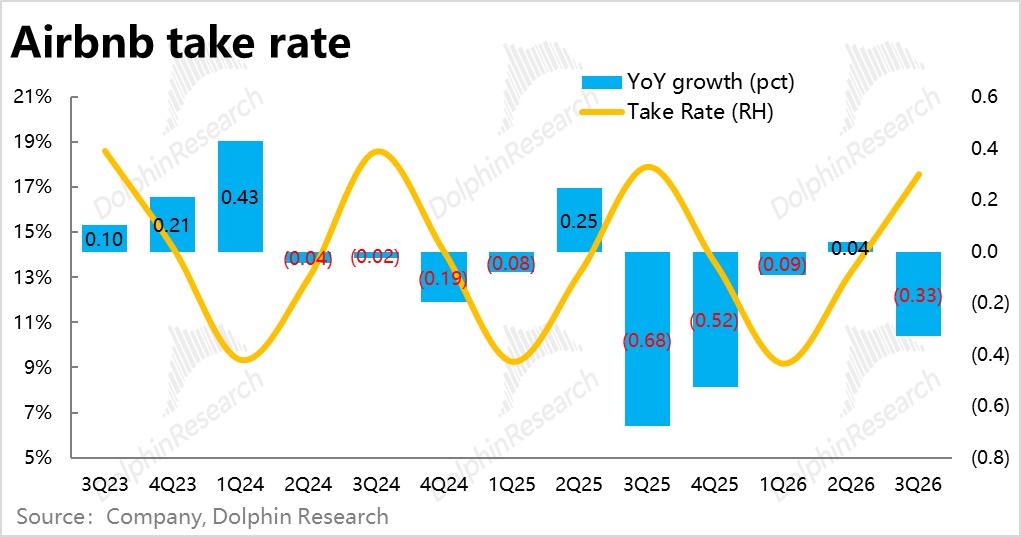
On revenue, Q3 came in at $4.87bn, +19% YoY (+16% ex-FX), a 3pt acceleration vs. last quarter, ahead of expectations. However, the take rate (revenue/GBV) was 17.6%, down 0.3pt YoY and below expectations, leading revenue growth to lag GBV growth. The primary driver was RNPL: GBV is recognized at booking, while revenue is recognized at stay, so longer revenue lag depresses the take rate. Management also noted heavier use of incentives and credits in new initiatives this quarter, which reduced recognized revenue.
4) Opex ratio was diluted; margins rose instead of falling
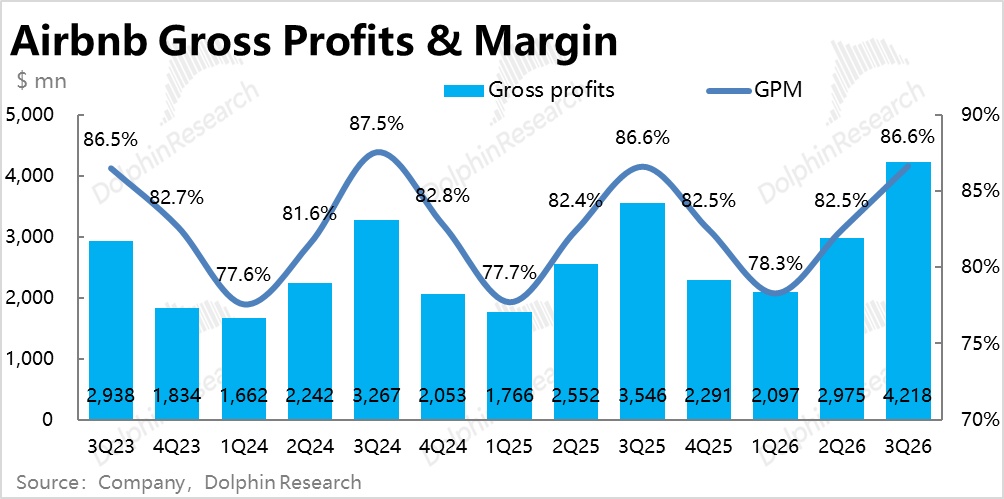
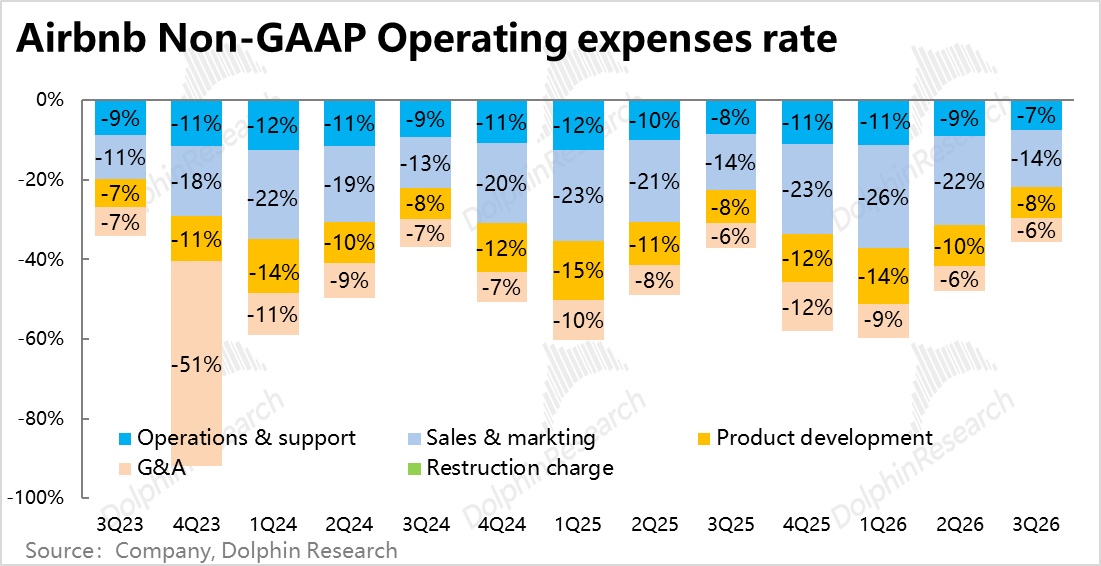
On costs, GPM was 86.6%, flat YoY and broadly in line. Cost of revenue grew 19% in line with revenue, mainly due to higher payment processing fees, chargebacks and server costs. Operating expenses rose ~14% YoY, which is not low, but faster revenue growth narrowed the opex ratio by ~1.8pt YoY, coming in better than expected.
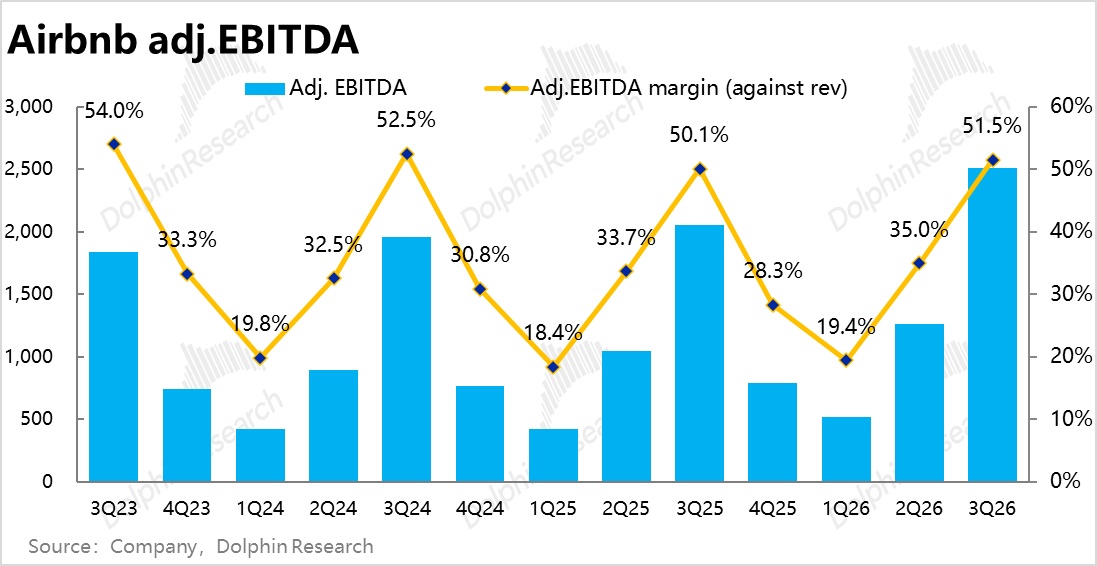
By line item, marketing remained the fastest-growing, +19% YoY, with brand and performance spend +24%, focused on paid acquisition and partner channels. R&D was +13%, mainly headcount, while operations support grew only 8%, as AI support replaced part of outsourced seats, lowering customer service cost per booking by >17% YoY. On profits, Adj. EBITDA was $2.51bn, +22% YoY and ~6% above expectations, with margin at 52%, +1.4pt YoY, rising rather than falling.
That said, part of Q3 marketing spend was deferred into Q4, making Q3 margins higher than management had anticipated. This timing shift was one reason for Q4 margin guidance calling for a modest YoY decline.
5) Shareholder returns: new $12bn buyback authorization
Q3 buybacks were ~$700mn, bringing YTD to ~$2.8bn, which annualized equates to ~3%–4% of current market cap. The company also added a new $12bn authorization; combined with $2.7bn remaining under the prior plan, total available capacity is ~$14.7bn, or ~13%–15% of current market cap.
6) Key financials at a glance; see link for call transcript
Dolphin Research view:
1) This quarter: growth re-accelerated; margins beat, with some temporary factors
Overall, Airbnb delivered a broad-based beat this quarter: the most critical metrics—nights and GBV—accelerated sharply, with all regions speeding up. On the profit side, faster growth and diluted opex lifted margins, confirming the Q2 theme of 're-accelerating growth and unlocking margin' with stronger evidence. That said, RNPL amplified the acceleration. Excluding the ~3pt net lift from RNPL, nights growth was ~13%, still accelerating but less dramatic than the headline.
Cash flow data corroborate this. GBV rose 21% YoY, but deferred service fees on the balance sheet fell ~16% YoY, and cash collected from bookings rose only ~3%, with both as a share of GBV down materially, indicating a significant portion of orders were 'booked now, cash later' advance bookings in Q3. Profitability also had temporary help: part of marketing was shifted from Q3 to Q4, boosting Q3 margin, which is one reason Q4 margin guidance calls for a slight YoY decline.
2) Outlook
For guidance, Q4 revenue is guided to $3.22–$3.28bn, +16%–18% YoY (including ~2pt FX tailwind), with the midpoint ~3% above Street. However, GBV and nights guidance both step down vs. Q3: GBV growth guided to mid-teens (vs. 21% in Q3), and nights to 'at least low-teens' (vs. 16% in Q3).
Margin guidance also implies a modest YoY decline (partly due to marketing deferred from Q3 to Q4). Management said Q3 was the peak quarter for RNPL's net lift, with the impact fading QoQ in Q4 and timing mismatches normalizing thereafter. Combined with tough comps in H1 next year from RNPL rollout and strong U.S. demand, a growth deceleration is the base case. Guidance does not assume sustained major impacts from EMEA geopolitics (especially France) or the Middle East.
As RNPL effects fade, the depressed take rate should recover modestly in Q4. Longer term, unified service fees and insurance should lift the take rate slightly, with insurance currently at single-digit penetration but carrying high margins.
On profits, management did not provide a margin target for 2027 and reiterated growth-first. The past two years show excess returns can be reinvested to sustain growth, which likely means margin expansion next year will be modest rather than large.
3) AI agents: the company's stance, actions, and why impact is relatively limited
In Sep, after Expedia announced integration with Meta's Muse agent, the market worried OTAs and platforms could be bypassed by general-purpose agents, sending travel-booking stocks lower and Airbnb down ~8% in a day. This was a key overhang on Q3 valuation. Airbnb's stance is clear: a single general agent will not do everything, and professional agents must be 2–5x better than current methods to change user habits.
As a response, the company has rolled out AI search, AI filters, AI listing summaries and wishlist comparisons, while AI support can independently resolve ~40% of issues, cutting customer service cost per booking by >17%. Externally, management is open to general-purpose agents as traffic sources similar to Google. So far, bookings from external agents are negligible (a tiny fraction of ~500k daily bookings), and related traffic peaked in early Oct and has been flat since.
The prevailing view is Airbnb is relatively insulated from AI, for several reasons: supply is unique and fragmented, with >60% of listings exclusive to Airbnb, and many individual hosts are not connected to property-management systems, making aggregation hard. About half of traffic is direct. Logic suggests Airbnb is advantaged, but the entry-point battle is a long-term variable. The key will be user experience once Airbnb's own agents are fully rolled out and the pace of external agent evolution.
4) Forecast updates, valuation and investment case
On earnings, Dolphin adjusted Q4 per guidance and raised 2027–28 nights and margin assumptions. Given RNPL's lift peaked in Q3, tough comps in H1 next year, and management's growth-first investment stance, we did not extrapolate Q3's acceleration linearly. We expect nights growth of ~10% in 2027 and margin expansion of ~1pt per year. Adj. EBITDA in 2027 is estimated at ~$6.1bn, above pre-print major-bank estimates.
On valuation, at after-hours ~$189, market cap is ~$113bn. Net cash is ~$10bn, implying ~17x 2027 Adj. EBITDA. This multiple already reflects Q3 acceleration, sits at the upper end of a reasonable range, and is clearly above peer levels.
Further upside will depend on whether ex-RNPL organic growth can hold above ~10% and whether margins can continue to improve under a growth-first investment posture. Overall, Q3 reinforced the 're-accelerating growth + improving margins' narrative, but beware that RNPL may have pulled forward some performance, potentially marking a short-term high. The magnitude of deceleration in Q4 and early next year is the next watch point.
Risk disclosure and statements:海豚研究免责声明及一般披露
Past Dolphin Research pieces on Airbnb:
Earnings reviews
Aug 7, 2026 earnings review 'Airbnb: World Cup 'Heat' Ignites Travel'
Aug 7, 2026 transcript 'Airbnb (Trans): Full-year Guidance Raised Twice; Q3 Margin Slightly Down'
May 8, 2026 earnings review 'Airbnb: Near-term Fine, But Hitting a 'Midlife Crisis'?'
May 8, 2026 transcript 'Airbnb (Trans): Building a Full-Category Entry?'
Feb 13, 2026 earnings review 'Airbnb: Decent Prints, But Now a Cyclical?'
Feb 13, 2026 transcript 'Airbnb (Trans): Accelerating Boutique Hotel Onboarding and AI Capabilities'
Nov 7, 2025 earnings review 'Airbnb: Truly Out of the Trough, Or Just a 'Dead Cat Bounce'?'
Recommended Articles








Comments (0)
Click the $ button, enter the symbol, and select to link a stock, ETF, or other ticker.