


USD/CHF (USDCHF) Is down 0.52% on Oct 22: What Is Driving the Move?



USD/CHF (USDCHF) is down 0.52% at Oct 22 03:10(ET), now at $0.81961, with a 7-day down of 0.82%.
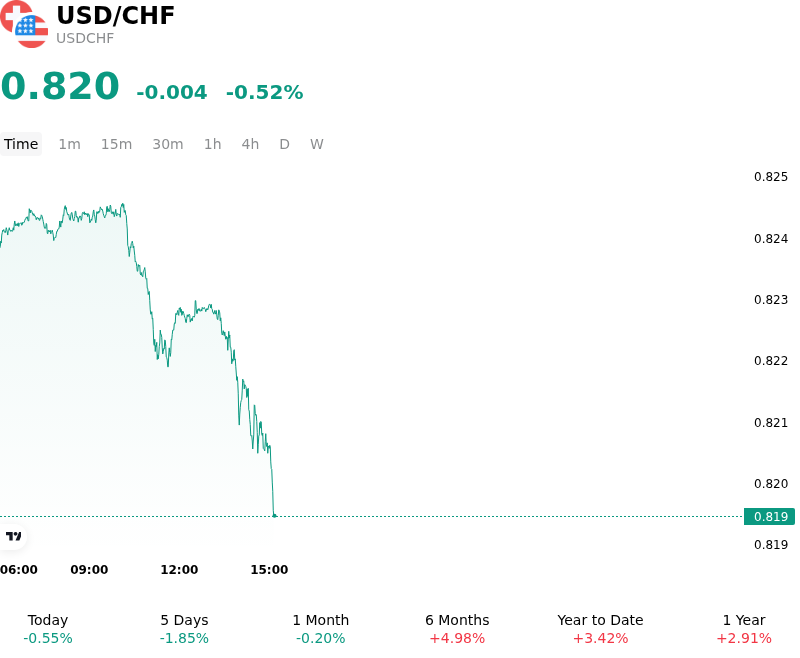
What is driving USD/CHF (USDCHF)’s stock price down today?
The decline in USD/CHF was primarily driven by downside pressure on the U.S. dollar, triggered by disappointing U.S. macroeconomic data and a recalibration of Federal Reserve rate expectations ahead of the upcoming Federal Open Market Committee policy decision. Recent economic releases highlighted emerging softness in U.S. economic activity, highlighted by declining housing starts and pending home sales hitting record lows. This weaker housing data raised concerns over domestic growth momentum, reducing immediate upward pressure on U.S. Treasury yields and weighing on the U.S. dollar relative to low-yielding safe-haven counterparts like the Swiss Franc.
Financial markets have increasingly priced in a Federal Reserve policy pause at its late-October meeting, with futures pricing reflecting a very high probability of rates holding steady. Although persistent energy price increases and Middle East geopolitical tensions maintain broader inflation risks, recent cautious messaging from Federal Reserve officials has led market participants to discount the likelihood of an immediate rate increase. This shift in near-term monetary policy expectations encouraged investors to trim long U.S. dollar exposures, providing room for the Swiss Franc to appreciate.
While the fundamental interest rate differential continues to favor the U.S. dollar over the Swiss Franc due to the Swiss National Bank maintaining its accommodative stance, short-term flows favored the Franc. Low Swiss interest rates continue to position the Franc as a preferred funding currency for carry trades over a longer horizon. However, intraday profit-taking on greenback positions, coupled with technical selling as USD/CHF breached key short-term moving averages and support levels, reinforced the pair's downward path.
Overall, the intraday movement appears driven by a temporary macro recalibration and positioning adjustment rather than a fundamental reversal in medium-term monetary policy divergence. Institutional investors will continue to monitor upcoming Federal Reserve forward guidance, U.S. yield movements, and global energy developments to assess whether U.S. dollar weakness persists or reverses back toward its broader structural trajectory.
Technical Analysis of USD/CHF (USDCHF)
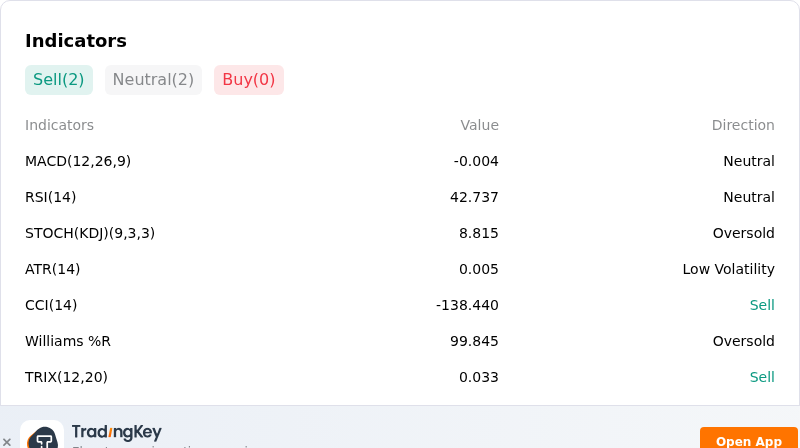
Technically, USD/CHF (USDCHF) shows a MACD (12,26,9) value of -0.004, indicating a neutral signal. The RSI at 42.737 suggests neutral condition and the Williams %R at 99.845 suggests oversold condition. Please monitor closely.
More details about USD/CHF (USDCHF)
Recent Events and Risks:
- Resurgent Safe-Haven Demand for the Franc: Escalating global geopolitical tensions and risk-off market sentiment over the past 48 hours have spurred defensive capital flows into the Swiss Franc, generating intraday downside pressure on USD/CHF toward critical support zones.
- Weakening US Economic Data Signals: Disappointing recent US economic indicators, including sharp declines in September housing starts and record-low pending home sales, have raised concerns over US economic momentum and reduced demand for the US Dollar.
- Fed Rate Pause Expectations Capping Dollar Yields: Futures markets are pricing in an 84% probability that the Federal Reserve will hold interest rates steady at its upcoming meeting, which, combined with un-commissive Fed guidance, is capping US Treasury yield gains and limiting USD/CHF upside buffer.
- Technical Pressure and Support Breakdown Risk: Intraday trading beneath key dynamic resistance levels, such as the 50-period exponential moving average, leaves the pair vulnerable to accelerated corrective selling if pivotal support at 0.8227 fails to hold.
This article may include AI-generated content that is human-reviewed, which is for reference and general information purposes only and does not constitute investment advice.
Recommended Articles









Comments (0)
Click the $ button, enter the symbol, and select to link a stock, ETF, or other ticker.