


NZD/USD (NZDUSD) Drops on Sep 29: What Are the Key Reasons?



NZD/USD (NZDUSD) is down 0.50% at Sep 29 11:00(ET), now at $0.56368, with a 7-day down of 1.55%.
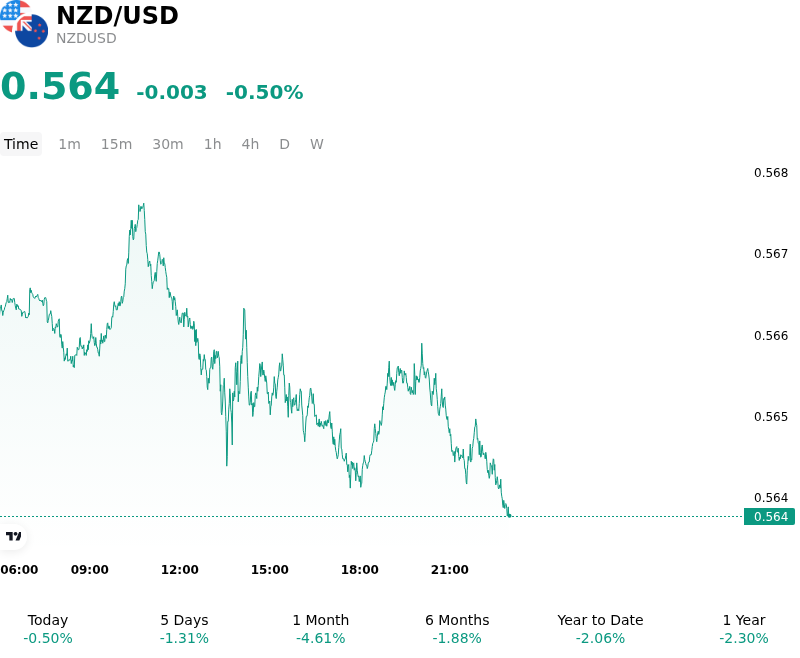
What is driving NZD/USD (NZDUSD)’s stock price down today?
The decline in the New Zealand dollar against the US dollar was primarily driven by safe-haven capital flows into the greenback alongside a widening US yield advantage, which outweighed domestic monetary policy expectations in New Zealand. Geopolitical friction in the Middle East and ongoing concerns regarding potential trade disruptions around the Strait of Hormuz dampened global risk appetite. This environment boosted international demand for liquid, safe-haven assets, prompting institutional investors to rotate away from growth-sensitive, pro-cyclical currencies like the Kiwi and into the US dollar.
Relative interest-rate dynamics and short-end bond yield differentials continued to provide structural support to the US dollar. US Treasury yields remained firm at the front end of the curve as market participants adjusted to persistent inflation risks and a relatively restrictive Federal Reserve stance. The resulting yield differential between short-term US and New Zealand debt maintained a significant spread in favor of the US dollar. Although market expectations for Reserve Bank of New Zealand policy have remained firm due to domestic inflation risks tied to elevated energy prices, the prevailing interest-rate advantage offered by US fixed-income assets continued to attract yield-seeking capital flows at the expense of New Zealand assets.
Broader macro risk sentiment and technical trading flows further reinforced the downward pressure on the exchange rate. As a high-beta commodity currency, the New Zealand dollar remains particularly vulnerable to shifts in global growth expectations and broader market risk aversion. The failure to sustain corrective bounces led to systematic selling and technical trend-following flows, accelerating the pair's lower trajectory. Looking ahead, institutional investors will closely monitor developments in energy markets, geopolitical risk headlines, and upcoming macroeconomic releases in both economies to assess whether interest-rate differentials and risk appetite will offer a catalyst for stabilization.
Technical Analysis of NZD/USD (NZDUSD)
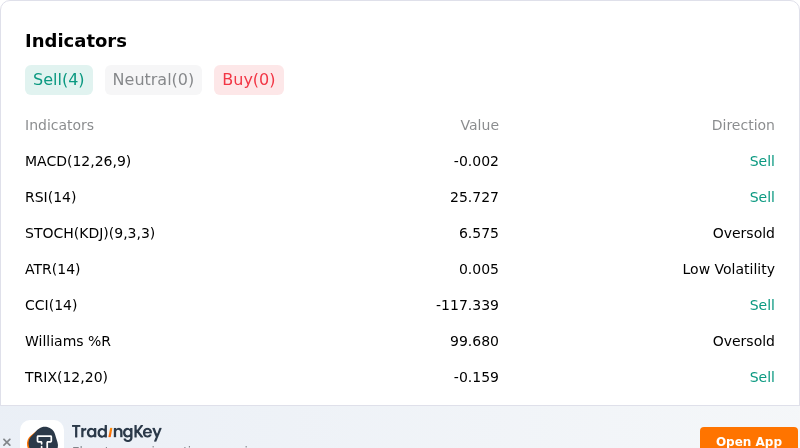
Technically, NZD/USD (NZDUSD) shows a MACD (12,26,9) value of -0.002, indicating a sell signal. The RSI at 25.727 suggests sell condition and the Williams %R at 99.680 suggests oversold condition. Please monitor closely.
More details about NZD/USD (NZDUSD)
Recent Events and Risks:
- Dovish Central Bank Rate Path Differential: Although the Reserve Bank of New Zealand recently adjusted the Official Cash Rate to 2.75%, its dovish forward guidance signaling a cautious tightening path contrasts with a hawkish Federal Reserve stance and elevated US Treasury yields, eroding yield support for the Kiwi dollar.
- Geopolitical Safe-Haven Demand for USD: Escalating Middle East geopolitical conflicts and US-Iran hostilities continue to depress global risk sentiment, encouraging capital rotation out of high-beta commodity currencies like the New Zealand dollar and into safe-haven US dollar assets.
- Energy Price Shock and Domestic Economic Pressure: Spiking global crude oil prices driven by Middle East trade disruptions are imposing severe imported inflation on New Zealand as a net oil importer, suppressing domestic consumer spending and compounding downside risks for the currency.
- Technical Breakdown and Downside Trend Acceleration: Persistent trading below key technical moving averages (including the 50-period and 100-hour SMAs) has reinforced intraday downside momentum in NZDUSD, exposing the pair to deeper sell-offs toward support levels near 0.5610.
This article may include AI-generated content that is human-reviewed, which is for reference and general information purposes only and does not constitute investment advice.
Recommended Articles







Comments (0)
Click the $ button, enter the symbol, and select to link a stock, ETF, or other ticker.