


AUD/USD (AUDUSD) Is down 0.51% on Sep 29: What Is Driving the Move?



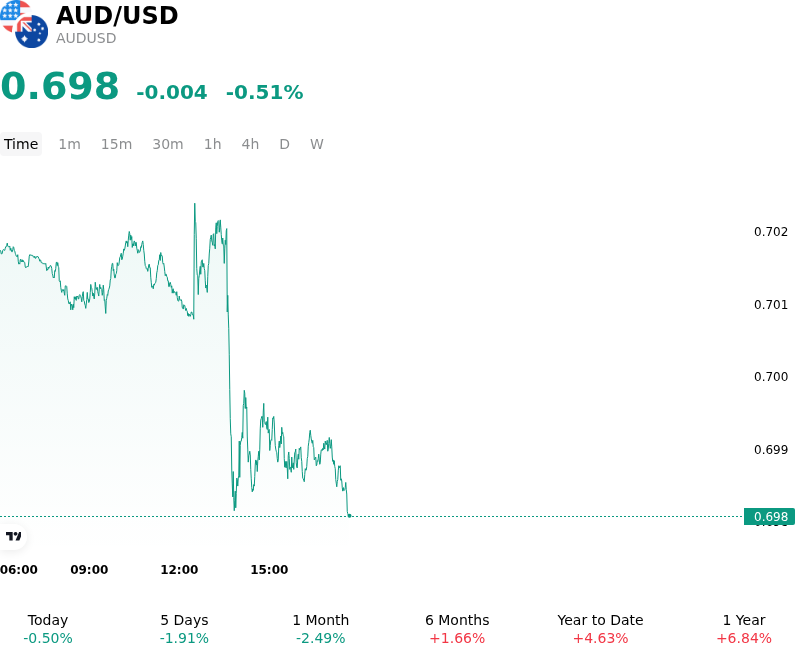
AUD/USD (AUDUSD) is down 0.51% at Sep 29 05:40(ET), now at $0.69803, with a 7-day down of 1.87%.
What is driving AUD/USD (AUDUSD)’s stock price down today?
The decline in AUD/USD was primarily driven by a sell-the-fact response following the Reserve Bank of Australia’s monetary policy announcement. Although the RBA raised its cash rate target by 25 basis points to 4.60% in a widely anticipated decision, market participants focused heavily on the central bank's forward guidance and post-meeting remarks. RBA Governor Michele Bullock delivered a balanced assessment, acknowledging that while elevated inflation warranted higher borrowing costs, the board remains mindful of slowing domestic growth and labor market softening. Her indication that additional tightening might not be required if inflation expectations remain anchored prompted traders to scale back bets on further rate hikes later in the year, stripping away a key driver of recent Aussie dollar strength.
On the other side of the pair, the US dollar held a firm footing, underpinned by resilient US Treasury yields and a cautious broader market mood. The perceived end or near-completion of the RBA's tightening cycle prevented Australian government bond yields from extending their premium over US counterpart yields. Additionally, the RBA highlighted ongoing external risks, including global energy price shocks stemming from supply disruptions in the Middle East. Because higher energy prices operate as a tax on global growth while stoking headline inflation, the combination of supply-driven price pressures and softer domestic consumer demand dampened market risk appetite, which typically disproportionately weighs on commodity-linked and growth-sensitive currencies such as the Australian dollar.
From a technical perspective, the currency pair encountered heavy selling pressure after breaching the psychological support level at 0.7000. The break below this pivotal handle accelerated systematic intraday sell flows and triggered stop-loss orders, reinforcing the downward trajectory. Moving forward, institutional investors will closely monitor upcoming monthly CPI data and economic activity prints in both Australia and the US to evaluate whether the RBA's balanced stance will endure or if persistent core price pressures will force another recalibration of interest-rate differentials.
Technical Analysis of AUD/USD (AUDUSD)
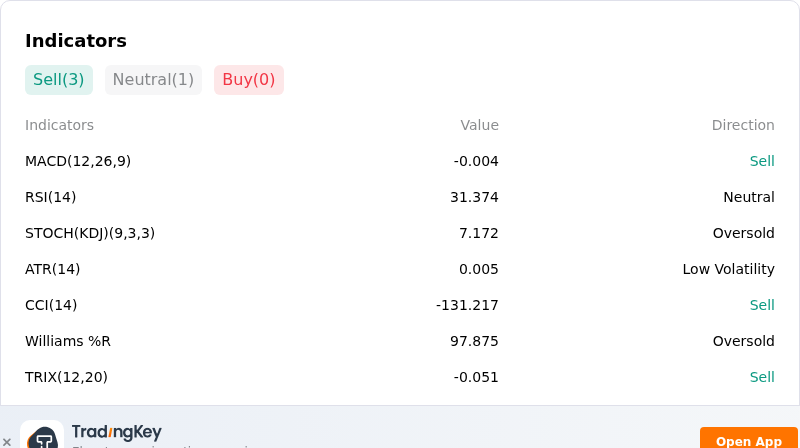
Technically, AUD/USD (AUDUSD) shows a MACD (12,26,9) value of -0.004, indicating a sell signal. The RSI at 31.374 suggests neutral condition and the Williams %R at 97.875 suggests oversold condition. Please monitor closely.
More details about AUD/USD (AUDUSD)
Recent Events and Risks:
- Fed Hawkish Expectations and Yield Spread Pressure: Persistent hawkish messaging from Fed officials and surging US Treasury yields have reinforced expectations of further US interest rate hikes, narrowing the Australian-US yield differential and generating persistent downside volatility for AUD/USD.
- China Growth Softness and Commodity Vulnerabilities: Unchanged loan prime rates from the People's Bank of China and muted macroeconomic momentum across key trade partners continue to weigh on iron ore prices and commodity sentiment, limiting export demand and eroding support for the trade-sensitive Australian Dollar.
- RBA Policy Ambiguity and Domestic Growth Downgrades: Heightened market sensitivity surrounding the Reserve Bank of Australia's policy path, alongside concerns over sluggish domestic GDP growth and rising unemployment, creates downside exposure if central bank guidance signals reluctance to sustain restrictive policy.
- Safe-Haven Dollar Flows and Risk-Off Market Sentiment: Energy-driven inflation risks and persistent geopolitical tensions have reinforced broad risk-averse market positioning, driving safe-haven capital toward the US Dollar and increasing put option demand relative to calls on AUD/USD.
This article may include AI-generated content that is human-reviewed, which is for reference and general information purposes only and does not constitute investment advice.
Recommended Articles








Comments (0)
Click the $ button, enter the symbol, and select to link a stock, ETF, or other ticker.