


Carvana Co Stock (CVNA) Moved Down by 6.92% on Sep 28: A Full Analysis



Carvana Co (CVNA) moved down by 6.92%. The Retailers sector is down by 0.37%. The company underperformed the industry. Top 3 stocks by turnover in the sector: Amazon.com Inc (AMZN) down 0.80%; Costco Wholesale Corp (COST) up 0.17%; Carvana Co (CVNA) down 6.65%.
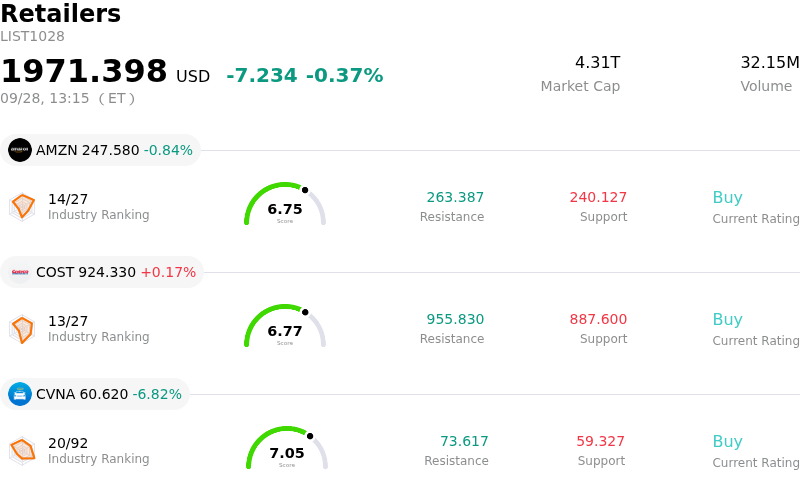
What is driving Carvana Co (CVNA)’s stock price down today?
Carvana experienced a sharp drop in sentiment as a broader risk-off mood across U.S. equity markets hit high-beta growth stocks particularly hard. Rising Treasury yields and macro pressure on the consumer discretionary sector have reinforced market concerns that elevated interest rates continue to constrain high-ticket, credit-sensitive purchases like used vehicles. With a beta significantly higher than the broader market, Carvana remains highly sensitive to systemic sell-offs and sector-wide risk aversion, magnifying general market losses.
The downward movement was further exacerbated by increased speculative short-selling activity and the introduction of new derivative instruments, including perpetual futures contracts. These instruments have facilitated short exposure and created additional localized selling pressure, amplifying intraday price swings. In the absence of an immediate positive operational catalyst to counter the selling flow, short interest and tactical trading strategies exerted a dominant pull on the order book.
Investors also expressed renewed caution over execution risks connected to Carvana's aggressive operational expansion. While the company has been integrating inspection and reconditioning capabilities across its nationwide auction facilities to resolve inventory bottlenecks and expand same-day delivery, market participants remain focused on potential cost inflation and execution hiccups. Despite recent improvements in unit volume and debt refinancing efforts, persistent concerns surrounding gross profit per unit compression, operational margin sustainability, and inventory reconditioning capacity continue to trigger profit-taking.
Lastly, lingering regulatory overhangs and past short-seller scrutiny remain an ongoing drag on investor sentiment. Shadowing these fundamental dynamics is investor hesitation ahead of the company's upcoming quarterly financial results. The compounding effect of unresolved legal uncertainties, valuation friction relative to trimmed Wall Street targets, and cautious full-year guidance leaves the stock vulnerable to outsized drawdowns during market-wide declines.
Technical Analysis of Carvana Co (CVNA)
Technically, Carvana Co (CVNA) shows a MACD (12,26,9) value of -1.716, indicating a sell signal. The RSI at 34.127 suggests neutral condition and the Williams %R at 98.492 suggests oversold condition. Please monitor closely.
Fundamental Analysis of Carvana Co (CVNA)
Carvana Co (CVNA) is in the Retailers industry. Its latest annual revenue is $20.32B, ranking 11 in the industry. The net profit is $1.41B, ranking 7 in the industry. Company Profile
Over the past month, multiple analysts have rated the company as Buy, with an average price target of $82.77, a high of $120.00, and a low of $60.00.
More details about Carvana Co (CVNA)
Company Specific Risks:
- Increased Short-Selling Activity via Derivatives: The launch of new equity-linked perpetual futures contracts on offshore exchanges has lowered friction for speculative short sellers, driving immediate intraday volatility and intensifying down-trending price pressure as short interest accumulates.
- Gross Margin Compression and Soft Guidance: Market sentiment remains burdened by a 200 basis point contraction in adjusted EBITDA margins down to 10.4% and falling gross profit per unit, alongside full-year profit targets that fell short of top-end Wall Street consensus expectations.
- Execution Risks in ADESA Operational Expansion: Aggressive build-outs of ADESA inspection and reconditioning hubs introduce significant operational overhang and inventory holding risk if unit sales growth fails to keep pace with fixed capacity additions.
- Executive Insider Selling and Premium Valuation Multiple: Sustained equity liquidations by executive leadership—including the CFO and COO—coincide with a premium forward earnings multiple relative to retail sector peers, leaving the stock vulnerable to sharp drawdowns on minor macro or fundamental stumbles.
This article may include AI-generated content that is human-reviewed, which is for reference and general information purposes only and does not constitute investment advice.
Recommended Articles







Comments (0)
Click the $ button, enter the symbol, and select to link a stock, ETF, or other ticker.