


Natural Gas (NATGAS) Is up 2.15% on Aug 19: What Changed in Supply and Demand?



Natural Gas (NATGAS) is up 2.15% at Aug 19 07:55(ET), now at $2.845, with a 7-day up of 1.57%.
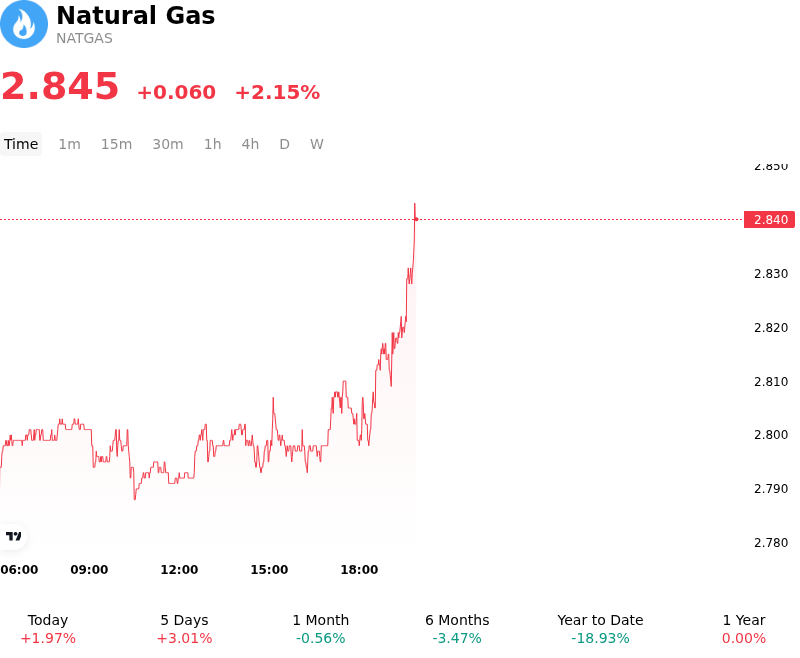
What is driving Natural Gas (NATGAS)’s stock price up today?
US natural gas futures advanced as updated weather forecasts projected sustained, above-average temperatures across key population centers in the American South, West, and Central regions through late August. The persistent late-summer heatwave generated a significant surge in cooling degree days, compelling power utilities to maximize natural gas burn for electricity generation to handle peak air-conditioning loads. Domestic power burn remained exceptionally strong, holding well above seasonal averages and providing the primary demand-side impetus for the upward price movement.
Market participants also engaged in tactical buying ahead of the upcoming weekly storage report, anticipating that intense heat-driven power burn would result in a narrower weekly storage build. Projections for a below-average inventory injection suggested a temporary deceleration in the rate of stock accumulation relative to five-year historical norms, helping to absorb excess supply and trim the storage surplus. Although national underground storage levels remain relatively comfortable, localized tightening in heat-stressed regions reduced immediate downside market pressure and prompted short-covering across prompt-month contracts.
On the supply side, lower-48 dry gas production showed signs of short-term stabilization, while daily feedgas flows to US liquefied natural gas export terminals held firm near recent elevated levels. Robust export intake provided a consistent demand floor, offsetting localized pipeline maintenance and infrastructure bottlenecks. While comfortable macro storage buffers and strong underlying production capacity continue to weigh on the medium-term forward curve, the intraday gain largely reflected an event-driven repricing anchored by intense late-summer cooling demand and tightening near-term market balance expectations.
Technical Analysis of Natural Gas (NATGAS)
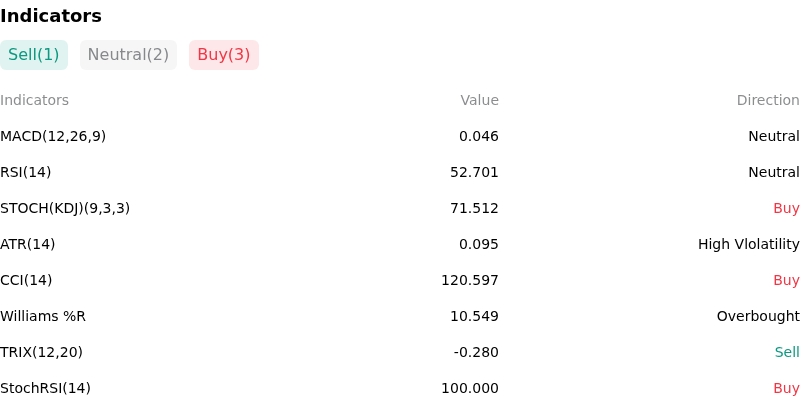
Technically, Natural Gas (NATGAS) shows a MACD (12,26,9) value of 0.046, indicating a neutral signal. The RSI at 52.701 suggests neutral condition and the Williams %R at 10.549 suggests overbought condition. Please monitor closely.
More details about Natural Gas (NATGAS)
Recent Events and Risks:
- Expanding Storage Surplus and Bearish Injections: The EIA reported a larger-than-expected weekly natural gas storage injection of 36 Bcf, expanding working inventories to 3,153 Bcf (6.7% above the five-year average). Forecasts projecting total underground storage to reach a 10-year high of 3,985 Bcf by late October continue to generate heavy overhead price resistance.
- Elevated Domestic Dry Production: Lower-48 dry gas production has held near historic summer highs of 112 to 114.4 Bcf per day. Unyielding associated gas output from Permian Basin oil drilling, combined with recent increases in active gas rigs, is generating a persistent structural oversupply that exceeds baseline domestic demand.
- Reduced LNG Export Feedgas Intake: Net gas deliveries to U.S. LNG export facilities slipped to roughly 17 to 18 Bcf per day due to seasonal maintenance and facility throttling. Unscheduled maintenance at key terminals, such as Freeport LNG, has temporarily taken nearly 2 Bcf per day of export capacity offline, backing up gas into domestic distribution networks.
- Waning Weather-Driven Cooling Demand: Forecast models show intense summer heatwaves easing across the Midwest and Northeast into late August. Diminishing power-sector burn for air conditioning is accelerating the market's transition into the low-demand autumn shoulder season well before winter space-heating demand begins.
This article may include AI-generated content that is human-reviewed, which is for reference and general information purposes only and does not constitute investment advice.
Recommended Articles









Comments (0)
Click the $ button, enter the symbol, and select to link a stock, ETF, or other ticker.