


SpaceX Stock Price Forecast: SPCX Rises to $164 After Hours as $8 Billion Spectrum Acquisition Opens Mobile Communications Market



SpaceX is expanding into the mobile communications market by acquiring Grain Management’s 800 MHz low-band spectrum licenses for approximately $8 billion in cash, intensifying competition with traditional telecom operators like AT&T, Verizon, and T-Mobile. This spectrum acquisition addresses indoor coverage gaps in Starlink’s direct-to-cell service, creating a hybrid satellite-terrestrial architecture. Technically, SpaceX shares trade above key moving averages, indicating an intact medium-term uptrend despite cooled momentum. Resistance sits at $170–$175, while critical support rests near the 20-day moving average of $153.83, framing the current pullback as normal consolidation.
TradingKey - SpaceX (SPCX) is accelerating its expansion from a satellite internet provider into the mobile communications market.
On October 8 local time, the company announced an agreement with investment firm Grain Management to acquire its nationwide portfolio of 800MHz low-band spectrum licenses for approximately $8 billion in cash.
Following the announcement, SpaceX shares rose about 2.3% in after-hours trading to $164.30. Meanwhile, shares of AT&T (T), Verizon (VZ), and T-Mobile US (TMUS) all fell more than 6%.
As SpaceX further integrates satellite resources with terrestrial communications infrastructure, its competition with traditional telecom operators is gradually expanding from filling satellite coverage gaps in remote areas to the broader mobile communications market.
800 MHz Spectrum Fills Starlink’s Indoor Coverage Gap
SpaceX is acquiring up to 14MHz of paired 800MHz low-band spectrum in this deal. This type of spectrum offers long propagation distances and strong wall-penetration capabilities, making it suitable for providing mobile signals inside buildings and in densely populated areas, and is supported by a large number of existing mobile devices.
This addresses a major limitation of direct-to-cell satellite services. While satellite networks are well-suited for covering mountainous areas, highways, and other regions difficult for terrestrial cell towers to reach, signal strength and network capacity drop significantly inside buildings. With the 800MHz spectrum, SpaceX can integrate the Starlink satellite constellation with small cells, rooftop equipment, or traditional cell towers to create a hybrid architecture where satellite and terrestrial networks complement each other.
SpaceX stated that this spectrum is a key piece needed for Starlink Mobile to become a major US mobile carrier. Historically, the company primarily partnered with T-Mobile to provide basic connectivity in remote areas. As its owned spectrum expands, SpaceX may directly offer mobile services to consumers in the future, thereby reducing its reliance on traditional carriers.
In addition, regulatory progress is propelling SpaceX's mobile communications plans forward. The US Federal Communications Commission recently approved SpaceX to deploy up to 15,000 next-generation satellites for direct-to-cell services. The constellation plans to utilize both satellite spectrum previously acquired by SpaceX and carrier bands to boost Starlink Mobile's data transmission capabilities.
SpaceX Stock Technical Analysis
Source: TradingView
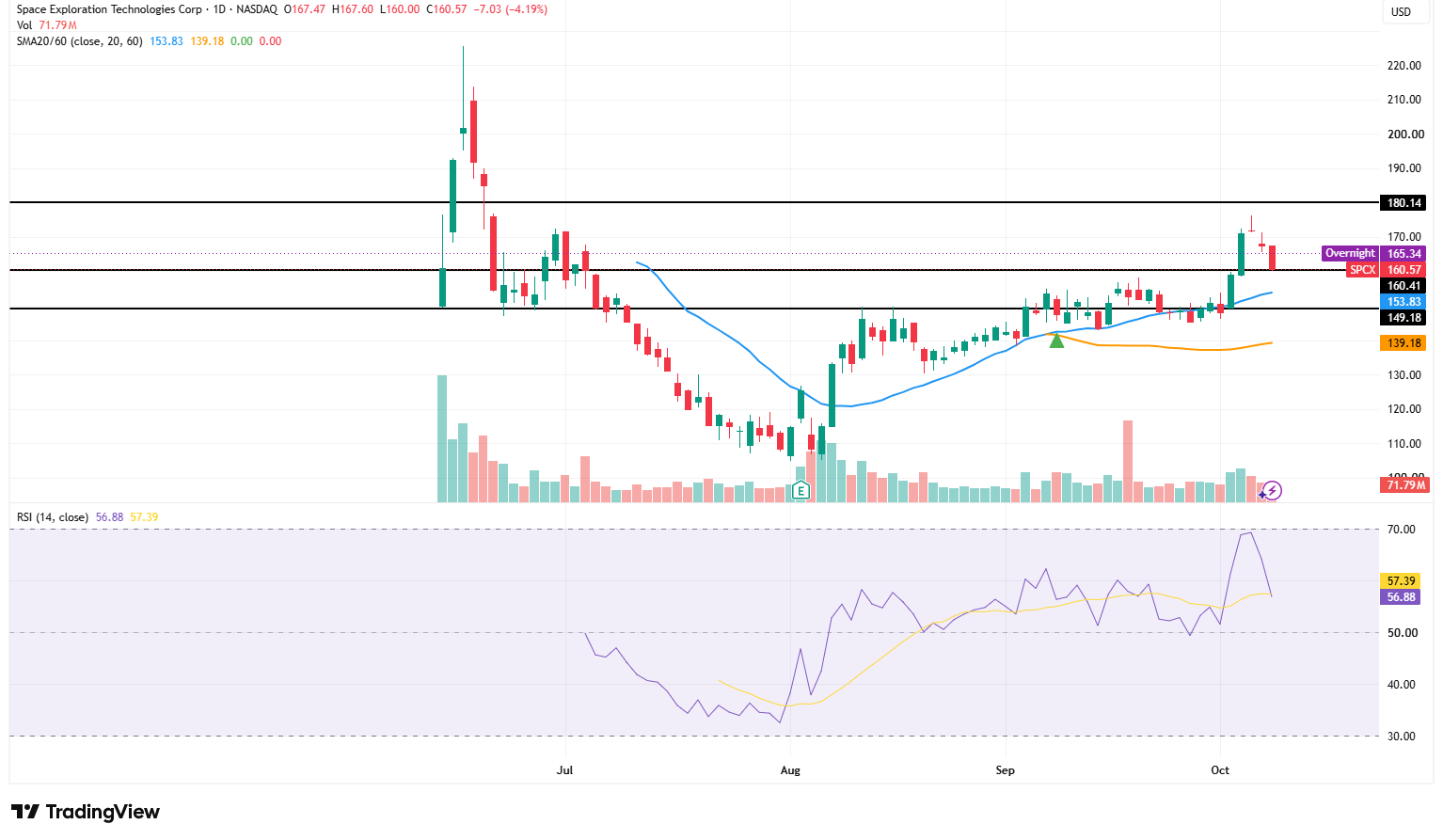
From the daily chart, SPCX closed at $160.57 during regular trading hours and bounced back to $164.30 in after-hours trading. The stock remains above its 20-day moving average of $153.83 and 60-day moving average of $139.18, with the short-term moving average positioned above the long-term moving average, indicating that the medium-term uptrend structure remains intact. However, after previously surging above $170, the stock pulled back, reflecting significant profit-taking pressure in the $170–$175 range.
The RSI stands at 56.88, remaining above 50 but slightly below the signal line of 57.39, indicating that bulls maintain the upper hand, though momentum has cooled somewhat, and it has not yet entered overbought territory. News of the spectrum acquisition could reignite market expectations, but the after-hours gain still requires confirmation from trading volume and the closing price on the next trading day.
Regarding key levels, $165–$168 is the first short-term resistance, with a more significant resistance level at $170–$175. If the stock breaks through $175 on heavy volume and closes above it for consecutive sessions, further upside space could open up, with subsequent targets to watch at $185–$190, and under strong momentum, the psychological $200 level.
On the downside, attention should first be paid to the $158–$160 support zone, followed by $153–$154 near the 20-day moving average. If it falls below the 20-day moving average, it may retest $148–$150, with a more critical medium-term support located near the 60-day moving average around $139. As long as the stock holds near $153, the current pullback can still be viewed as a normal consolidation following a breakout.
This content was translated using AI and reviewed for clarity. It is for informational purposes only.
Recommended Articles









Comments (0)
Click the $ button, enter the symbol, and select to link a stock, ETF, or other ticker.