


Indian Rupee corrects further on continued US Dollar outperformance



- The Indian Rupee retreats against the US Dollar as the latter continues to advance.
- Fears that the Fed would pace up its monetary tightening cycle have underpinned the US Dollar.
- India’s retail inflation accelerated to 6.09% YoY in October.
The Indian Rupee (INR) extends its previous day’s correction against the US Dollar (USD) on Friday after rallying in the past few weeks. The USD/INR pair rises further to near 94.19 after recovering from the five-month low of 93.61, as the US Dollar continues to outperform due to fears that the Federal Reserve (Fed) will follow a more aggressive monetary tightening approach amid accelerating United States (US) inflationary pressures.
In the Asian trade, the US Dollar Index (DXY), which gauges the Greenback’s value against six major currencies, holds near its 19-month high of 103.24 posted on Thursday.
Dollar Index hits fresh high as Fed hike expectations firm into year end
Analysts at MUFG note that the US Dollar has “continued to strengthen,” pushing the Dollar Index to “a fresh year-to-date high.” They argue that the Dollar’s “renewed upward momentum has been encouraged by expectations that the Fed is likely to speed up the pace of rate hikes in response to the recent run of stronger US inflation data.”
The US Consumer Price Index (CPI) data on Tuesday showed that both the headline and the core inflation growth was faster than expected at 0.4% and 0.3%, respectively, on a monthly basis.
Meanwhile, investors await the US Producer Price Index (PPI) data for October, which will be published at 13:30 GMT.
What lent strength to INR in the past few weeks?
Strategists at Societe Generale highlight the Indian Rupee as “the surprise star performer in EMs this month,” noting a total return of “+1.6% vs USD” driven by robust foreign portfolio demand. They point out that FPI inflows have already “topp[ed] $5bn” as investors broaden market bets “beyond AI-themed markets like South Korea and Taiwan,” while sentiment has also been buoyed by “optimism over Iran truce following US mid-term election that has deflated Brent toward $90/b.”
Rising India’s inflation growth paves way for more RBI interest rate hikes?
On Thursday, India’s CPI data for October arrived at 6.09% year-on-year (YoY), higher than 5.93% estimates and the prior release of 5.54%. This is the 12th straight month of a faster growth in inflation at retail level.
Such a scenario strengthens the case for an interest rate hike by the Reserve Bank of India (RBI) at the December policy meeting. Indian central bank hiked its key Repo Rate also in the October meeting by 25 basis points (bps) to 5.5%.
Analysts at Commerzbank Research highlight that, “more worryingly for RBI, this low base effect will persist into November and December, which is likely to keep inflation elevated above 6.0% throughout Q4 2026.” This reinforces their broader view that price pressures will remain near the top of the central bank’s target band well into the medium term, underpinning expectations for further policy tightening.
USD/INR Technical Analysis
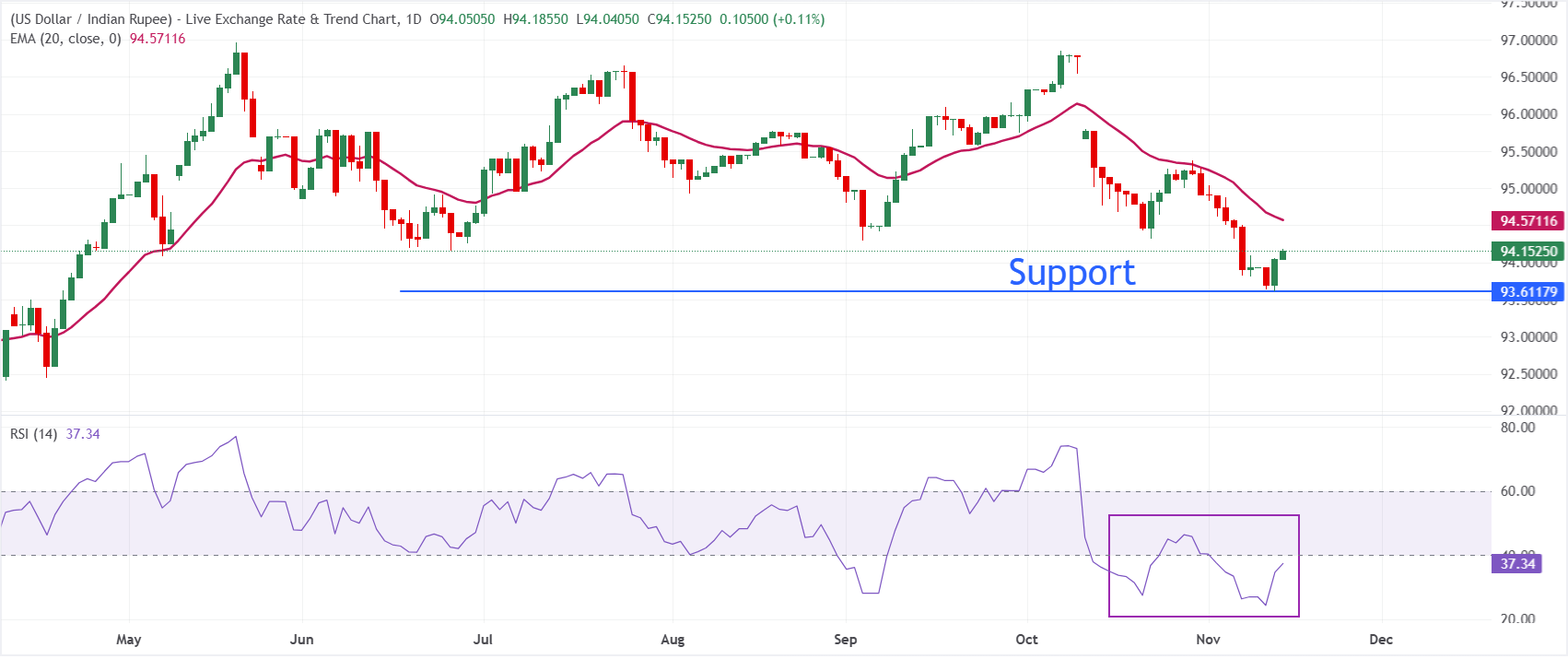
In the daily chart, USD/INR trades at 94.15, keeping a bearish near-term tone as spot remains below the 20-day exponential moving average (EMA) at 94.57, which caps the topside.
The recent recovery in the Relative Strength Index (14) to 37.34 lifts the pair off oversold conditions but still suggests subdued bullish momentum while price trades under the key EMA barrier.
On the topside, immediate resistance is located at the 20-day EMA at 94.57, and a sustained break above this level would be needed to ease the current downside bias. On the downside, the five-month low of 93.61 is the key support level.
(The technical analysis of this story was written with the help of an AI tool. Know more.)
Indian Rupee FAQs
The Indian Rupee (INR) is one of the most sensitive currencies to external factors. The price of Crude Oil (the country is highly dependent on imported Oil), the value of the US Dollar – most trade is conducted in USD – and the level of foreign investment, are all influential. Direct intervention by the Reserve Bank of India (RBI) in FX markets to keep the exchange rate stable, as well as the level of interest rates set by the RBI, are further major influencing factors on the Rupee.
The Reserve Bank of India (RBI) actively intervenes in forex markets to maintain a stable exchange rate, to help facilitate trade. In addition, the RBI tries to maintain the inflation rate at its 4% target by adjusting interest rates. Higher interest rates usually strengthen the Rupee. This is due to the role of the ‘carry trade’ in which investors borrow in countries with lower interest rates so as to place their money in countries’ offering relatively higher interest rates and profit from the difference.
Macroeconomic factors that influence the value of the Rupee include inflation, interest rates, the economic growth rate (GDP), the balance of trade, and inflows from foreign investment. A higher growth rate can lead to more overseas investment, pushing up demand for the Rupee. A less negative balance of trade will eventually lead to a stronger Rupee. Higher interest rates, especially real rates (interest rates less inflation) are also positive for the Rupee. A risk-on environment can lead to greater inflows of Foreign Direct and Indirect Investment (FDI and FII), which also benefit the Rupee.
Higher inflation, particularly, if it is comparatively higher than India’s peers, is generally negative for the currency as it reflects devaluation through oversupply. Inflation also increases the cost of exports, leading to more Rupees being sold to purchase foreign imports, which is Rupee-negative. At the same time, higher inflation usually leads to the Reserve Bank of India (RBI) raising interest rates and this can be positive for the Rupee, due to increased demand from international investors. The opposite effect is true of lower inflation.
Recommended Articles






Comments (0)
Click the $ button, enter the symbol, and select to link a stock, ETF, or other ticker.