


186 fake AI domains funnel ChatGPT and Claude typos into malware



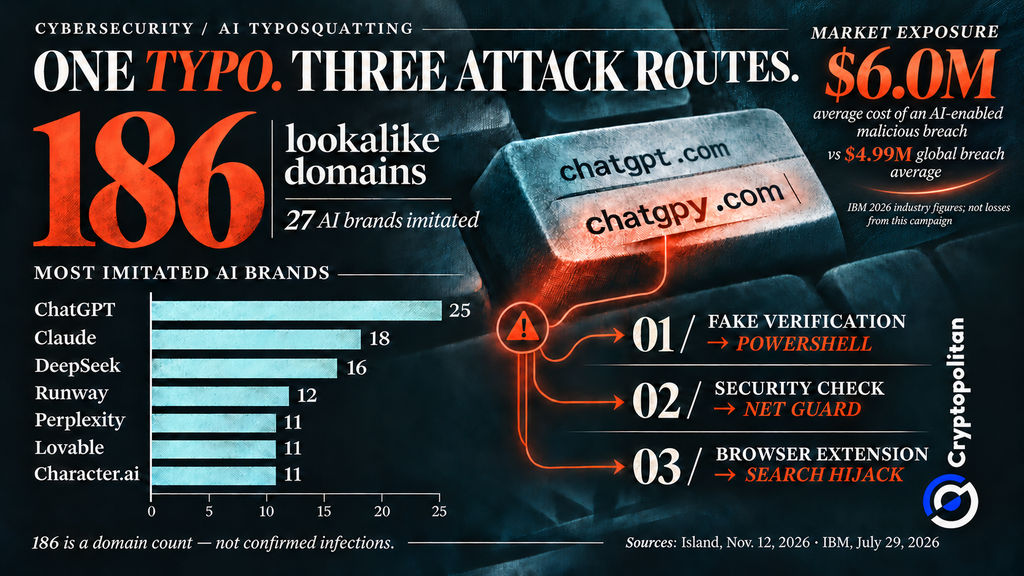
A mistake in spelling in an AI tool’s domain may mean more than just seeing an error page. In a report released on November 12, enterprise-browser security company Island found 186 domains that look similar to the domains of 27 known AI brands. This number corresponds to web addresses rather than actual confirmed cases of infection. Some addresses redirect users to advertisement pages while others send them to malicious sites.
A typo that lands somewhere else
Island calls the method “TypoPrompting.” ChatGPT is the most frequently imitated AI brand, with 25 lookalike domains. Claude follows with 18, DeepSeek with 16 and Runway with 12. Perplexity, Lovable, and Character.ai have 11 each.
Not every lookalike address leads to the same destination. Some generate advertising revenue. Others send visitors to traffic brokers, which decide where to redirect them based on their location, browser, or device.
Three routes from mistyped name to malware
Island found out that there were three hacked pathways associated with the lookalike addresses. The first pathway started from cloude[.]ai, which is a misspelled domain name associated with Claude. Visitors were redirected to a fraudulent Cloudflare verification page asking visitors using Windows to execute a PowerShell command. This page created a network involving 211 domains, including domains impersonating companies unrelated to AI business.
The second pathway led to a fake “Security Check” promoting Net Guard. Although available through the Microsoft Store, Island found that the app could hijack browsers and run remotely supplied scripts.
The third pathway included 30 browser extensions that hijacked searches. Out of those, 13 were eliminated, leaving 17 still in use, which cumulatively had 972,000 users. This number was gotten from extension-store listings, not through confirmed instances of infection.
Why ClickFix slips past automated defenses
The fake Cloudflare check uses ClickFix. As Microsoft explains, the trick is getting people to run malicious commands themselves inside familiar Windows tools. That can help attacks bypass automated defenses.
Browser-security firm Push Security cited Microsoft’s 96.3% ClickFix malware-delivery conversion figure. ClickFix also accounts for more than half of Push’s monthly attack detections. Neither statistic measures Island’s campaign.
Who profits when a visit goes wrong
Even a visit that stops short of infection can earn money. Island linked some redirects to advertising and affiliate payments through shared tracking IDs.
DNS-security company Infoblox found that over 90% of visits in its parked-domain tests reached scams, unwanted software or malware.
Separately, software-supply-chain security firm Socket identified 319 search-hijacking extensions with roughly 13.4 million users. These were separate investigations, not additional TypoPrompting victims.
What a hijacked browser could cost a business
For businesses, a hijacked browser can pose a much bigger threat than an unwanted redirect. Attackers could gain access to company accounts or internal systems. However, Island has not established any financial losses from this campaign.
Broader cybersecurity findings indicate what’s involved. Verizon’s 2026 report indicates that system intrusion is the leading breach pattern at 61%. IBM’s 2026 research reveals that AI-enabled malicious breaches cost an average of $6 million, higher than the overall breach average of $4.99 million.
Both figures exclude losses from Island’s fake AI domains. As more companies hop on the bandwagon of AI tools, the OECD’s 2026 outlook raises the alarm on digital security as a growing concern.
What readers can do now?
There are also other risks that go further than simply mistyped web addresses. In another campaign, Cryptopolitan had previously reported that over 260,000 Chrome users had installed at least 30 malicious extensions posing as AI helpers. In both instances, the attacks demonstrate how attackers capitalize on people’s trust toward familiar AI brands. The same precautions can help users avoid these traps. Bookmark official AI websites, never run terminal commands prompted by a web page, and regularly check installed browser extensions. Enable two-factor authentication for added protection. Businesses should also restrict unauthorized add-ons.
Don’t just read crypto news. Understand it. Subscribe to our newsletter. It's free.
Recommended Articles










Comments (0)
Click the $ button, enter the symbol, and select to link a stock, ETF, or other ticker.