


DoorDash Rises Over 6% Pre-Market After Announcing $17 Billion Instacart Acquisition: Can a 26% Premium Deliver Expected Returns?



AI Podcast


Before the market open on October 29 ET, DoorDash announced a definitive agreement to acquire Instacart at an equity valuation of approximately $17 billion, or $65 per share, representing a 26% premium. Funded primarily by cash and debt, the deal aims to expand DoorDash's grocery delivery network and integrate membership services, targeting over $500 million in annual net synergies. Concurrently, DoorDash reported strong Q3 results with revenue up 34% year-over-year. Key risks include heavy financing pressures, complex regulatory approvals, potential integration challenges, and intense competition from major retail giants.
TradingKey - Before the market open on October 29 ET, DoorDash (DASH) announced a definitive acquisition agreement with Maplebear Inc. (which operates Instacart, ticker symbol CART), with an equity valuation of approximately $17 billion, or $65 per share, representing a 26% premium over Instacart's closing price on October 22.
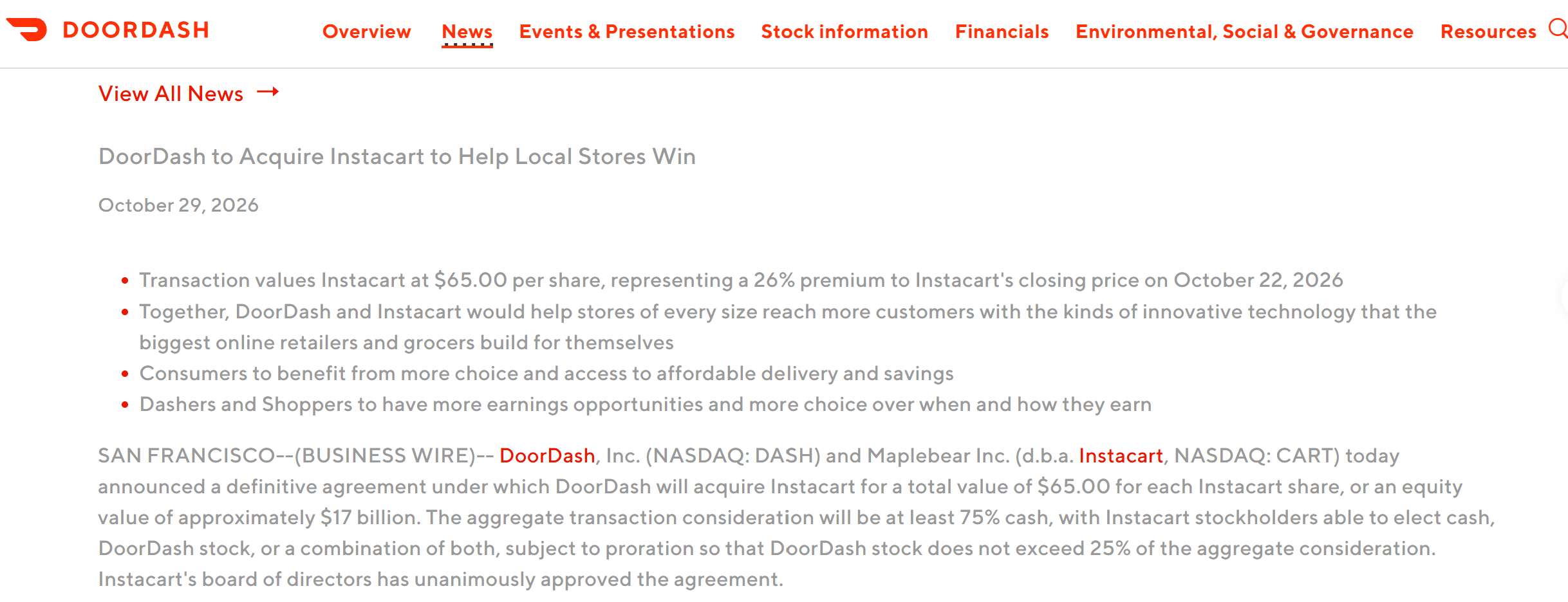
[Source: DoorDash official website]
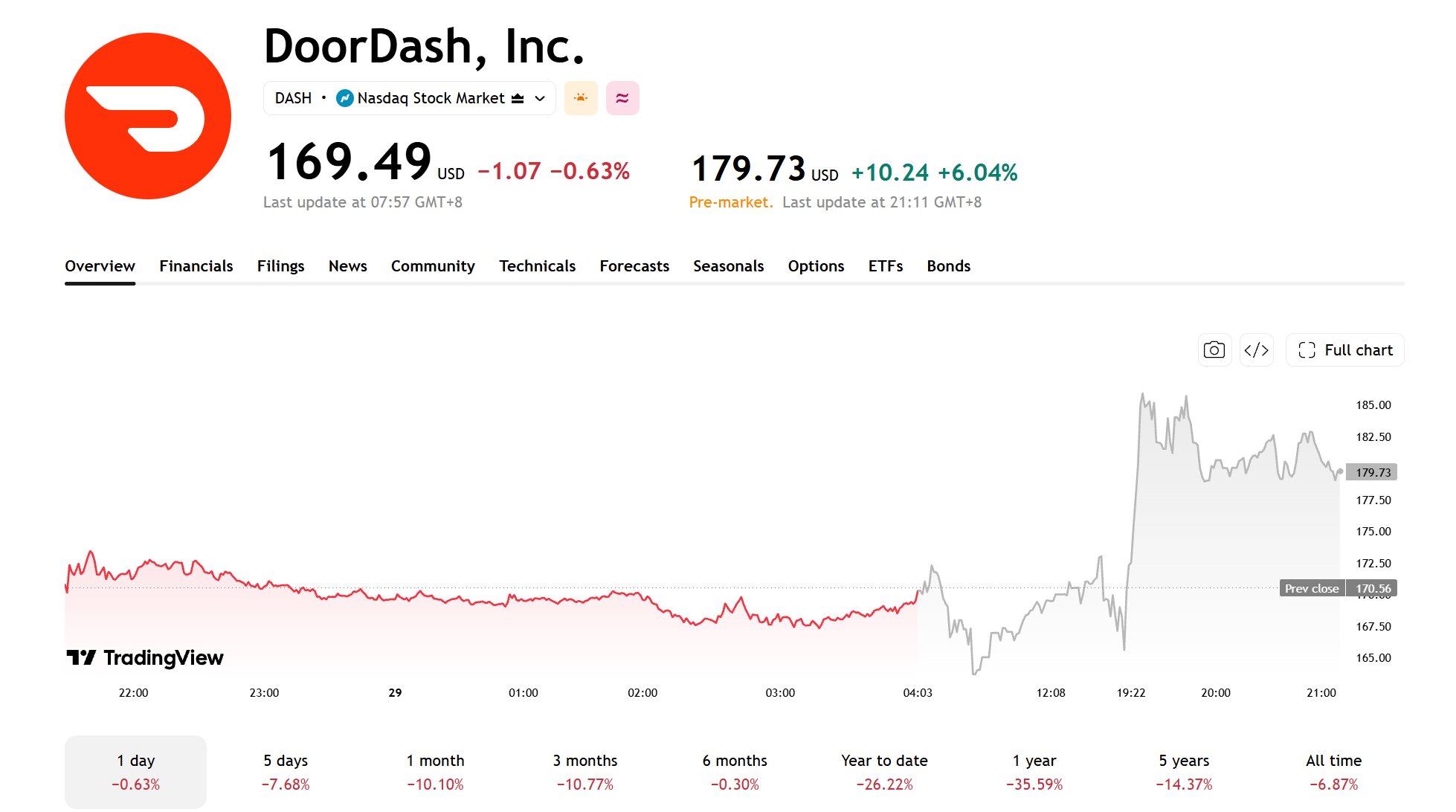
Following the announcement, as of press time, DoorDash shares rose over 6% in pre-market trading, while Maplebear gained 0.56%.
However, DoorDash also released its third-quarter earnings report on the same day, with revenue up 34% year-over-year and adjusted EBITDA up 41% year-over-year. Its pre-market stock performance may have been influenced by both the earnings report and the acquisition news.
According to the announcement, at least 75% of the transaction consideration will be paid in cash, with DoorDash stock consideration accounting for no more than 25%. The transaction is expected to close between late 2027 and the first half of 2028, and remains subject to Instacart shareholder approval and relevant regulatory approvals.
[Source: TradingView]
Why Would DoorDash Acquire Instacart?
DoorDash started as a restaurant food delivery business and has continuously expanded into grocery and other retail delivery services in recent years. Instacart partners with more than 2,200 retailers across nearly 100,000 store locations, providing online shopping, order fulfillment technology, and retail advertising services.
DoorDash projects that upon completion of the transaction, Instacart users will gain access to more than 50,000 additional store options beyond the nearly 100,000 existing locations.
The two companies also plan to integrate their DashPass and Instacart+ membership services, allowing members to access relevant services from both platforms for a single fee. DoorDash estimates that membership fees alone could save users approximately $100 million annually.
The acquisition is expected to expand DoorDash's grocery delivery coverage and drive greater adoption of its delivery and technology services among retailers.
Upon completion of the transaction, DoorDash plans to retain the Instacart brand, enterprise technology products, and application, while integrating both companies' delivery networks, retail e-commerce platforms, fulfillment technology, and advertising businesses.
However, an expanded operational footprint does not automatically translate into profit growth, as ultimate earnings will still depend on order growth, delivery efficiency, and cost control.
Will a $17 Billion Instacart Acquisition Pay Off?
Instacart's latest financial results provide a reference point for evaluating the transaction. In the third quarter of 2026, Instacart reported revenue of $1.095 billion, up 17% year-over-year, and Gross Transaction Value (GTV) of $10.528 billion, up 15% year-over-year. Net income for the period was $147 million, up 2% year-over-year, while adjusted EBITDA reached $342 million, up 23% year-over-year.
These figures reflect that Instacart possesses business scale and profitability, but a single quarter's results are not yet sufficient to justify the $17 billion acquisition valuation. DoorDash will still need to unlock the deal's value over time through revenue growth, cost savings, and operational synergies.
DoorDash expects that following the completion of the transaction, it will achieve annual net synergies of $500 million or more over multiple years, driven primarily by delivery network efficiency gains and the integration of both companies' business resources.
However, related investments in the first year post-closing will exceed the synergies generated that year, with positive net synergies expected only from the second year onward. Investors should monitor the progress of synergy realization and its actual contribution to profits and cash flow.
Financing Pressures, Regulatory Approvals and Business Integration Risks Coexist
DoorDash plans to fund the cash portion with existing cash and debt financing, and has secured a 364-day senior unsecured bridge loan commitment from JPMorgan Chase. The company stated that the transaction is not subject to a financing condition and that it plans to maintain an investment-grade credit rating.
As at least 75% of the transaction consideration will be paid in cash, the scale of financing, interest costs, and post-closing cash flow changes will be key focuses for investors.
In addition, the transaction requires approval from Instacart shareholders as well as regulatory clearances in jurisdictions including the U.S., Canada, and Israel; delays in approval or additional conditions could postpone closing and the realization of expected benefits.
The two parties also need to coordinate merchant partnerships, membership services, delivery, and technology systems, and contend with competition from Amazon (AMZN), Walmart (WMT), and other companies.
Overall, the return on this transaction depends on whether DoorDash can gradually achieve its target of $500 million or more in annual net synergies.
If the realization of benefits is slower than expected, financing costs and integration expenses could weigh on initial profits and cash flow; conversely, if delivery efficiency improves and merchant service revenues grow, the company's profitability is expected to gradually improve.
This content was translated using AI and reviewed for clarity. It is for informational purposes only.
Recommended Articles








Comments (0)
Click the $ button, enter the symbol, and select to link a stock, ETF, or other ticker.