


Musk Says SpaceX Reaches $40 Billion Debt Financing Deal as AI Industry Debt Financing Gets Harder



AI Podcast


On October 25, US Eastern Time, SpaceX secured $40 billion in debt financing primarily for future GPU procurement, despite surging capital expenditures driven by AI infrastructure. Meanwhile, Musk warned that tightening debt markets threaten emerging AI cloud providers lacking independent revenue streams, potentially triggering industry consolidation. This risk was underscored by severe market sell-offs in heavily debt-reliant firms like CoreWeave amid rising bond yields and financing costs. Investors must closely monitor data center deployment progress, cash flow coverage, and refinancing pressures across the capital-intensive AI sector.
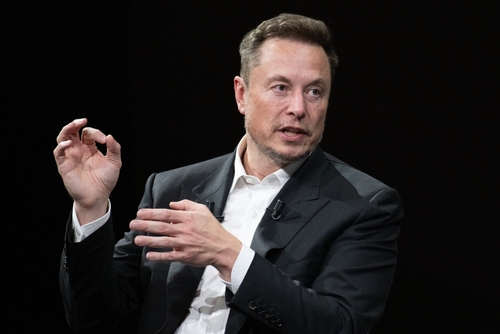
TradingKey - On October 25, US Eastern Time, Elon Musk stated on platform X that SpaceX (SPCX) has completed $40 billion in debt financing, primarily used to procure AI chips.
Meanwhile, Musk warned that financing conditions in the debt market have tightened significantly recently, and AI cloud service providers relying on borrowing for expansion are facing greater financing pressure.
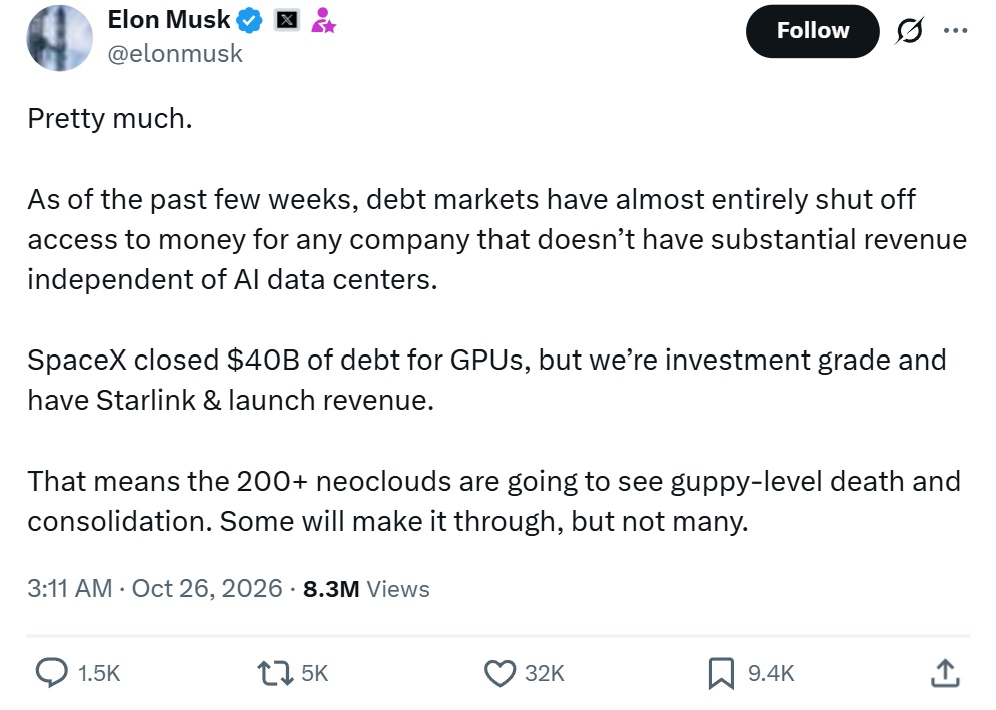
[Source: X]
SpaceX Will Still Require Massive Capital Investment in the Future
Musk stated that SpaceX's completed $40 billion debt financing is primarily intended to purchase GPUs expected to be delivered in the first and second quarters of 2027. He noted that the financing consists mainly of prepayable debt and has little impact on the current quarter.
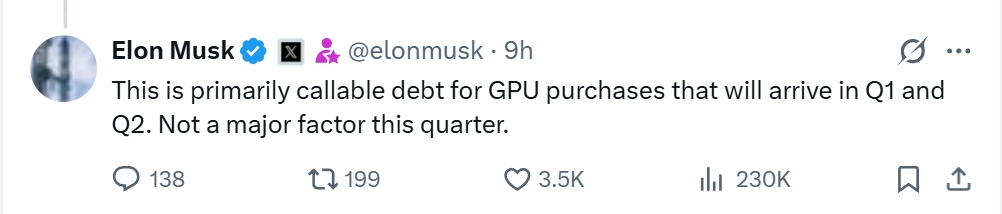
[Source: X]
SpaceX's capital expenditures are growing rapidly. In the third quarter of 2026, the company's revenue increased 161% year-over-year to $14.58 billion, while capital expenditures reached $19.6 billion, about 1.34 times revenue for the same period, primarily spent on AI computing infrastructure, the Starship project, and satellite production. The company expects fourth-quarter capital expenditures to increase further to between $35 billion and $40 billion.
As AI data centers continue to expand, GPU procurement scales up, and in-house chip projects progress, SpaceX will continue to face substantial funding requirements in the future.
Musk stated that SpaceX maintains an investment-grade credit profile, and that its Starlink satellite internet and rocket launch businesses provide stable revenue streams, enabling the company to continue securing debt financing.
Musk Warns AI Cloud Providers Face Funding Crunch
Musk stated on X on October 25: "Over the past few weeks, debt market financing channels have almost completely closed for companies that do not have substantial revenue independent of artificial intelligence (AI) data centers."
He expects that more than 200 emerging AI cloud service providers in the market will face a major shakeout and consolidation, adding, "Some companies may survive, but not many."
Such companies primarily procure GPUs and build data centers to rent AI computing power to clients, with some relying heavily on debt financing to support their expansion.
As borrowing costs rise, if data center deliveries are delayed or customer demand falls short of expectations, companies' cash flow and debt service pressures could increase further.
CoreWeave Debt Risk Sparks Market Alarm
CoreWeave (CRWV) is a typical enterprise that relies on debt financing to expand its AI computing power business. As of the end of June 2026, the company's principal debt was approximately $35.55 billion, operating lease liabilities were about $16.32 billion, and there were also uncommenced lease commitments as well as ongoing data center investment needs.
In mid-October, CoreWeave's bonds and stock suffered heavy sell-offs. According to Reuters, yields on some of the company's bonds issued in June rose from 9.675% at issuance to around 15%.
On October 14, U.S. September CPI exceeded expectations and interest rate hike expectations heated up. CRWV's stock price fell about 15.5% that day, reflecting intensifying market concerns over its debt burden and financing costs.
Rising bond yields mean investors demand higher risk compensation. If the market financing environment continues to tighten, CoreWeave's cost of issuing new bonds or refinancing in the future could increase, further adding to cash flow pressure.
Unlike SpaceX, CoreWeave's revenue comes mainly from AI computing power services, resulting in a relatively concentrated business.
However, both companies need to continuously invest large amounts of capital. Moving forward, key areas to monitor include the progress of data center commissioned operations, customer contract execution, and whether operating cash flows can cover interest, lease payments, and capital expenditures.
This content was translated using AI and reviewed for clarity. It is for informational purposes only.
Recommended Articles










Comments (0)
Click the $ button, enter the symbol, and select to link a stock, ETF, or other ticker.