


Micron Rises 1.2% Pre-Market as Taiwan Taoyuan Union Rejects Profit-Sharing Plan; Labor Talks to Continue Nov. 27



AI Podcast


Micron Technology’s proposed global quarterly profit-sharing plan faced rejection by 70% of voting members at its Taoyuan plant union on October 23 ET, as workers demand a fixed 15% operating profit allocation. Labor negotiations, postponed by a typhoon to October 27, remain a short-term sentiment risk, though no material production losses have been reported. Medium-term stock performance relies primarily on DRAM and HBM demand, memory pricing, and earnings fundamentals. Investors should closely monitor upcoming negotiation outcomes, potential labor disruptions, and semiconductor market supply-demand dynamics.
TradingKey - On October 22 ET, Micron Technology (MU) launched a global quarterly profit-sharing plan, but the labor union at its Taoyuan plant in Taiwan still rejected the company's proposal. On October 23, the union stated that about 70% of voting members opposed the proposal; labor-management negotiations originally scheduled for that day were postponed to October 27 due to a typhoon. As of press time, Micron's pre-market stock price was up 1.19% at $866.50.
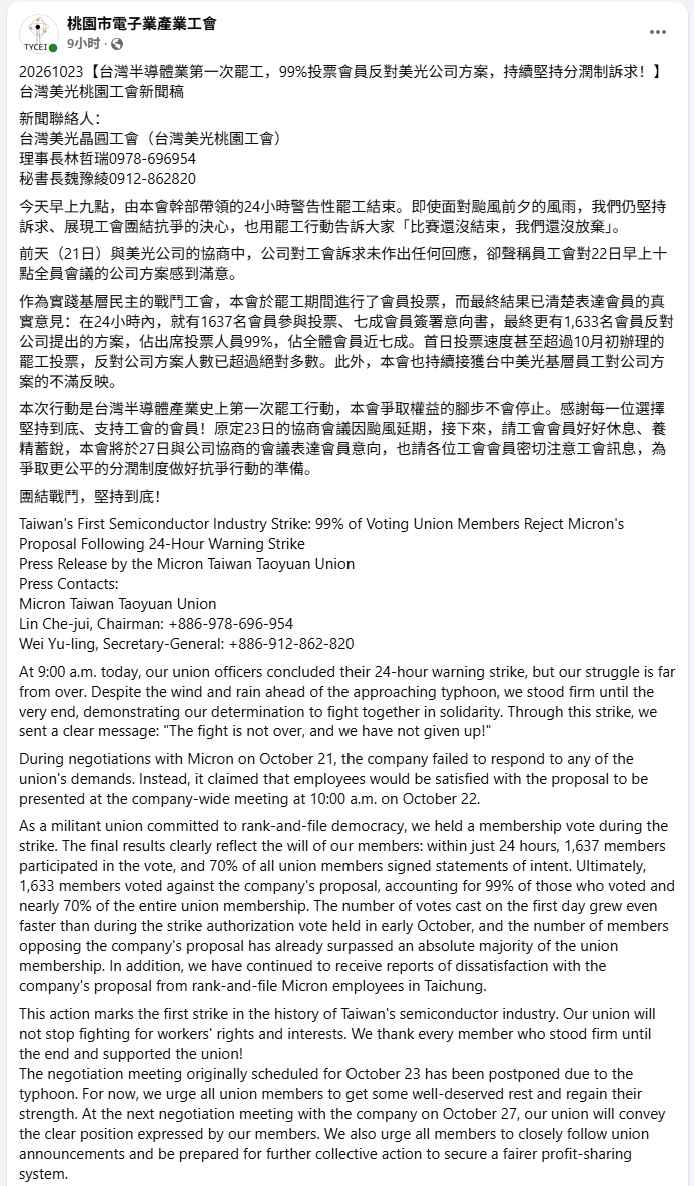
[Source: FaceBook]
How Are Global Quarterly Profit-Sharing Plans Calculated?
Micron announced that starting from fiscal 2027, it will launch a quarterly profit-sharing plan for eligible global employees, running concurrently with its existing annual incentive plan.
The bonus pool will be calculated based on net profit after tax minus projected capital expenditures for the following quarter, using fiscal 2026 as the baseline; the bonus is split 50-50 between cash and stock, with the stock portion subject to a one-year vesting period.
In addition, Micron will raise the pension contribution rate for its Taiwan employees from 8% to 10% and add three days of paid leave.
However, Micron has yet to announce a fixed profit distribution ratio or the total size of the bonus pool. The labor union at its Taoyuan plant demanded that 15% of the company's global operating profit be allocated for employee profit-sharing, arguing that the new scheme still fails to clarify the proportion of profit employees can share.
As the two sides have yet to reach an agreement, whether upcoming negotiations can achieve consensus on the distribution ratio and calculation mechanism remains the key focus of the labor dispute.
Taoyuan Labor Negotiations Become Recent Focus
Micron reached an agreement with the union at its Taichung plant on October 21, but labor-management negotiations at its Taoyuan plant have yet to reach a consensus. On October 22, the Taoyuan plant union held a 24-hour token strike; the following day, the union stated that about 70% of voting members rejected the company's proposed profit-sharing plan.
Affected by a typhoon, the next round of negotiations originally scheduled for October 23 was postponed to October 27. Whether the two sides can reach an agreement on the profit distribution ratio and bonus calculation mechanism will impact future labor relations. Currently, there is no public evidence indicating that the token strike has caused material production losses.
MU Stock Price Outlook: Labor Negotiations and Memory Demand in Focus
In the short term, labor negotiations at Micron's Taoyuan plant are one of the factors influencing market sentiment. Progress in subsequent negotiations would help reduce the risk of escalating labor disputes; if differences persist, attention will need to be paid to whether further employee actions affect production schedules. Currently, there is no public evidence showing that the previous symbolic strike has caused substantive production losses.
In the medium term, MU's stock price remains primarily dependent on DRAM and HBM demand, memory prices, earnings performance, and capital expenditures.
Recently, the semiconductor sector has been affected by concerns over AI return on investment, leading to volatility in Micron's stock price. Investors should monitor the outcome of the next round of labor negotiations, as well as changes in memory supply and demand and company performance guidance.
Micron introduced a global quarterly profit-sharing plan aimed at linking employee incentives to company business performance, but the Taoyuan union still demands a clear profit allocation ratio.
Whether the new plan can ease labor disputes depends on whether the two sides can reach a consensus on bonus calculation methods and allocation mechanisms; the actual impact on the stock price will also need to be assessed in light of production operations and memory market fundamentals.
This content was translated using AI and reviewed for clarity. It is for informational purposes only.
Recommended Articles











Comments (0)
Click the $ button, enter the symbol, and select to link a stock, ETF, or other ticker.