


Micron Technology Stock Price Forecast: CEO Reaffirms Tight Supply for Next Two Years, How Will HBM4 Mass Production and CXMT Controversy Impact Stock Price Expectations?



AI Podcast


Micron Technology reaffirmed that memory supply will remain tight over the next two years, supporting sustained profitability. Management downplayed the near-term cost scalability threat of competitor CXMT’s 4F² DRAM architecture while announcing that HBM4 has entered high-volume mass production to drive AI revenue growth. Techncially, Micron exhibits a weak rebound structure trading below key moving averages. The 0.5 Fibonacci retracement level around $923.25 serves as a critical pivot; sustaining prices above this threshold is necessary to extend the recovery, whereas a break below $879.50 would resume the downside pullback.

TradingKey - Micron Technology (MU) reaffirmed at a technology webinar that it sees no signs of memory supply and demand balancing over the next two years, and disclosed that HBM4 has entered high-volume mass production. In addition, Micron questioned the cost and future scalability of the 4F² DRAM architecture.
These three developments touch upon three key variables for Micron's stock price, respectively: How long can the memory upcycle last? Will competitors erode its technological edge? And can AI demand continue to translate into revenue?
Expectations of Supply Tightness Persist, Supporting Views of Sustained High Profitability
Micron President and Chief Technology and Products Officer Scott DeBoer said during a Q&A session that memory supply will remain tight over the next few years, with no signs of supply and demand reaching balance over the next two years.
Management also explained that high-performance products such as HBM and vertical HBM consume more wafer resources. As these products account for an increasing proportion of production, additional wafer inputs may not yield a proportional increase in bit supply. This means that even if manufacturers continue to expand capacity, supply tightness may not ease quickly.
For Micron's stock price, supply-demand dynamics directly affect market assessments of how long peak earnings can be sustained. If supply remains tight, the company may maintain favorable pricing conditions, which could also ease investor concerns regarding a subsequent decline in earnings.
Micron Responds to CXMT Competition Controversy: Emphasizes Cost and Mass Production Capacity Are More Important
In addition to industry supply and demand, whether competitors can reduce costs through technological progress is also a key factor in assessing the sustainability of Micron's profitability.
Regarding the 4F² DRAM architecture recently introduced by Chinese memory manufacturer ChangXin Memory Technologies (CXMT), DeBoer stated that Micron has studied it for years and acknowledged its feasibility at certain earlier nodes, but noted that its process complexity and costs are high, and subsequent scaling also faces bottlenecks.
According to his explanation, actual memory density is constrained by factors such as capacitor spacing. Therefore, adopting the 4F² architecture does not mean directly achieving a corresponding increase in density or reduction in costs; it still needs to be evaluated in conjunction with the complete manufacturing process.
This view provides a reference for evaluating the competitive pressure brought by the new architecture. If the relevant technology struggles to convert design advantages into low-cost products suitable for mass production, the competitive pressure facing Micron may be lower than some investors fear, helping stabilize market assessments of its profit margins and technological standing.
However, it should still be noted that even if CXMT's new architecture has not yet demonstrated a clear advantage, competitors could still increase supply by expanding capacity. Therefore, what remains more decisive for Micron's stock price is the actual cost, mass-production scale, and customer adoption of competing products.
HBM4 Mass Production Drives Monetization, Further Broadening AI Growth Sources
Industry conditions and competitive dynamics determine Micron's operating environment, while product delivery dictates how much revenue the company can generate from it. Micron stated that HBM4 has entered high-volume mass production. If subsequent deliveries proceed smoothly, it will help alleviate market concerns regarding execution capabilities and support HBM revenue growth.
Meanwhile, PCIe Gen6 SSDs have entered mass production, progress has been made in sampling 512GB DDR5 RDIMMs, and the company is also advancing HBM4E and customized products. These initiatives address the varying requirements of AI inference for high-bandwidth memory, high-capacity server memory, and data center storage, which is expected to expand Micron's AI revenue streams.
Micron Technical Analysis
From a technical perspective, Micron's current structure is closer to a weak rebound after a deep pullback that is turning weak again, which cannot yet be seen as having bottomed out, let alone forming a new uptrend. The 0.5 Fibonacci retracement level (around $923.25) is currently the key pivot determining whether the rebound can continue.
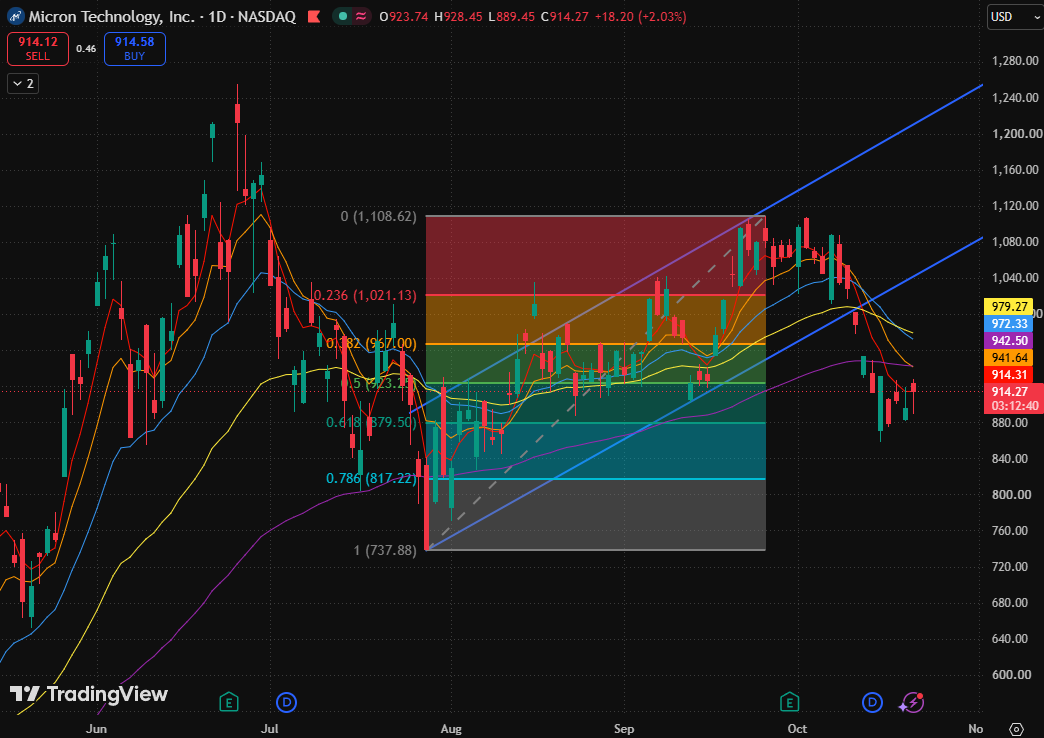
Micron Stock Price Chart, Source: TradingView
Regarding moving averages, the 5-day exponential moving average (EMA) is $913.07, the 10-day EMA is $940.96, the 20-day EMA is $971.98, the 80-day EMA is $979.08, and the 160-day EMA is $942.41. The current price is below all of the aforementioned moving averages, indicating that the rebound lacks sustained moving average support.
The day's opening price of $923.74 was close to the 0.5 Fibonacci retracement level, after which it pushed up to a high of $928.45 but failed to hold, indicating clear selling pressure above $923. Only if the daily chart re-establishes a footing above $923 will the rebound have a chance to recover toward the $940.96 to $967.00 range.
If the stock price continues to trade below $923.25 and breaks below $879.50, the pullback structure will continue.
This content was translated using AI and reviewed for clarity. It is for informational purposes only.
Recommended Articles











Comments (0)
Click the $ button, enter the symbol, and select to link a stock, ETF, or other ticker.