


US Stocks Fall Sharply as Philadelphia Semiconductor Index Drops Over 6%: What Caused the Decline?



AI Podcast


On October 22 Eastern Time, US stocks declined sharply, led by the Nasdaq and Philadelphia Semiconductor Index. The downturn was driven by Meta’s rising spending commitments—reaching approximately $825 billion—which intensified market anxieties regarding AI capital expenditures and corporate financing pressures, causing credit default swap prices and bond spreads to widen across major tech firms. Additionally, reports of planned US and Israel military strikes against Iran following the US midterm elections added geopolitical risk. These combined factors weighed heavily on tech stock valuations and heightened investor concerns over capital returns and broader market stability.

TradingKey - On October 22 Eastern Time, US stocks fell sharply, with the Nasdaq Composite Index dropping over 2%. The Philadelphia Semiconductor Index tumbled over 6%, reaching its lowest level since July 29.
Reportedly, Meta's disclosure of massive spending commitments has further heightened market concerns over the scale of AI investments and financing pressures. Meanwhile, reports indicated that the US and Israel plan to launch another military strike against Iran after the US midterm elections.
According to a regulatory filing submitted by Meta on Thursday, as of the end of September, the company's future spending commitments reached approximately $825 billion, an increase of about $125 billion from the roughly $700 billion disclosed in July. These include $355.7 billion in off-balance-sheet leases, $454.5 billion in non-cancelable contracts, and up to $14.7 billion in commitments to purchase cloud computing power over five years, spanning data centers, energy, third-party cloud services, and consumer hardware.
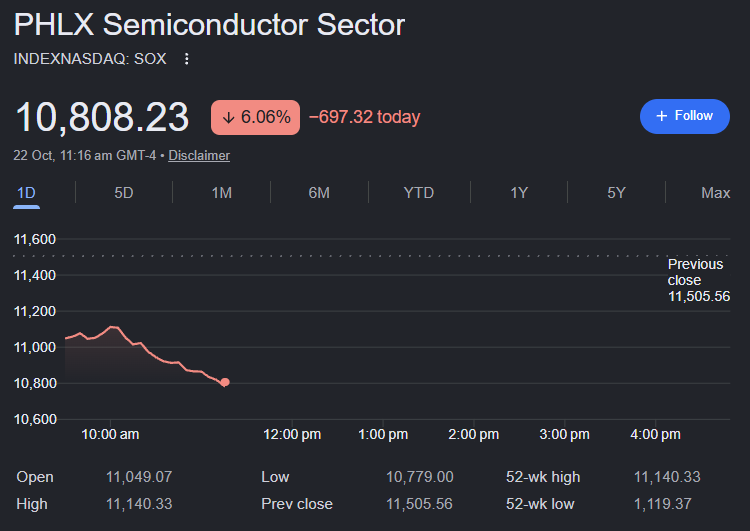
[Source: Google Finance]
The credit market has already responded. According to data from ICE Data Services, the price of Meta's five-year credit default swap (CDS) rose by as much as 8.9 basis points intraday on Thursday to about 119.3 basis points, reaching a record high since the contract started trading, signaling higher insurance costs for investors hedging against default risk.
Meanwhile, spreads on Meta bonds relative to US Treasuries widened, and CDS prices for Oracle, Microsoft, and Broadcom rose in tandem. Market concerns are expanding from the spending scale of a single company to the financing costs and returns on capital for AI capital-intensive companies, weighing on tech stock valuations.
In addition, according to US officials and other people familiar with the matter, the US and Israeli militaries have formulated specific plans to launch another military strike against Iran after the US midterm elections.
The US and Israel are reportedly planning a short-duration, high-intensity military operation and stepping up joint exercises, including flying military aircraft over Iraq for simulated strike training. Sources said the new round of targets could include Iran's energy infrastructure, nuclear facilities, as well as missile and drone arsenals. Some US officials believe that initiating another large-scale military operation could further hit the Iranian economy and force Iran to make concessions in diplomatic negotiations.
This content was translated using AI and reviewed for clarity. It is for informational purposes only.
Recommended Articles









Comments (0)
Click the $ button, enter the symbol, and select to link a stock, ETF, or other ticker.