


Bank of America Stock Forecast: $1.2 Billion Fine Clouds Q3 Earnings



AI Podcast


Bank of America faces a challenging third-quarter earnings environment following an unexpected $1.2 billion non-tax-deductible regulatory settlement, reducing EPS by roughly $0.17. While net interest income and loan growth remain solid supports, declining investment-banking fees, increasing compliance and remediation expenses, and senior banker departures weigh on the outlook. Investors are closely monitoring deposit pricing, credit costs, and management guidance on containment of compliance burdens. Technically, the stock remains vulnerable, with critical support identified at $52.23 and resistance near $54.87 to $56.72, leaving a cautious bias pending clearer operational updates.
TradingKey - Bank of America (NYSE: BAC) closed at $53.96 on October 13, down 1.14% prior to its third quarter report. A regulatory settlement after the close also creates an unexpected cost to an already difficult earnings environment.
NII and stable credit are being tested to offset decreased deal fees and increased costs from compliance. The results are expected to be released at approximately 6:45 a.m. E.T. on October 14.
Regulatory Settlement Adds a $1.2 Billion Charge
On October 13, the Treasury Department announced more than $1.21 billion in anti-money-laundering and sanctions enforcement actions. FinCEN assessed $1.2 billion, with credit for the OCC's $750 million penalty. The two figures should not be added together. Separately, OFAC announced an $11.6 million settlement for apparent sanctions violations.
Regulators identified more than $5 billion of unreported suspicious activity, including national-security concerns. Bank of America expects a non-tax-deductible Q3 charge of approximately $1.2 billion, which will reduce earnings by roughly $0.17 per share.
Compliance Spending Is the Longer-Term Risk
According to the OCC, persistent and significant breakdowns continued after the December 2024 order and require additional corrections. While the regulators didn't impose an asset cap, regulators also required Bank of America to undertake an independent review and lookback analyses of transactions.
What I find relevant is the uncertainty with respect to the duration and extent of remediation costs. Continuous monitoring costs could impact buyback and EPS more than the one-time penalty.
Net Interest Income Remains BAC's Main Support
Bank of America’s average loans and leases for the quarter increased by 8% to approximately $1.22 trillion and average deposits increased by more than 2% from the prior quarter to $2.020 trillion. Net interest income for the quarter increased by 9% from a year earlier to $16.0 billion.
While strong loan and deposit growth is positive, competition for deposits will likely increase. I will be watching funding costs to NII more closely.
Investment-Banking Fees Face a Decline
In September, CEO Brian Moynihan said that Investment Banking fees would be in the range of $1.6 - $1.8 billion for the quarter, down by at least 10% from the $2 billion in fees for the same quarter last year. Sales and Trading revenues for the quarter were expected to be roughly flat from the $5.4 billion for the same quarter last year.
Moynihan said deal pipelines were healthy, but BAC was smaller in some of the most active industries and sectors. The issue isn’t delayed deals.
Q2 Profit and Credit Set a Strong Baseline
Bank of America recorded net income of $9.1 billion, up 27% from the same quarter last year, with revenue increasing 15% to $31.6 billion. Diluted EPS increased to $1.21, and the return on the bank’s tangible common equity increased to 17.0%. The Q2 results continue to support the bank’s profitability and earnings power.
Credit conditions remained stable during the quarter as the provision for credit loss declined to $1.4 billion, and net charge-offs also declined to $1.4 billion. Continued increases in the provision for credit losses would negatively impact the earnings outlook for the quarter, as compared to the impact of regulatory adjustments.
Senior Banker Departures Add Another Concern
Reuters reported that senior banker Amy Lissauer was among several senior bankers to have left Bank of America this year, with Lissauer joining JPMorgan. Management stated that they expect continued hiring at the managing director level, as they have this year with more than 40 such hires.
Departures of bankers do not usually impact the number of mandates a bank has, however, with declining fees, bankers’ retention is important. I will look to see how management guides on hiring for 2027 and the expected level of mandates for the firm.
Dividends and Buybacks Face a Capital Test
With the repurchase of $6 billion of common shares in Q2, Bank of America returned $8 billion to shareholders including dividends. The bank announced an increase in its quarterly dividend by 14% to $0.32, and continues to have a discretionary share repurchase authorization of $40 billion. The bank reported an 11.2% standardized CET1 ratio.
Q3 Results Will Test the Core Earnings Outlook
Before the announcement, FactSet estimates pointed to revenues of about $30.58 billion, with EPS of about $1.10. Investors should not misinterpret the estimates to reflect reported earnings after the regulatory charge. Settlement and core performance should be differentiated.
The critical disclosures are NII guidance, deposit pricing, credit costs, trading and investment banking revenues, remediation costs and the compliance burden. My base case improves if NII and credit costs remain favorable and management shows the compliance burden is contained.
Bank of America Technical Analysis: $52.23 Support Is Critical
BAC closed its regular session on October 13 at $53.96, below the draft chart's resistance zone of $54.87 to $56.72. The supplied analysis mentions a break of the trendline and trading below both moving averages. These chart-based elements have not been verified.
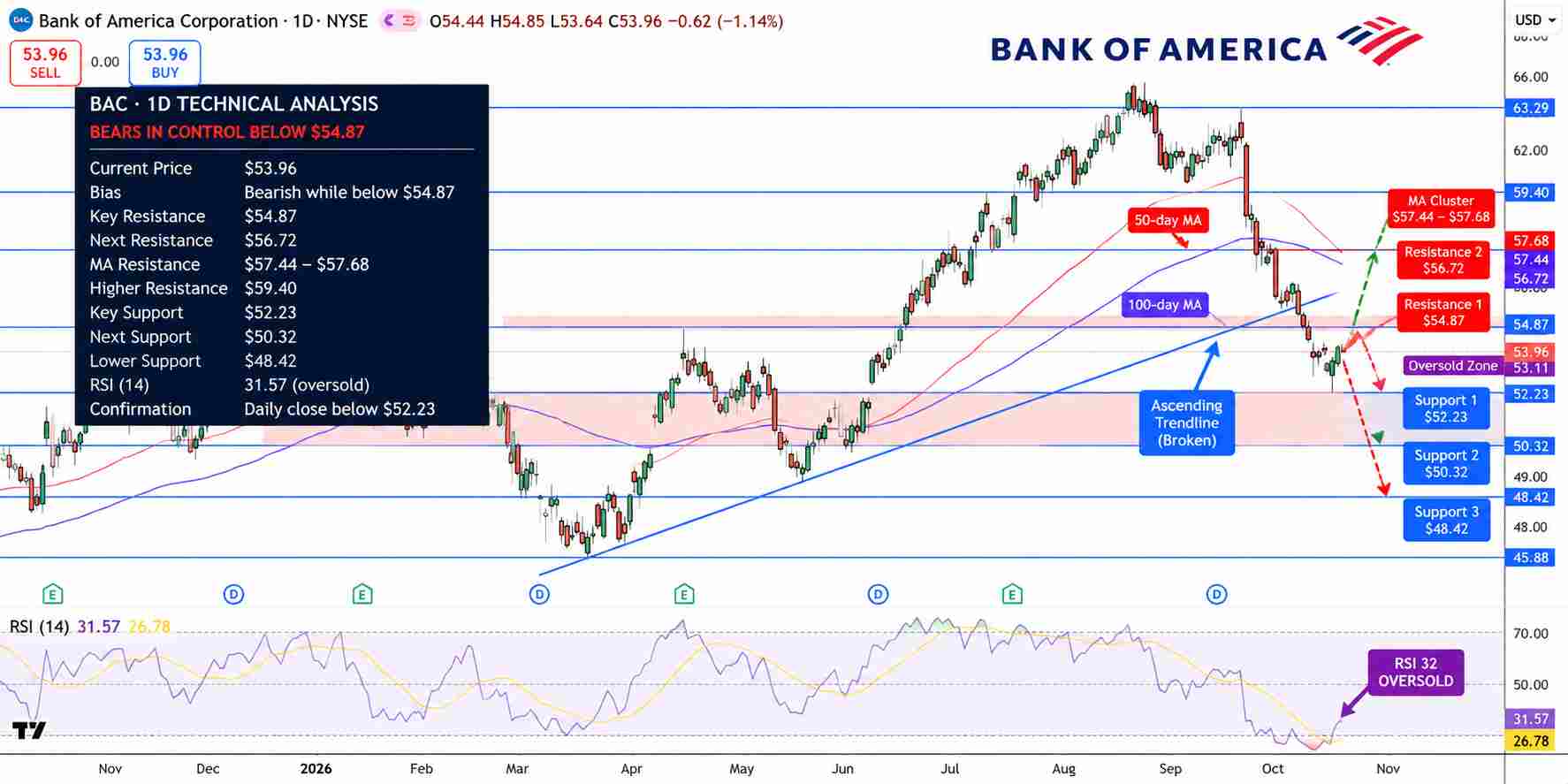
Bank of America Price Chart - Source: Tradingview
The Relative Strength Index (RSI) on the chart is near 32. The RSI’s signal line is near 27. An RSI below 50 does not mean a recovery, especially with an earnings release potentially generating an enormous price gap.
Below the resistance zone, I am bearish below the $54.87 level. A sustained close above $56.72 could bring the $57.44 to $57.68 resistance levels and $59.40 into focus. A confirmed close below $52.23 would test the $50.32 to $48.42 to $45.88 support levels. These levels have not been verified.
Key Levels
Latest Close: $53.96 on October 13, down 1.14%
Support: $52.23, then $50.32, $48.42, and $45.88
Resistance: $54.87, then $56.72 to $57.44 to $57.68
RSI: near 32 on the supplied chart, not independently verified
Breakout Target: $59.40
Breakdown Target: $45.88
FAQ: How Much Will the Regulatory Charge Affect BAC Earnings?
BAC has acknowledged approximately a $1.2 billion, or $0.17 per share, non-tax-deductible charge, for Q3. The longer-term costs of remediation are still unclear.
FAQ: What Is BAC's Main Breakdown Level?
The provided chart shows $52.23 as immediate support. A daily close below it would put $50.32 into play.
Bottom Line
BAC's lending and deposit franchises are positive, but lower deal fees and unresolved compliance costs complicate the Q3 picture. I'm cautious below $56.72, and would want to see improvement to turn positive on the stock.
Recommended Articles








Comments (0)
Click the $ button, enter the symbol, and select to link a stock, ETF, or other ticker.