


Amazon Stock Forecast: $7 Billion Decart Talks Add to AWS AI Momentum



AI Podcast


Amazon’s accelerating AWS revenue growth and expanding AI capabilities, bolstered by potential partnerships with Decart and Qualcomm, highlight its strong market position. However, surging capital expenditures projected at $220 billion by 2026 and negative free cash flow present notable financial risks. While technical indicators show the broader October uptrend intact, investors should monitor upcoming Q3 earnings for concrete proof that cloud profits can offset massive infrastructure spending. Cautious positioning is advised near support at $253.78, with a decisive breakout above resistance at $263.70 required to confirm further upside potential.

TradingKey - Amazon (NASDAQ: AMZN) closed October 12 at $259.53, down 1.11% after reaching an intraday high of $263.70. Recent reports state that Amazon is in talks to acquire AI software startup Decart. This comes as another development in Amazon’s growing cloud infrastructure business.
The investment case balances the accelerating growth of AWS against an expected $220 billion in capital spending in 2026. Investors need to see proof that cloud profits can offset the massive capital spending to improve free cash flow.
Decart Talks Could Expand AWS AI Capabilities
According to a report by Reuters on October 11, citing The Wall Street Journal, Amazon is in discussions to acquire Decart for approximately $7 billion. The startup uses AI and world models to create simulated environments including videos. As noted earlier, the deal is not certain to happen.
I’m interested in what AWS Trainium can do in conjunction with Decart. While Trainium is in the public domain, any potential cost savings from the use of custom chips remains to be seen, and would be determined only with an integration.
AWS Growth Is Accelerating
A 37% increase year-over-year pushed revenue for AWS to $42.2 billion in the second quarter, which was the company’s highest growth rate in 18 quarters. Segment operating profit for the quarter was $16.6 billion, up from $10.2 billion reported in the same quarter last year. The figures further demonstrate the connection between the booming artificial intelligence (AI) industry and the significant earnings cloud providers are realizing.
During a recent event, Amazon CEO Andy Jassy stated that the company’s AI and semiconductor businesses were both growing at a rapid pace and had each surpassed a $25 billion annualized revenue run rate. These types of growth numbers (pace) should not be added to the quarterly revenue numbers for AWS.
Bedrock Expands AI Model Choice
In early October, AWS announced the public preview of Amazon Bedrock Managed Agents, powered by OpenAI, which allows customers to build agents optimized for OpenAI models within AWS. While the announcement provides another AI tool to enterprises, it is unclear when, or if, the service will contribute meaningfully to revenue.
It is likely Amazon will keep inference close to business data to maintain competitive advantage. Ultimately customer acceptance and pricing will drive monetization.
Qualcomm Broadens the AI Hardware Strategy
In September, Qualcomm revealed it was working with Amazon for multiple generations on custom data-center chips and optical interconnects. Reuters reported that Amazon could spend up to $60 billion on chips and related products. That reported number is a potential ceiling and not committed spending.
It means AWS can expand its supply beyond Trainium and Nvidia GPUs. Diversifying supply should improve negotiability and efficiency. The big question is how long will it take for the commercial benefits of this deal to become apparent?
Capital Expenditure Weighs on Free Cash Flow
Amazon expects to spend about $220 billion in capital expenditure in 2026, largely for AI infrastructure. Free cash flow was negative $7.6 billion in the trailing 12 months (ttm) compared to positive $18.2 billion a year earlier. Net property and equipment purchases increased by $66.1 billion, causing much of the negative pressure on free cash flow.
I believe the recent strength and overall profitability of AWS is a good sign, but for me, the most important factor is the returns on the infrastructure investments.
Proposed Chip Financing Adds Complexity
The Financial Times recently reported that Amazon is considering transferring roughly $8 billion of Nvidia’s Grace Blackwell chips to a special-purpose vehicle and leasing them back. This is still a proposed financing, not an actual financing.
Using a special-purpose vehicle can release capital tied up in chips, but leasing the chips increases Amazon’s obligation and future computing costs. Investors should not view a financing structure as a reduction in Amazon’s computing costs.
Q3 Earnings Are the Next Major Catalyst
A confirmed date for the release of Amazon’s Q3 earnings was not found in the sources reviewed as of October 13. Results are expected to be released in October. The next earnings report should disclose details on revenue growth for AWS, operating margins for retail, profitability of retail, as well as cash flow and updated capital expenditures.
My base case improves if Amazon derives operating leverage from increased AI demand and does not worsen cash conversion. Any positive progress on the proposed Decart acquisition could provide a tailwind to the case, but actual AWS economics will be the biggest driver of the case.
Amazon Technical Analysis: AMZN Tests $263.70 Resistance
AMZN closed at $259.53 on October 12 following an open at $262.50 and a high of $263.70. The stock previously bounced from the October 5 close of $251.40 to $262.43 on October 9. The rejection on Monday indicates selling pressure at these levels. However, the broader October uptrend remains intact.
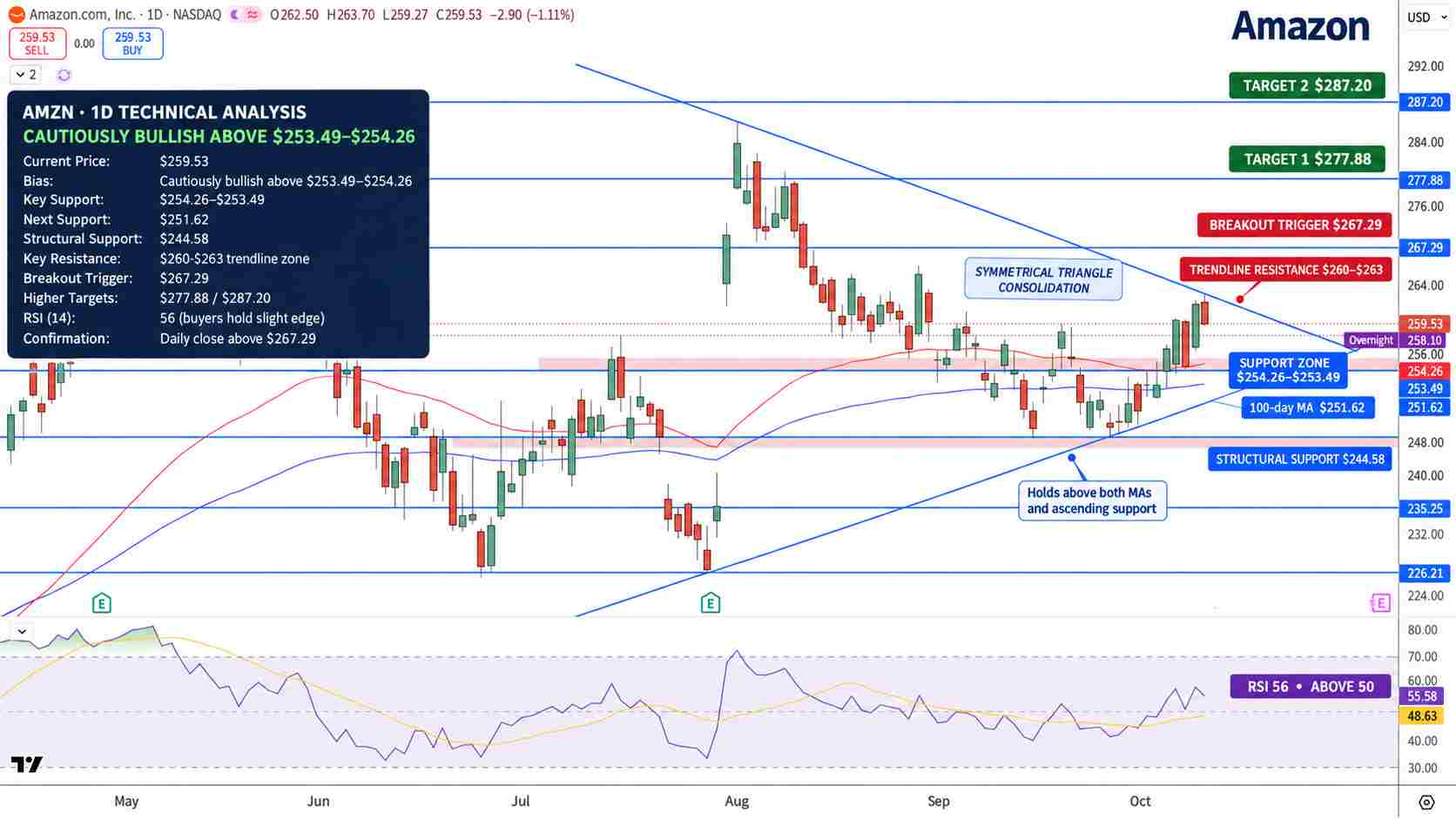
Amazon Stock Price Chart - Source: Tradingview
The chart provided shows a symmetrical triangle with a RSI of 56 and moving averages of $253.49 and $251.62. I would take confirmed support and resistance levels and trends as immediate trading levels, given the absence of verifiable historical prices to confirm the provided chart.
I am bullish above the October 8 low of $253.78. A close above $263.70 would be bullish and could bring $267.29 into play. A close below $253.78 would bring the October 5 low of $250.18 into play, with support potentially found at the September 28 low of $244.73. The $287.20 52 week high remains a long term target, not an immediate target.
Key Levels
Latest close: $259.53 on October 12, down 1.11%
Support: $253.78; then $250.18 and $244.73
Resistance: $263.70; chart-derived $267.29 unverified
RSI: near 56 on supplied chart; not independently verified
Breakout trigger: sustained daily close above $263.70
Breakdown trigger: decisive loss of $253.78
FAQ: Why Is Amazon Stock in Focus?
Reports of potential acquisitions of Decart coincide with other events including an increase in the demand for AI-based Amazon Web Services (AWS) and the company's highest level of capital expenditures (capex) ever.
FAQ: What Is AMZN's Main Breakout Level?
The high at $263.70 on October 12 is now immediate resistance. A close above this level would lead to further upside.
Bottom Line
AWS’s artificial intelligence cloud capability appears to be growing and, as a result, is providing support to the AI growth thesis. Increased capital spending, financial complexity, and M&A activity remain risks. I recommend approaching upside potential at $253.78 with caution and would require a breakout beyond $263.70 for further upside potential.
Recommended Articles








Comments (0)
Click the $ button, enter the symbol, and select to link a stock, ETF, or other ticker.