


Meta Stock Approaches Record High: AI Monetization Expectations Support Valuation, Q3 Earnings and Capex Serve as Key Test



AI Podcast


Meta Platforms approaches historical resistance near $780, driven by robust advertising revenues and accelerated AI commercialization, including the release of Muse Wonder. While Q2 revenue rose 28% year-over-year to $60.801 billion, heavy AI infrastructure investments squeezed operating margins to 31% and reduced free cash flow to $784 million. With full-year capital expenditures projected between $130 billion and $145 billion, investor focus centers on the upcoming October 21 earnings report to gauge AI monetization progress and capital return cycles. Failure to meet expectations risks triggering high-level consolidation, whereas successful monetization could propel the stock toward the $800 psychological level.

TradingKey - On October 13, US Eastern Time, Meta Platforms (META) hovered around $760, just 2.54% away from its recent high of $779.8 and only 4.7% away from its all-time high.
If bulls can effectively break through this historical resistance zone, $800 could become the next psychological level; however, if the stock price faces resistance near its previous high again, recently accumulated profit-taking may also be concentrated.
This round of stock price upside is not driven purely by a technical rebound; behind it lies the expectation that Meta will continuously strengthen its AI products and commercialization capabilities. Meta announced that Muse Wonder has been opened to developers and users via the Meta Model API and Muse Code, while Muse Wonder Full is made available first to Muse Code subscribers. The market interpreted this as Meta accelerating the productization of its AI capabilities and attempting to establish new revenue streams in personal agents, enterprise applications, and subscription services.
Meta's existing advertising business also provides fundamental support for this valuation recovery. The company's second-quarter revenue reached $60.801 billion, up 28% year-over-year; as of June, daily active people across its Family of Apps reached 3.6 billion, up 3% year-over-year. However, AI infrastructure investments simultaneously pushed up costs, with the second-quarter operating margin falling from 43% in the same period last year to 31%, and capital expenditures reaching $31.08 billion.
The real risk, however, lies in whether Meta can start converting AI investments into higher revenue, profits, and cash flow. The company's second-quarter free cash flow dropped to approximately $784 million, down significantly from $8.55 billion in the same period last year, while its full-year capital expenditure guidance reached $130 billion to $145 billion. In other words, the market is currently willing to price in Meta's future AI monetization capabilities in advance, but if spending continues to grow and margins remain under pressure, stock price volatility near historical highs will also be significantly amplified.
Looking ahead, investors will focus heavily on Meta's third-quarter results to be released after US market close on October 21, as well as whether management provides further details on the commercialization progress of AI products, advertising efficiency improvements, and the capital expenditure return cycle.
From a technical perspective, if the results prove that AI investments are boosting ad monetization and new business revenue, it is not impossible for the stock price to break through around $787 and further challenge $800; however, if results or guidance fall short of expectations and the stock price drops back to the $730 to $750 range, the short-term uptrend could shift into high-level consolidation.
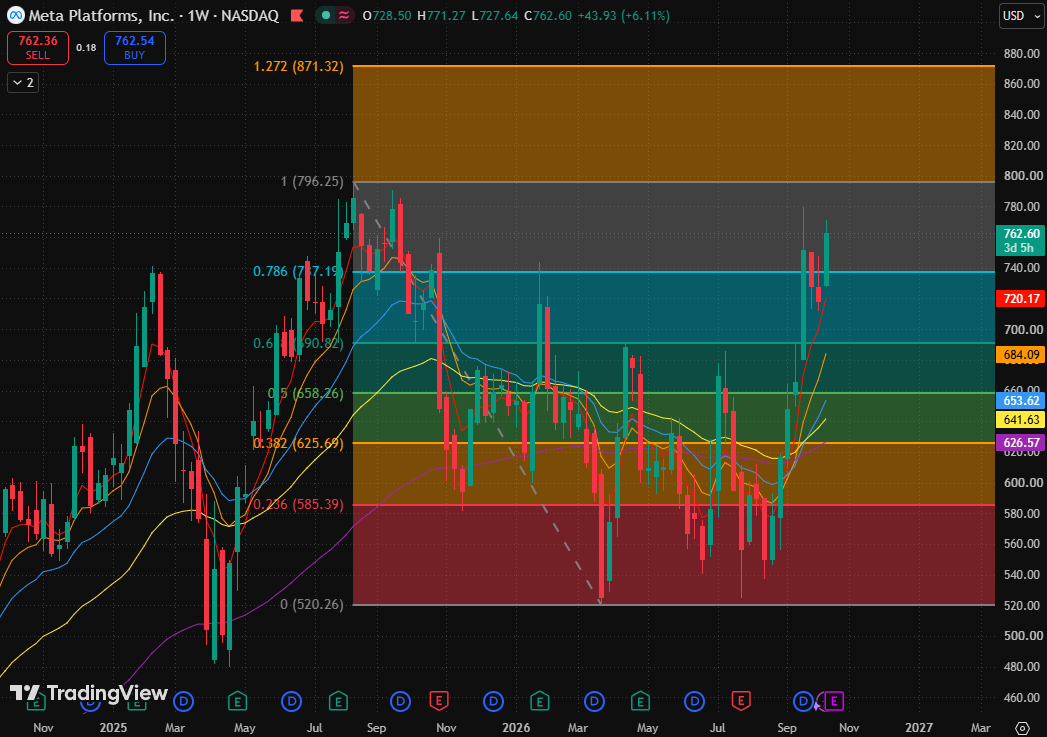
META weekly chart, Source: TradingView
This content was translated using AI and reviewed for clarity. It is for informational purposes only.
Recommended Articles






Comments (0)
Click the $ button, enter the symbol, and select to link a stock, ETF, or other ticker.