


Nvidia Stock Price Forecast: NVDA Falls for Five Straight Days, Where Is the Next Line of Defense?



AI Podcast


Nvidia shares declined for five consecutive sessions, testing near $223 amid profit-taking, customer in-house chip developments, and AI capital expenditure concerns. The pullback stems from industry-wide factors rather than fundamental deterioration. While Microsoft’s expanded use of self-developed chips and memory technology breakthroughs weigh on sentiment, Wall Street remains constructive, noting a reasonable forward P/E of 14.5–15 and strong Blackwell demand. Technically, $220 serves as a critical defense line; holding this level offers a potential buying window, whereas a breakdown could drive the stock toward the $207–$210 support range.
TradingKey - Nvidia Stock Falls Further Toward $220; Could Breaking Below Trigger a Bigger Crash?
Nvidia (NVDA) shares recorded five consecutive sessions of pullbacks following profit-taking selling at high levels in the semiconductor and AI memory sectors after peaking at $243. In pre-market trading today, the stock continued to drop over 1%, testing near $223.
Since peaking on October 6, the continuous pullback in Nvidia's stock price has not been driven by a deterioration in the company's own fundamentals, but rather by multiple factors including threats from major customers developing in-house chips, volatility among competitors and supply chain partners, and broader industry ripple effects.
In early October, market rumors suggested that OpenAI's annualized revenue was around $50 billion, lower than the market's previous expectations of close to $70 billion. Although institutions later clarified that OpenAI is accelerating its enterprise business, the news temporarily raised market concerns about a slowdown in the return on investment from AI capital expenditure, weighing on the chip leader's performance.
On October 10, ChangXin Memory Technologies (CXMT) announced a breakthrough in 4F² DRAM technology, causing high-bandwidth memory (HBM) and memory giants such as Micron Technology (MU) and SK Hynix (SKHY) concept stocks to undergo a continued pullback, which in turn triggered collective high-level liquidation and arbitrage unwinding in semiconductor ETFs and high-beta computing stocks like Nvidia and AMD.
On October 12, Microsoft (MSFT) explicitly stated that it would increase the architecture share of its in-house Maia AI chips for running AI models in data centers, with plans to deploy gigawatt-scale computing capacity in the future. As one of Nvidia's largest customers, Microsoft's expanded use of self-developed chips raised market concerns that major cloud hyperscalers might lower their purchasing ratio of expensive Nvidia GPUs in the future, potentially impacting future revenue growth.
Despite Nvidia's stock experiencing a five-day losing streak, mainstream Wall Street firms like Goldman Sachs and Morgan Stanley have not turned bearish, generally believing that Nvidia's forward P/E ratio has pulled back to a reasonable range of around 14.5–15 times, while Blackwell orders remain in short supply.
On the technical front, the primary line of downside defense is around $220. If the stock stabilizes on shrinking volume, it remains an observation window for medium- to long-term capital to buy on dips. However, if it breaks below this level, Nvidia's stock price could move down to $207–$210, which represents the bottom of an important consolidation range formed by bulls in August this year, combined with strong support from the 50-day moving average.
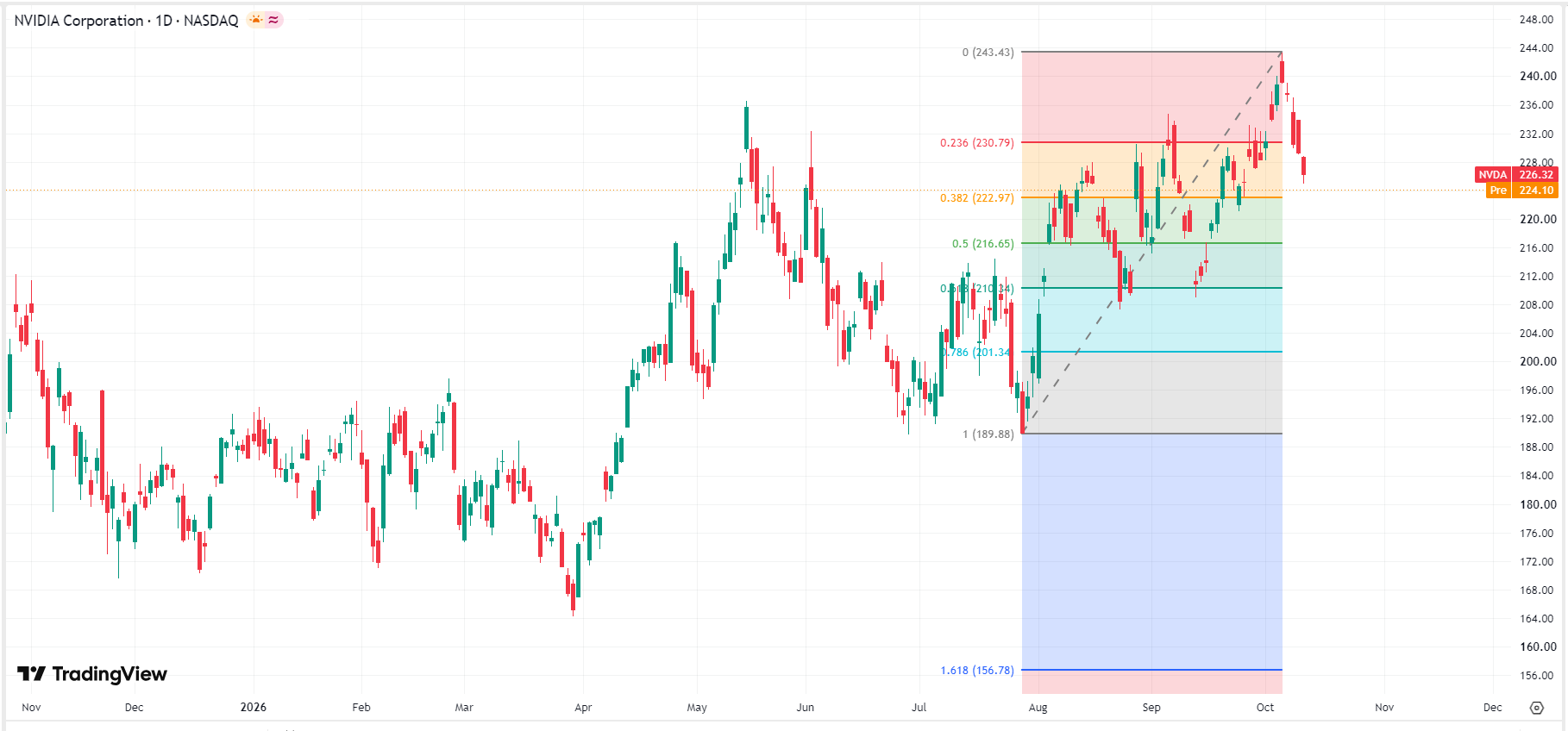 Nvidia stock price forecast, Source: TradingView
This content was translated using AI and reviewed for clarity. It is for informational purposes only.
Recommended Articles










Comments (0)
Click the $ button, enter the symbol, and select to link a stock, ETF, or other ticker.