


Chevron Stock Forecast: Hess Synergies and $100 Oil Strengthen the Cash Flow Story



AI Podcast


Chevron benefits from high oil prices, record U.S. production, strong refining margins, and accelerated Hess acquisition synergies, particularly the Guyana Stabroek block. While a Hess Midstream restructuring incurs a one-time accounting loss, it reduces debt and cuts midstream costs. Venezuelan expansion offers high-return upside alongside geopolitical risks. Financially, Chevron exhibits robust cash generation and capital returns, bolstered by a strategic Microsoft AI power agreement. Technically, the stock maintains a bullish bias while holding above the $201.83–$202.62 support zone, with a potential breakout dependent on surpassing the $217.94 resistance ahead of the October 30 earnings report.

TradingKey - Chevron (CVX) enters October with higher oil prices, record U.S. production, and the Hess acquisition, improving its earnings outlook. With its recent run-up, CVX closed at $211.55 on October 8. Energy stocks and oil prices were both up on October 8. Brent crude closed at $104.28 on October 8 and traded around $103.53 on October 9 as U.S.-Iran diplomatic discussions reduced some of the concern for the oil supply.
What’s interesting is the breadth of the current cash-flow setup. CVX is benefiting from higher oil prices, increased production, tight refining margins, and the faster than expected integration of Hess, which is leading to synergies. The next major catalyst is already baked in, with the company reporting 3rd quarter results on October 30.
Hurricane Isaias Creates a Short-Term Gulf Disruption
The latest operational risk is Hurricane Isaias. As of October 8, Reuters reported that 63% of U.S. Gulf of Mexico oil production and 57% of natural gas production was shut-in. Chevron shut-in production and evacuated personnel from offshore production facilities. Some of CVX’s other production facilities were unaffected. Based on the current situation, I would view the disruption as a temporary loss of production, unless the hurricane causes significant damage to offshore production and/or refining facilities.
On the other hand, a loss of production from the Gulf of Mexico is helping to remove excess oil from the global oil markets and should support crude prices.
Oil Above $100 Provides a Powerful Earnings Tailwind
Chevron is poised to benefit from higher oil prices. On October 6, Chevron CEO Mike Wirth stated that oil and fuel supply buffers are depleting with each passing day of the Middle East conflict. He said the physical market is tighter than what is reflected in the futures market. He added that the price of crude delivered to Asia was more reflective of $150 per barrel than $100 per barrel.
This environment will positively impact Chevron's upstream results. Q2 results showed how Chevron's upstream business benefits from higher prices and volume.
Chevron reported strong results, reported $12.1 billion of net income or $6.11 per diluted share. Adjusted earnings were $12.0 billion or $6.06 per share. Chevron's worldwide production increased 20% from the year prior. U.S. production also reached a new record of 2.1 million barrels of oil equivalent per day.
Given the strong price of crude through the end of the year, Chevron should continue to see strong results from its upstream business.
Hess Synergies Are Arriving Faster Than Expected
One of the best parts of Chevron’s investment case is the Hess acquisition. Chevron credits the integration with Hess as achieving $1.5 billion of run-rate synergies, 50% above the target and 6 months ahead of schedule.
Synergies justify an acquisition and improve the combined portfolio economics. Faster synergies integrate the portfolio more quickly, thereby reducing the risk of the integration and improving the likelihood the acquisition is accretive to cash flows and returns ahead of schedule.
The strongest Hess scenario is the cost synergies combined with Guyana production growth. I see potential for Chevron to more fully integrate the Chevron and Hess assets beyond merely growing production.
Guyana Extends Chevron’s Growth Runway
The most valuable element of the Hess deal is Chevron’s 30% stake in Guyana’s Stabroek block. The block contains approximately 11 billion barrels of discovered recoverable oil-equivalent resources and is one of the premier large scale oil development opportunities.
Current production is greater than 900,000 barrels of oil per day and is expected to continue to grow. ExxonMobil operates the block with a 45% interest, Chevron holds 30% and CNOOC holds the remaining 25%.
The combination of low costs and long reservoir life is strategic for Chevron. Stabroek block offers both and an extended development plan. Therefore, even if oil prices remain at current levels, Chevron is expectant for growth.
Hess Midstream Restructuring Improves the Cost Base
On October 6, Chevron entered into agreements to transfer its interests and general partnership in Hess Midstream, along with its crude midstream assets in the DJ Basin for improved commercial terms and $200 million in cash.
Chevron has stated that the revised Bakken agreements will decrease unit midstream costs by approximately 50%. Additionally, the transaction will deconsolidate about $3.7 billion of Hess Midstream debt from Chevron’s balance sheet.
There will be a large accounting cost. Chevron has stated that it expects a one-time after-tax loss of approximately $3 billion to $4 billion due to the inability to capitalize future Bakken cost savings. I would not view this loss in the same way as an operating loss. Management expects that the transaction will improve return on capital employed by about 0.5 percentage point on an absolute basis.
What is interesting is the discipline. Chevron is not keeping every Hess asset. It is actively changing the shape of the acquired portfolio, and focusing on businesses where it has the strongest competitive advantages.
Venezuela Adds High-Return Upside and Political Risk
Chevron announced in September that they plan to spend more than $7 billion in their Venezuelan joint ventures to more than double production to approximately 600,000 barrels per day. They expect project costs to be less than $20 per barrel, making the projects potentially economically attractive.
There is a number of risks, especially political, and contractual. While production from these projects could meaningfully enhance Chevron’s asset base, the legal and geopolitical framework remains less stable than in Chevron’s US, Guyana or Australia operations. I would treat these projects as potentially strong upside rather than as the core of Chevron’s valuation.
Record Production and Refining Strengthen the Base Business
Chevron achieved 20% year-over-year growth in worldwide production and record U.S. production for the quarter. U.S. production hit a record 2.1 million boe/d.
Chevron’s downstream business achieved record U.S. refinery throughput of over one million barrels per day. Refinery crude-unit utilization was 97%.
Record crude production and refining, along with strong refining margins for products in the current market, gives Chevron several levers to pull to improve financial performance.
Microsoft Power Deal Adds an AI Infrastructure Angle
Chevron announced a 20-year power agreement with Microsoft in June. The Microsoft partnership will see Energy Forge One build a power facility in West Texas to provide power to an AI data center. This facility will be co-located with the AI data center and is expected to supply approximately 2.67 gigawatts of capacity. The majority of the capacity will be generated by large GE Vernova turbines with additional capacity to be generated by Caterpillar’s Solar Turbines. First power is expected in the later part of this decade.
Chevron expects Project Level returns for this project. The model used for Project Kilby uses Chevron’s natural gas and energy infrastructure to develop the power project. This addresses the need for power for AI data centers. Chevron can also use its model to monetize natural gas to an extent without having to operate as a traditional utility.
Cash Returns Remain a Core Attraction
In Q2 Chevron returned $6.5 billion to shareholders. It expects to return a significant portion of the cash generated by the business by using a combination of dividends and share repurchases. The board of directors recently approved a 4% increase to the quarterly dividend to $1.78. Chevron has continued to reduce its structural costs. These reductions along with increased production and higher prices provide Chevron with additional operating leverage. Cost discipline strengthens capital return capacity.
October 30 Earnings Could Be Exceptionally Strong
According to their investor-relations schedule, Chevron will report their third quarter results on October 30. While reporting, I will pay particular attention to Guyana production, Hess synergies, Gulf disruptions, upstream realizations and refining, progress with Venezuela, capex, and the return of capital.
The commodity backdrop for the next few quarters should be chevron’s friend. Brent is above $100, physical markets are tight, and the refining system is experiencing challenges. Furthermore, Chevron’s production has increased after their acquisition of Hess.
The main concern is that the positive oil price momentum could reverse if tensions in the Middle East ease. Temporary disruptions to Gulf production from Hurricane Isaias, political risk in Venezuela, and a large one-time charge associated with the Hess Midstream restructuring also pose a risk.
Current commodity conditions give a fair value for Chevron. However, the valuation would become less appealing if oil prices and refining margins fell to more normalized levels. At the current price of $211.55, Chevron’s valuation is around 19.7x and 12.2x trailing and forward earnings, respectively.
Chevron Technical Analysis: CVX Jumps 3.12% as Bulls Target $217.94 Resistance
Chevron closed Thursday at $211.55, up 3.12% and forming a strong bullish candle after several days of consolidation. CVX continues to respect the rising trendline, and is supported by both moving averages, favoring the bullish case.
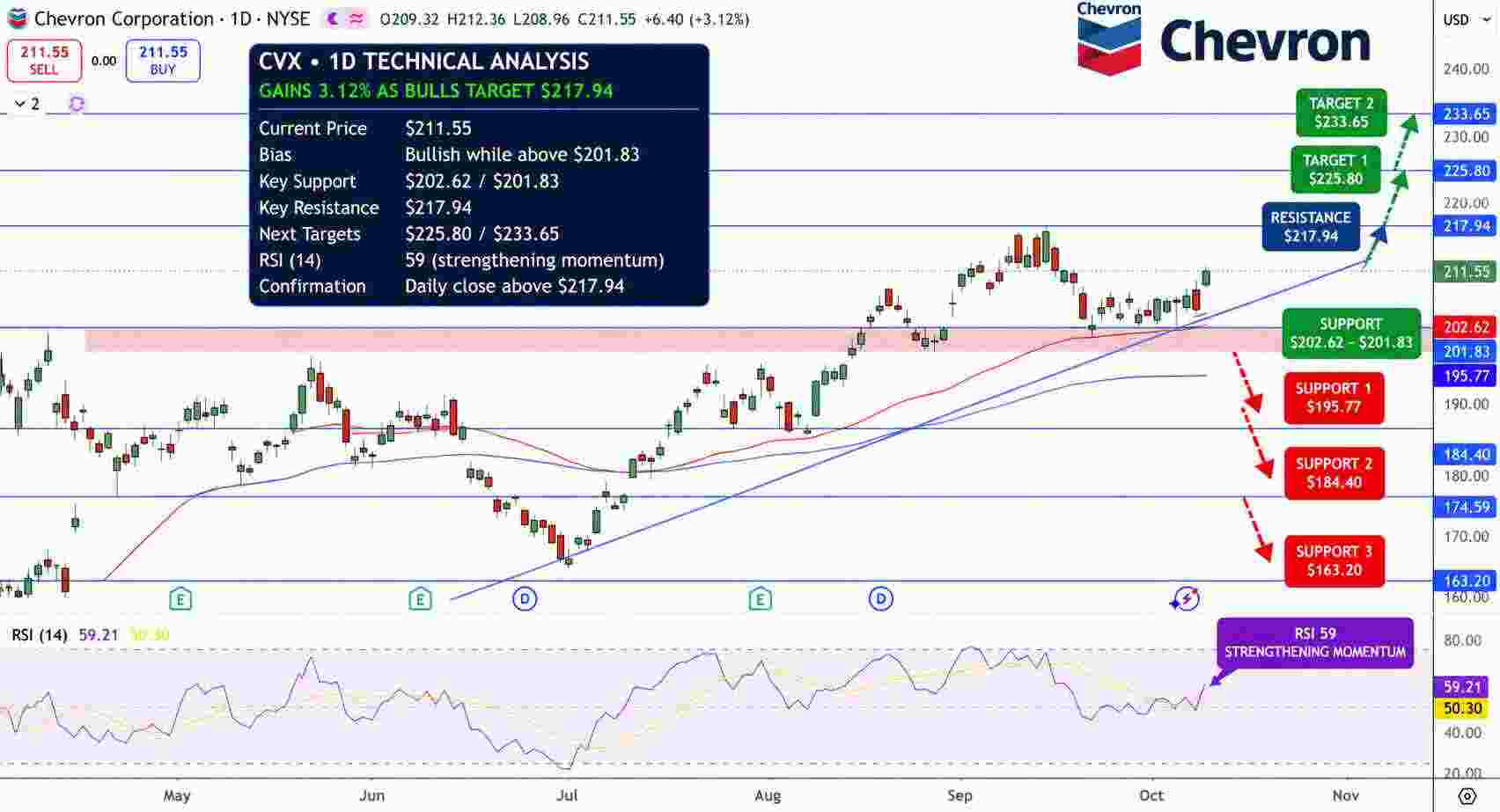
Chevron Stock Price Chart - Source: Tradingview
Renewed buying interest is signaled by the Relative Strength Index (RSI) at 59, but is not yet overbought. This indicates that there is potential for an upside breakout.
The bullish case would be further supported by a daily close above the $217.94 resistance. The next big targets from there would be $225.80 and then $233.65.
Daily support would come from the rising trendline, with the $202.62 to $201.83 area being key support and demand. This area is further reinforced by the 50-day moving average at $202.62. A close below this area would give bears control, with the 100-day moving average at $195.77 being the next key area of support. This would then open the $184.40 area. My bias would stay bullish as long as Chevron is holding above the $201.83 to $202.62 area.
Key Levels
• Latest Close: $211.55
• Major Support: $202.62 to $201.83, $195.77 then $184.40
• Major Resistance: $217.94 then $225.80 then $233.65
• RSI: approx. 59
• Breakout Resistance: $217.94
• Breakdown Support: $201.83
Why is Chevron stock in focus now?
Chevron is benefitting from: Brent crude oil prices being above $100, faster than expected synergies from Hess, expanding production from Guyana, record US production in Q2, very strong refining margins in Q2, and a new 20-year AI power agreement in West Texas with Microsoft.
What level confirms a stronger CVX breakout?
A daily close above $217.94 would support a bullish target of $225.80 and then $233.65. A close below $201.83 would be a bearish sign and support a move lower to $195.77.
Bottom Line
Chevron has one of the best cash generation set ups in the integrated oil sector heading into October. Strong refining margins, expanding production from Hess and Guyana, and higher crude oil prices have all been working in Chevron's favor.
The main question is, how long will these factors support Chevron stock? Strong oil prices have improved Chevron's earnings and cash flow, and if Hess synergies continue to improve, Chevron's valuation may be justified. From a technical perspective, the bullish trend continues as long as the stock is above $201.83. Fundamentally, the October 30th report needs to show higher oil prices are boosting free cash flow, and that returns are going to shareholders without sacrificing capital discipline.
Recommended Articles









Comments (0)
Click the $ button, enter the symbol, and select to link a stock, ETF, or other ticker.