


Samsung Stock Forecast: Q3 Profit Surges 783%, Can AI Memory Demand Continue to Push the Stock Higher?



AI Podcast


On October 8, Asia-Pacific time, Samsung Electronics reported record third-quarter results, with consolidated revenue reaching approximately 195 trillion Korean won and operating profit hitting 107.4 trillion Korean won, driven by surging memory chip prices and AI server demand for HBM and DRAM. Despite beating operating profit estimates, shares dipped 0.19% to 268,000 won as strong earnings were partially priced in. Meanwhile, rising component costs pressured consumer electronics, and won appreciation impacted overseas revenue. Key future monitors include semiconductor profitability, HBM shipment growth, 2027 demand sustainability, and critical technical resistance at 285,500 won.
TradingKey - On October 8, Asia-Pacific time, Samsung Electronics announced its preliminary results for the third quarter of 2026: consolidated revenue was approximately 195 trillion Korean won (about $145.7 billion), up 13.7% quarter-on-quarter and 126.6% year-on-year; operating profit was approximately 107.4 trillion Korean won, up 20% quarter-on-quarter and 782.5% year-on-year, with both revenue and operating profit setting record quarterly highs.
As of press time, Samsung Electronics shares fell 0.19% to 268,000 won, with a morning trading range of 266,000 to 270,000 won. The failure of the stock to rise following the record results indicates that the strong earnings performance was already partially priced in by the market, as investors also evaluate the sustainability of the results and the specific performance of individual business divisions.
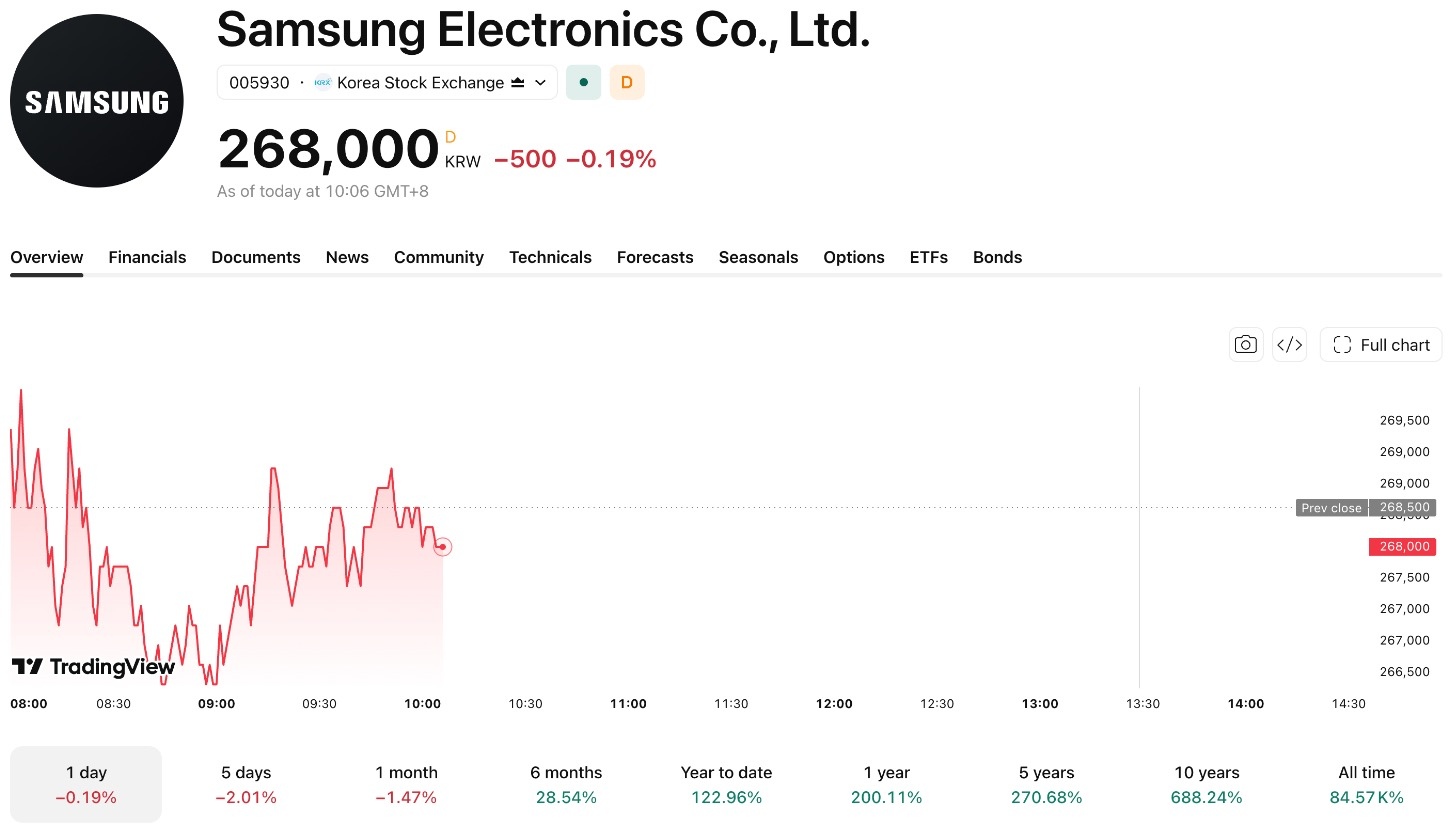
[Source: TradingView]
Rising Memory Chip Prices Drive Samsung Profits to Record High
Samsung's third-quarter operating profit reached 107.4 trillion won, exceeding the LSEG SmartEstimate expectation of about 106 trillion won; revenue was 195 trillion won, below the FactSet estimate of roughly 206.81 trillion won. The preliminary results did not disclose data by business segment, and the company will release its full financial report later in October.
Analysts expect the semiconductor business to be the primary driver of profit growth. AI servers continue to boost demand for HBM and high-capacity server DRAM, while major memory manufacturers have shifted more advanced process capacity to high-performance products, keeping supply tight for certain memory products.
TrendForce forecasts that contract prices for conventional DRAM will rise 10% to 15% quarter-over-quarter in the fourth quarter; including HBM, overall DRAM contract prices are expected to increase 15% to 20%.
Samsung has begun mass production of HBM4 and started delivering commercial products to customers. For the full earnings report, key focus areas include semiconductor business profit, HBM shipment growth, and management's assessment of fourth-quarter memory prices and supply-demand conditions.
Consumer Electronics Business Still Faces Cost Pressures
Higher memory prices improved profitability in Samsung's semiconductor business, while also increasing component costs for its smartphones and home appliances. Analysts estimate that combined operating losses for these two divisions in the third quarter could exceed 1 trillion won, reflecting that Samsung has not yet fully passed on rising costs to consumers.
In the third quarter, the South Korean won appreciated by more than 14% against the U.S. dollar, reducing the won-denominated value of translated overseas revenue. Going forward, key factors to monitor include DRAM and NAND prices, HBM shipment volumes, and whether the smartphone and home appliance divisions can improve profitability through price hikes, product mix optimization, and cost controls.
Market focus has shifted toward memory chip supply and demand dynamics as well as profit sustainability for 2027. If Samsung raises its HBM shipment targets or semiconductor profit guidance, the market may revise up the company's earnings forecasts; however, if memory prices retreat or HBM shipments fall short of expectations, earnings estimates and the stock price could come under pressure.
Samsung Stock Technical Analysis: 285,500 Won Forms Major Resistance
[Source: TradingView]
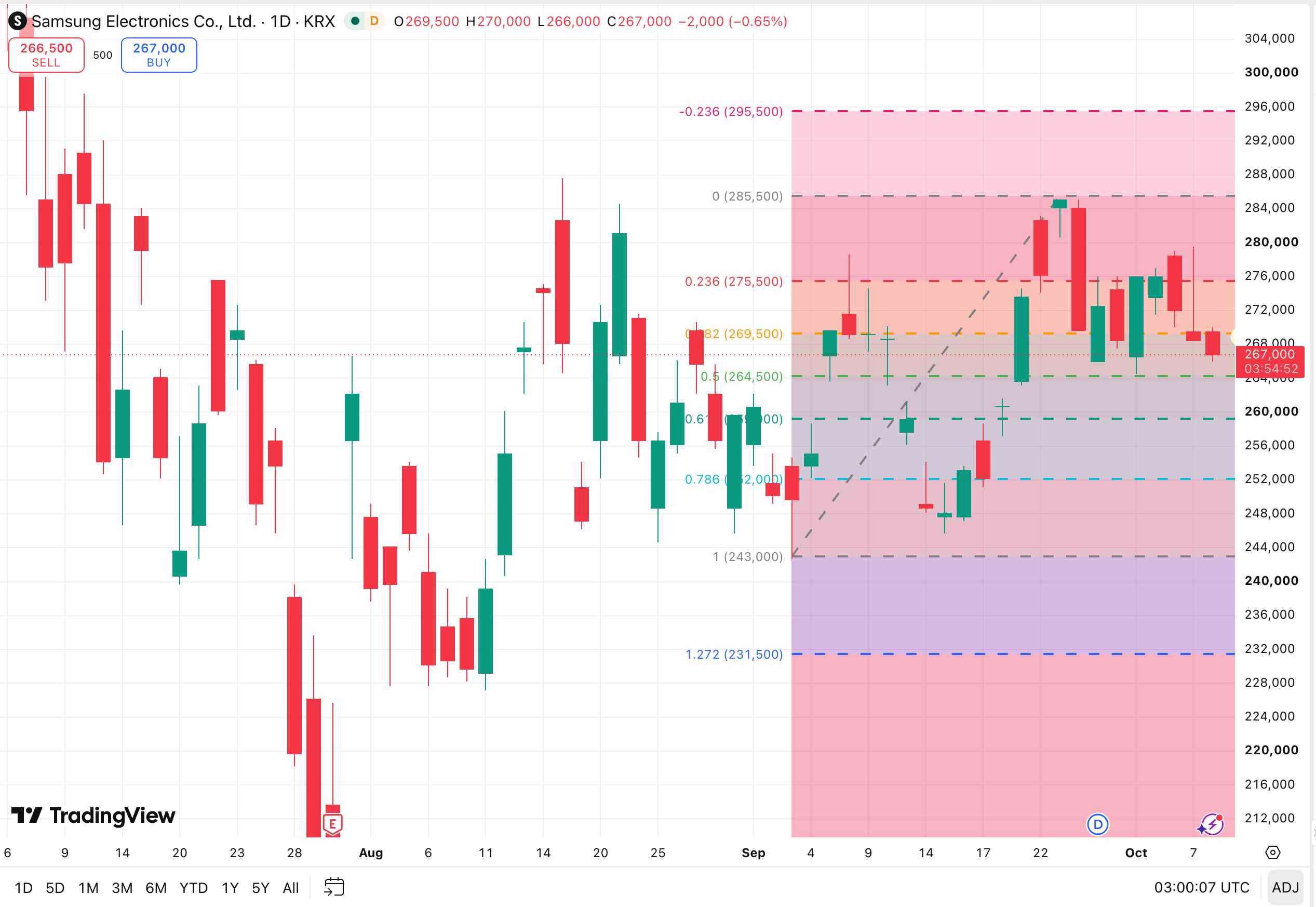
Based on the calculation from the intraday low of 243,000 won on September 3 to the high of 285,500 won on September 23, the 0.382, 0.500, and 0.618 Fibonacci retracement levels are 269,500 won, 264,500 won, and 259,000 won, respectively.
As of press time, Samsung Electronics' stock price was around 268,000 won, remaining below the 0.382 retracement level. If the daily chart closes back above 270,000 won, focus can shift to 275,000–276,000 won, as well as the high of 285,500 won touched twice in September.
If the stock breaks out on heavy volume and holds above 285,500 won, the -0.236 Fibonacci extension level is around 295,500 won, followed by the psychological level of 300,000 won.
Primary support below lies at 264,000–265,000 won. If this region gives way, the stock price could retest 259,000 won, with further support at 252,000–253,000 won.
This content was translated using AI and reviewed for clarity. It is for informational purposes only.
Recommended Articles







Comments (0)
Click the $ button, enter the symbol, and select to link a stock, ETF, or other ticker.