


US Midterm Elections Approach: Here Is Why They Could Impact US Stocks



AI Podcast


The 2026 U.S. midterm elections will critically impact equities through three potential scenarios. If Republicans retain the House, fiscal expansion and relaxed AI regulations persist, supporting offensive sectors while raising bond yield pressures. A Democratic House takeover creates a divided government, sparking tech regulatory risks and debt ceiling disputes, though falling yields offer duration support. Disputed results would trigger extended uncertainty, weighing on high-beta tech stocks and boosting safe-haven assets. Historically, post-election certainty fosters market recovery, with macroeconomic variables like fiscal policy, executive actions, and outcome clarity driving overall market direction.
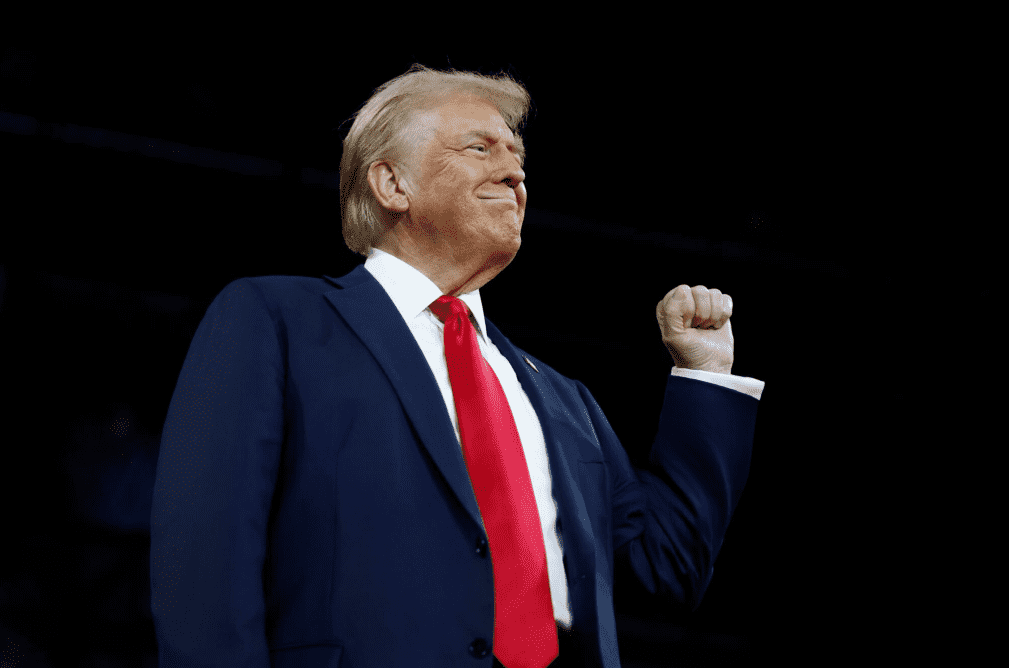
TradingKey - The 2026 U.S. midterm elections will be held on November 3, with all seats in the House of Representatives and a portion of the Senate up for election. According to data from polling aggregator FiftyPlusOne cited by CNBC, Democrats lead by about 6 percentage points in the generic House ballot, needing a net gain of just 3 seats to retake control of the House and end full Republican control of Congress.
For U.S. stocks, the suspense lies not in the election itself, but in how three potential outcomes—Republicans retaining the House, a Democratic flip, or a contested result—will reshape expectations for fiscal, trade, and AI policies, which will then feed through to stock indexes led by tech shares.
Republicans Retain House: Status Quo Continues, but Fiscal Concerns Mount
If Republicans retain the House in November or even maintain full control of Congress, the policy path will offer the greatest continuity. The tax cut and spending package ("one big beautiful bill") previously passed by Republicans along party lines would face less resistance to implementation, while the relaxed regulatory environment relied upon for AI capital expenditures and data center expansion would also be sustained, allowing offensive sectors such as AI and semiconductors to maintain their strength.
According to analysis by Bank of America's chief investment strategist Michael Hartnett and his team, if Republicans hold the Senate and Texas Governor Greg Abbott wins reelection, the market will interpret the outcome as a signal that AI capital expenditures and data center expansion will continue, and US stocks—particularly the AI sector—are expected to extend their strength through 2027.
It is worth noting that under unified party control, expectations for fiscal expansion are more fully formed, placing upward pressure on long-term bond yields and creating duration pressure on high-valuation growth stocks. JPMorgan pointed out in a June report that since 1950, the S&P 500 has actually performed better under a divided Congress than under single-party control—conversely interpreted, when Republicans have full control, "extreme versions" of policies like tax cuts and tariffs are more likely to be implemented, so market volatility will not necessarily be lower.
Democrats Retake House: Tech Stocks Face 'Mixed Bag' Under Divided Congress
This is the baseline scenario under current polling. At the macro level, a divided government implies that major legislation will largely stall, fiscal expansion expectations will cool, and long-term bond yields will trend lower—which should theoretically serve as a valuation tailwind for tech growth stocks with longer duration.
However, statistics from Natixis strategists show that since 2000, the S&P 500 has generated an average return of 10.9% to nearly 12% under single-party control, compared with just 4.8% under a divided government. In other words, there is clear tension between short-term valuation support and long-term return patterns.
The real threat to watch is policy risk. Ed Mills, Managing Director of Washington Policy at Raymond James, noted that the biggest policy volatility in US equities over the past two years stemmed precisely from executive orders rather than legislation: "If Democrats take the House, Trump is more likely to double down on executive actions rather than work with Democrats."
Specifically for tech stocks, risks are concentrated in several areas. Regulatory discussions within the Democratic Party around datacenter moratoriums are heating up, even as a large share of the market value in the current AI trade is betting on datacenter construction and profitability. Morgan Stanley noted that a Democratic sweep would be most unfavorable for datacenter assets, whereas a relatively "fragile" Democratic majority would actually be more advantageous.
The debt ceiling is another ticking time bomb. Most financial institutions expect the US to reach the $41.1 trillion debt ceiling by mid-2027. A report from TD Securities suggests that if Democrats win at least one chamber, they could use opposing votes as leverage for policy concessions, dragging negotiations "down to the wire."
Should this scenario materialize, policy uncertainty would suppress high-risk-appetite sectors such as AI and semiconductors; meanwhile, if long-term bond yields fall due to cooling fiscal expectations, mega-cap tech stocks would receive duration support. As these two forces offset each other, the index is more likely to trade in a wide range rather than experience a unilateral decline.
Disputed or Delayed Election Results: Risk Assets May Face Pressure
The third scenario is the one investors least want to see: the election outcome remains delayed and uncertain.
Recent Supreme Court rulings have reinforced states' rights to continue counting votes after Election Day, while swing seats in the House of Representatives are heavily concentrated in states with longer vote-counting periods, such as California, meaning the final outcome may not be clear for weeks. TD Securities stated bluntly in a report: "Independent of the final result, election chaos itself is a scenario that could hit the market."
This will amplify market volatility. According to analysis by Molly Brooks at TD Securities, higher volatility will weigh on risk assets such as equities, while safe-haven capital flows into government bonds, potentially driving yields slightly lower. Ed Mills of Raymond James stated bluntly that "nobody wants a repeat of 2020"—when control of the Senate was not settled until January of the following year.
Under this scenario, high-beta tech stocks will bear the brunt of the sell-off, while defensive and safe-haven assets will be favored by capital.
The impact of the midterm elections on US equities is not a simple "bullish or bearish" proposition, but rather a repricing of a set of policy paths. Historical data shows that volatility is systematically higher during midterm election years, but the post-election relief of uncertainty is often the starting point for market recovery. According to Deutsche Bank data, across the 20 midterm election cycles since World War II, the S&P 500 has never recorded a negative return in the nine months following the election.
Scenario | Policy Path | Key Risks | Potential Market Reaction |
Republicans Retain the House | Continuation of tax cuts and spending bills; relaxed regulatory environment for AI and data centers maintained | Rising concerns over fiscal expansion; higher long-term bond yields weigh on high-valuation growth stocks | Offensive sectors such as AI and semiconductors maintain their strength |
Democrats Retake the House | Divided government leads to legislative gridlock, shifting policy focus to executive orders; debt ceiling negotiations reach a stalemate | Discussions on data center regulation heat up; debt ceiling negotiations are dragged out to the last minute | Policy uncertainty dampens AI risk appetite; declining long-term bond yields provide duration support for mega-cap tech, leading to wide index swings |
Disputed or Delayed Results | Policy vacuum period, with both fiscal and trade paths remaining uncertain | Volatility rises as control of Congress remains undecided for weeks, prolonging uncertainty | High-beta tech stocks come under pressure, while safe-haven assets dominate |
From a macro perspective, the three variables that truly dictate the market are: fiscal expansion expectations (determining long-term bond yields and growth stock valuations), the intensity of executive actions (determining tariffs and China policy), and the certainty of results (determining volatility levels). For tech stocks, Scenario 2 is the most conflicted—short-term policy risks coexist with duration support, which is precisely where institutional divergence is greatest.
This content was translated using AI and reviewed for clarity. It is for informational purposes only.
Recommended Articles










Comments (0)
Click the $ button, enter the symbol, and select to link a stock, ETF, or other ticker.