


DraftKings Stock Forecast: Prediction Markets Could Open a New Growth Engine



AI Podcast


DraftKings’ core sportsbook business demonstrates strong consumer volume and customer acquisition, despite Q2 revenue missing estimates due to lower monetization. Bank of America recently upgraded the stock to Buy, highlighting prediction markets via the DKeX exchange as a major potential revenue driver. However, significant regulatory and legal uncertainties regarding sports event contracts pose structural risks. Management maintains its full-year 2026 Adjusted EBITDA guidance of $700 million to $900 million. Technically, the stock remains in a broader bearish trend, facing key resistance at $20.65 and support at $18.50.

DraftKings (NASDAQ: DKNG) has had a difficult year, but October has the potential to be better. One reason is that investors have begun to turn their attention to prediction markets, a new category of potentially fast-growing business for the company. DKNG closed at $19.60 on October 5, a 5.43% increase from the previous day, after Bank of America (BofA) upgraded their rating to Buy. Prediction markets, in BofA’s opinion, could provide a significant earnings boost, making the investment a win-win scenario for the company.
DraftKings’ current operational state is better than what the stock price reflects. Customer acquisition and retention is strong, sports consumer volume is increasing, DraftKings’ sportsbook handle share is increasing, and the core business is performing well. The main point of contention among investors is Prediction Markets. Will Prediction Markets positively impact the company’s bottom line, or will the company be negatively impacted due to increased regulation?
Bank of America Sees Prediction Markets as a Win-Win
BofA also upgraded DraftKings to Buy from Neutral on October 5 and maintained its $27 price target. BofA believes DraftKings’ sharp price decline created a more favorable risk/reward scenario and that prediction markets can positively impact DraftKings’ sportsbook business.
Bank of America estimates DraftKings could bring in about $400 million in prediction-market fees and an additional $200 million to $400 million from market making in 2027. That represents a potential revenue opportunity of $600 million to $800 million, and these numbers are from analysts’ estimates, not from DraftKings themselves, so I’d look at them from an upside perspective.
There’s also what’s called a “win-win” situation, which is worth knowing. If sports prediction markets remain legal, then DraftKings has a new nationwide growth channel. But, if courts and/or regulators crack down on sports prediction markets, then one of the bigger competitive overhangs on traditional sportsbooks would disappear.
DKeX Gives DraftKings More Control
DraftKings officially launched its prediction markets exchange DKeX on June 26 and integrated it into the unified DraftKings Sports & Casino app. DKeX gives DraftKings greater control over its markets and the user experience rather than having to rely entirely on third parties.
DraftKings said Predictions was already doing around $3.4 billion in annualized consumer volume and $11.3 billion in annualized total trading volume for the week ending June 21. That was a massive increase from just a month prior, when annualized consumer volume was $1.3 billion and annualized total trading volume was $3.1 billion. Those are strong numbers, but it's important to keep in mind they are run-rate metrics that only reflect a short period of time, and those volume figures are not revenue, and DraftKings has not separately disclosed DKeX revenue.
Predictions operates within a CFTC-regulated framework and currently offers contracts for events in the sports, finance, crypto, economics, politics, and culture. This means DraftKings can capture users in markets outside of the sports betting markets where DraftKings currently operates. Market availability varies by jurisdiction.
Regulatory Risk Is Now More Concrete
Prediction markets remain the largest known unknown in the new thesis. Federal appeals courts have reached conflicting conclusions over whether states can regulate sports event contracts or whether the Commodity Futures Trading Commission (CFTC) has exclusive authority. The appellate split has increased the likelihood that the U.S. Supreme Court could eventually resolve the issue.
Recent legal decisions have increased the uncertainty surrounding prediction markets. The Sixth Circuit Court of Appeals said Ohio and Tennessee could apply their gambling laws to sports event contracts. Other courts have ruled differently in other states. Until those lawsuits reach a resolution, the legal environment surrounding prediction markets will remain unstable and could limit DraftKings’ ability to scale its prediction market exchange, DKeX, nationally.
In my opinion, the legal environment for prediction markets poses the greatest risk to the current bull case for prediction markets. As stated previously, the courts could ultimately force DraftKings to restrict its prediction market exchange to certain states, thereby eliminating DraftKings’ ability to capture the national prediction market opportunity.
Q2 Revenue Weakness Masked Strong Betting Activity
Revenue for the second quarter at DraftKings (DKNG) fell 4.6% to $1.443 billion, missing the $1.45 billion estimate. Adjusted EBITDA was approximately $115 million, while sports revenue fell 10.6% year over year.
DraftKings noted the underlying activity was much healthier. Sports Consumer Volume was $13.1 billion for the quarter, a 14.5% increase. Monthly Unique Payers was 3.6 million, a 9% increase from the year-ago period. Sportsbook handle was up 11% and management said handle share across sportsbook states improved year over year for the third consecutive quarter.
Management said the main issue was monetization. Sports Net Revenue Margin declined to 6.8% from 8.7%. Average revenue per MUP declined 13% to $132 due to customer-friendly sports outcomes and customer promotions. Management also said normalized revenue would have increased approximately 10% from the prior year.
Customer Acquisition Is Accelerating
In Q2 DraftKings focused on customer acquisition. Management said they acquired roughly 30% more customers than planned while spending about 10% more than planned. They said underlying customer acquisition costs came in about 25% better than planned.
Customer acquisition was up roughly 75% compared to the same period last year. It was around the NBA Finals and World Cup which drew a lot of interest. At the time of Q2 earnings, management said Predictions engagement drew over 600,000 customers and said early signs for retention and volume per customer was similar to a sportsbook customer.
It's a positive sign because it shows the company may not be buying low quality users with promotions. The biggest indicator of quality will be seen when promotional intensity slows. If customers remain active once promotional intensity slows, the lifetime-value of customers may justify the pressure on EBITDA in the short-term.
Core Profitability Still Looks Strong
DraftKings maintained its full-year 2026 guidance of $6.5 billion to $6.9 billion in revenue and $700 million to $900 million in Adjusted EBITDA. The company’s CFO Alan Ellingson stated the core business is on track to reach an Adjusted EBITDA of about $1 billion, giving the company financial flexibility to fund Predictions.
Ellingson’s comments distinguish Predictions from sports betting. Consolidated profitability is being reduced partly by deliberate investment in Predictions, not by broad deterioration in sportsbook economics. The case for the investment gets stronger, should Predictions begin to generate revenue and profits from fees and market-making over the next 1-2 years.
Regulatory uncertainty means Predictions investment may continue to pressure earnings for a longer time than investors expect. Predictions has the potential to pressure cash flow for some time if legal and regulatory uncertainty limits market availability, and if Predictions users do not generate enough revenue to offset customer-acquisition costs.
Competition in Sportsbook Remains Intense
FanDuel continues to be DraftKings’ largest U.S. sportsbook competitor. Fanatics also continues to expend a lot of capital to compete in the sports betting space. This means there is a higher likelihood of another promotional period, due to heightened competition, leading into the Football season. On top of this, DraftKings is also competing against Kalshi and Polymarket for customers who view event contracts as an alternative to traditional sports betting.
Having said this, DraftKings does not appear to be losing core sportsbook customers. Management said that sportsbook handle share improved for a third straight quarter. Prediction markets rely on repeat customers to be profitable. Hence, it is crucial for DraftKings to retain its customers.
Additionally, DraftKings' portfolio is quickly evolving to include more ways to monetize customers. Management said the Super App rollout is already paying dividends, giving DraftKings more ways to monetize the same customer relationship.
Q3 Earnings Will Test Football-Season Economics
According to Stock Analysis, DraftKings has not publically disclosed a date for Q3 earnings. Stock Analysis is estimating November 5.
For the next report, I would look most closely at sportsbook hold, NFL customer acquisition, Monthly Unique Payers, prediction market volume, promotional spending, and management's outlook regarding Adjusted EBITDA. The football season should provide a better test of the quality of DraftKings revenue.
The biggest change to my view would be Prediction market volume and profitability improving. The biggest negative change would be increasing pressure on sportsbook hold, a further increase in promotional spending, and Court decisions negatively impacting DkeX's addressable market.
DraftKings Technical Analysis: DKNG Rebounds From $18.50 but Bears Control Below $20.65
DraftKings closed October 5 at $19.60 after rebounding from the important $18.50 support area. However, what catches my attention here is the fact that the rebound comes after a break down from the former $20.65 demand area. Further, the price action remains below both major moving averages and a bearish trendline, so the bigger picture is bearish.
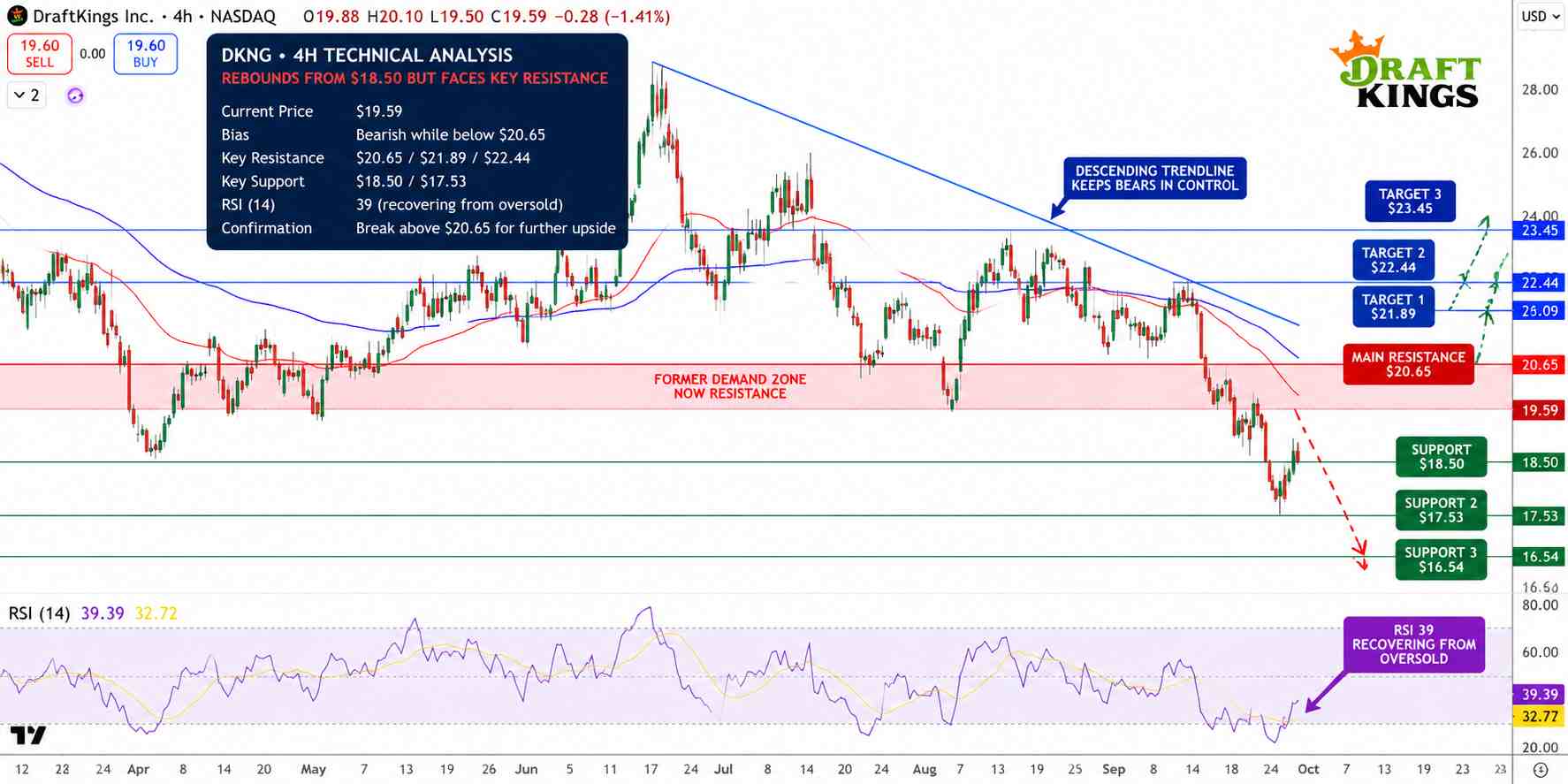
DraftKings Stock Price Chart - Source: Tradingview
The RSI is at 39, above the signal line at 33. This shows that the bounce is still in progress after RSI recently dropped below 30. However, the RSI is still below the 50 level, which indicates that the bounce is still in progress and not confirmed. The first major area of resistance is $20.65.
A 4-hour close above $20.65 could bring the price towards the 50-period moving average at $21.89 and then $22.44. A break above $23.02 and $23.45 could signal the end of the bearish trend. Moving below $18.50 would invalidate the rebound and support a breakdown to $17.53 and then $16.54.
I am still bearish below $20.65. A bounce from oversold conditions is expected, and could take price as high as $20.65, but a break above the demand area is not expected.
Key Levels
Latest completed close: $19.60
Major support levels: $18.50, $17.53, then $16.54
Major resistance levels: $20.65, $21.89 to $22.44, then $23.02 to $23.45
RSI: approximately 39, recovering but still below neutral
Recovery trigger: sustained 4-hour close above $20.65
Breakdown trigger: sustained 4-hour close below $18.50
Why is DraftKings stock in focus now?
Bank of America recently upgraded DraftKings stock and mentioned that prediction markets/event contracts could be a new, good source of revenue for DraftKings. DraftKings stock has fallen more than 40% in 2026, but customer and handle growth continued, and revenue growth slowed. Regulatory risks related to sports event contracts continue to be the biggest risk for DraftKings stock.
What level confirms a stronger DKNG recovery?
A close above 20.65 would confirm a breakout, and a close below 18.50 would continue the bearish trend and bring the next target at 17.53.
Bottom Line
October has a better story for DraftKings at a cheaper price. The sportsbook business is gaining customers, growing Sports Consumer Volume, and improving handle. DraftKings has maintained 2026 Adjusted EBITDA guidance of $700 million to $900 million, and the addition of prediction markets gives it an additional source of revenue, but prediction markets are also a new area of regulation for the company.
In your opinion, do you think DKNG can be truly independent from its sportsbook and iGaming business from prediction markets, or will it mainly shift customer activity to other markets?
Technically, $20.65 is the key near-term resistance for DKNG. Longer-term, if DraftKings can show better hold and revenue with its sports prediction markets, it could improve the outlook for the company.
Recommended Articles









Comments (0)
Click the $ button, enter the symbol, and select to link a stock, ETF, or other ticker.