


Sugar Prices Outperform S&P 500 in 2026: Can the Sugar Bull Market Continue?



AI Podcast


Spot sugar prices surged over 22% year-to-date, outperforming the S&P 500, driven by a rapidly tightening global supply-demand outlook for the 2026/27 marketing year. Significant production declines in Europe and Brazil, compounded by India's drought and duty-free import quotas, underpin this rally. Furthermore, a strong El Niño threatens major Asian exporters like India and Thailand, heightening supply risks. While baseline forecasts suggest a minor deficit, potential supply deterioration could widen the deficit to over 3 million tonnes, driving further upward price repricing depending on weather developments and milling decisions over the next six months.

TradingKey - Since 2026, sugar has been one of the standout performers in the commodities market. As of September 30, spot sugar prices have gained over 22% year-to-date, significantly outperforming the roughly 12% gain of the S&P 500 Index over the same period. In August in particular, sugar prices surged 22.9% in a single month, marking one of their strongest monthly performances since October 2010.
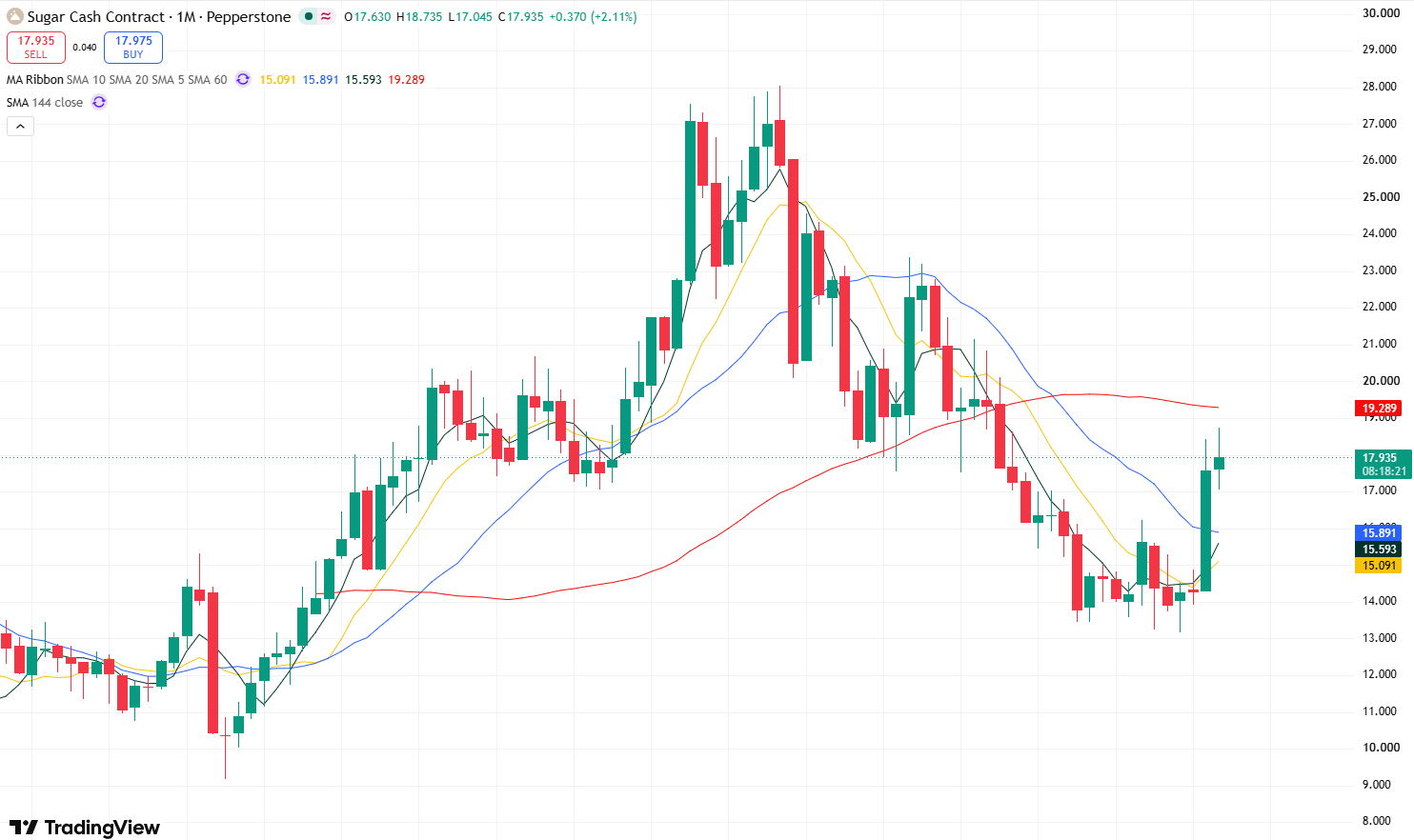
Monthly Sugar Price Chart, Source: TradingView
Why Are White Sugar Prices Rising?
The core shift driving this round of sugar price gains is the market's rapidly tightening outlook on the global sugar supply-demand balance for the 2026/27 marketing year.
First, European sugar production has declined significantly. Europe experienced multiple heatwaves this year, which impacted sugar beet yields. According to the European Commission's latest sugar supply and demand forecast, EU sugar production for the 2026/27 season could drop from around 16.6 million metric tons in the previous year to 13.4 million metric tons, a decline of about 19%. This means that Europe alone could see a reduction of more than 3 million metric tons in sugar supply.
Meanwhile, Brazil, the world's largest sugar producer and exporter, has not fully filled this gap. The FAO noted that declining sugar output in Center-South Brazil was a major reason for the sharp rise in international sugar prices in August. The FAO Sugar Price Index rose 11.9% month-on-month in August, reaching a one-year high.
Notably, El Niño could further escalate supply risks. The World Meteorological Organization recently stated that this El Niño event could be one of the strongest on record and is very likely to persist into early 2027. A strong El Niño alters global rainfall distribution, with a particularly pronounced impact on sugar: India and Thailand typically face higher risks of extreme heat and drought, while Brazil could experience abnormal precipitation.
Data shows that Brazil, India, and Thailand together account for about 70% of global sugar exports. Consequently, even a significant crop reduction in just one major producing region could rapidly shift the supply balance in international markets.
India has already shown clear warning signs. In June this year, Indian rainfall was about 35% below normal levels, and August rainfall was also below average. If rain deficits persist in September, it will not only affect current sugarcane yields but could also lower reservoir levels, impacting the planting and yields of this water-intensive crop in the next season.
The Indian government recently approved a duty-free import quota of 1 million metric tons of raw sugar, with nearly 800,000 metric tons already applied for. For a major global sugar producer, shifting from restricting exports to increasing imports inherently reflects tightening domestic supply.
El Niño could further exacerbate this issue. Reuters, citing climate and commodity market analyses, pointed out that drought caused by a strong El Niño could reduce India's sugar production by about 1 million metric tons. Meanwhile, if Thailand also suffers from inadequate rainfall, the sugar supply available to the international export market will shrink further.
Can the Sugar Bull Market Continue?
At present, white sugar fundamentals still possess the conditions to continue strengthening, but there is clear divergence in the market regarding the actual size of the supply deficit.
The latest August forecast from the International Sugar Organization (ISO) showed that ISO expects a small supply deficit of 262,000 tonnes in the global sugar market for the 2026/27 season for the first time. More importantly, ISO explicitly stated that El Niño poses the biggest threat to global sugar production forecasts over the coming months.
Currently, based on relatively normal production assumptions, the global sugar market faces only a slight deficit without a severe supply crisis. However, if India, Thailand, or Brazil are significantly impacted by a strong El Niño, this supply-demand balance could shift rapidly.
According to data cited by CNBC, Citi projects that the global sugar supply deficit in the 2026/27 season could reach approximately 1.3 million tonnes, while Green Pool forecasts it could even reach 3.2 million tonnes. Consequently, Citi raised its three-month sugar price target to 19 cents per pound.
From a market perspective, whether white sugar prices can sustain the bull market depends on two scenarios.
The first is a moderate scenario. Brazilian production returns to normal, and while India and Thailand are affected by El Niño, their output cuts remain limited, while higher sugar prices incentivize Brazilian mills to increase the proportion of sugar production. Under this scenario, ISO's current forecast of a supply deficit of around 200,000 tonnes may be close to reality. Although the global sugar market shifts from a surplus to a slight deficit, it would be difficult to support a sustained and rapid price increase.
The second is a scenario of significant supply deterioration. If a strong El Niño causes sugarcane output in India and Thailand to decline further, while Brazil faces crushing disruptions due to abnormal rainfall or high oil prices prompt mills to boost ethanol production, the global supply deficit could rapidly expand from several hundred thousand tonnes to over 1 million or even 3 million tonnes. Under this scenario, raw sugar prices, currently around 18 cents per pound, could continue to be repriced upward.
Overall, El Niño will serve as the core variable for assessing the sustainability of the white sugar bull market over the next six months.
This content was translated using AI and reviewed for clarity. It is for informational purposes only.
Recommended Articles












Comments (0)
Click the $ button, enter the symbol, and select to link a stock, ETF, or other ticker.