


Qualcomm Teams Up With Google as Snapdragon X Elite Enters First Googlebook Laptops



AI Podcast


On September 21, Eastern Time, Google opened pre-orders for Googlebooks starting at $899, with Qualcomm’s Snapdragon X Elite powering initial models from Dell and HP. This partnership expands Qualcomm’s PC chip market beyond Windows into the Android-based ecosystem, providing a new growth avenue amid pressures in its mobile chip business from Apple’s in-house modem development. However, Qualcomm's short-term shipment contributions remain constrained as competitors like Intel and MediaTek also secure ecosystem footholds. Investors should closely monitor upcoming shipment volumes and insights from the September 22-24 Snapdragon Summit regarding AI computing and PC strategy.

TradingKey - On September 21, Eastern Time, Google (GOOGL) officially opened pre-orders for the first batch of Googlebook laptops. Qualcomm (QCOM) confirmed that its Snapdragon X Elite platform will power the launch models from Dell and HP.
Googlebook is a new laptop category launched by Google, featuring the deep integration of the Android ecosystem, Gemini AI, and PC experiences. It runs on Googlebook OS, built on the Android technology stack, supports Android apps, and enhances file, application, and task collaboration with Android phones.
The first batch of Googlebooks is being released by five manufacturers: Acer, ASUS, Dell, HP, and Lenovo. Starting at $899 in the US market, they will be available on October 4.
Qualcomm Shares Pull Back Significantly Ahead of Partnership Announcement
Before the news of the Googlebook partnership was announced, Qualcomm's stock price had just experienced a pullback. On September 18, Qualcomm closed at $177.72, down 5.82% for the day. On the same day, the Philadelphia Semiconductor Index rose 3.14%, and Qualcomm underperformed the Philadelphia Semiconductor Index.
In early trading on September 21, as of press time, Qualcomm's stock price rebounded nearly 3% to $182.87.
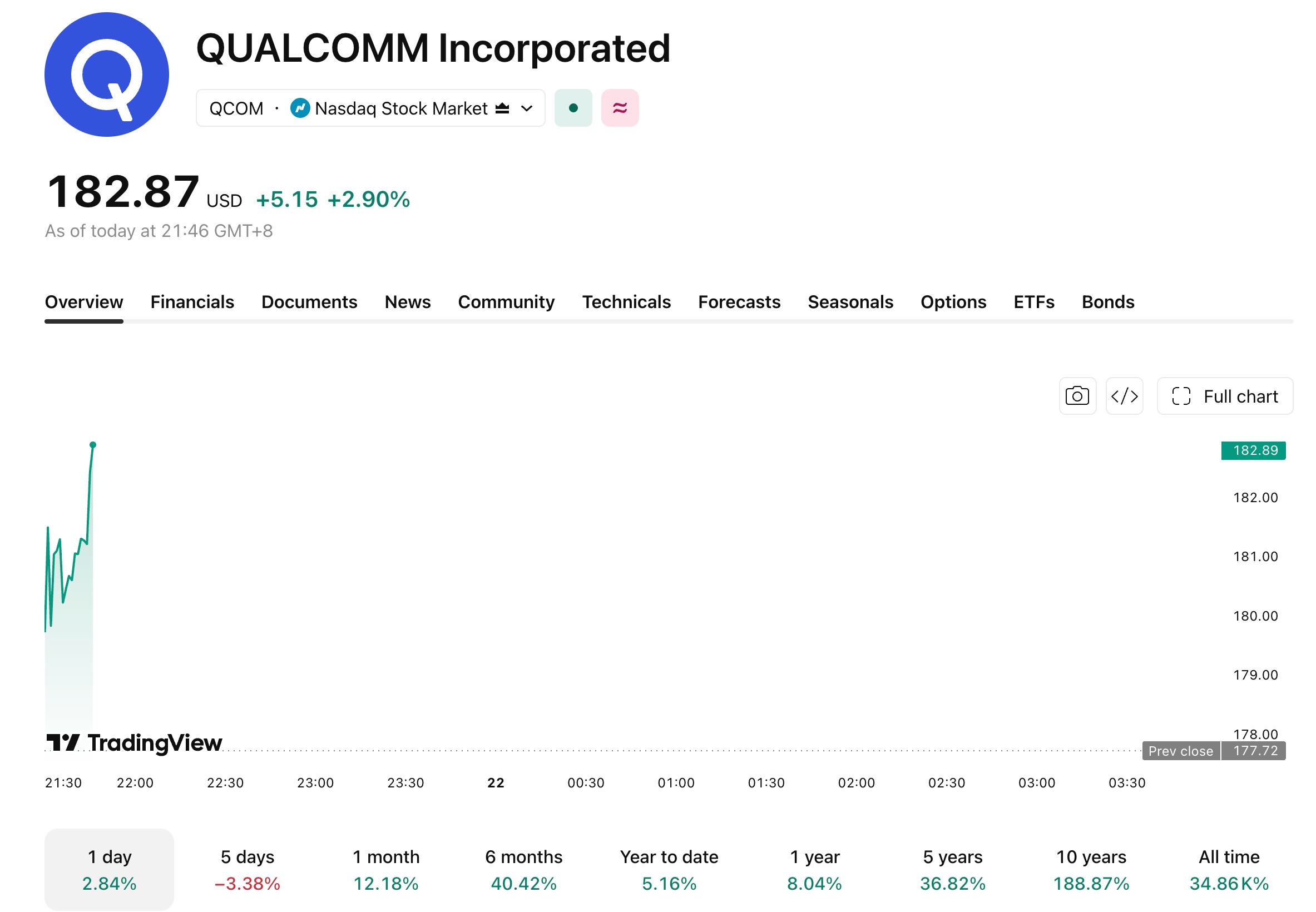
[Source: TradingView]
What Googlebook Means for Qualcomm?
The launch of Googlebook expands the PC chip market beyond Windows for Qualcomm. This marks the first time the Snapdragon X Elite has entered Googlebook, a new laptop platform based on the Android technology stack.
However, among the initial batch of five Googlebook models, only two from Dell and HP feature the Snapdragon X Elite, while products from Acer, Asus, and Lenovo adopt Intel's Core Ultra Series 3. Therefore, Googlebook's actual contribution to Qualcomm's short-term shipments remains to be seen.
MediaTek is also a chip partner for Googlebook, but has not yet entered the initial product lineup. Its solutions are expected to be introduced in subsequent models, with specific products and release dates yet to be announced.
Overall, Googlebook provides Qualcomm with a new entry point into the PC platform, but its commercial scale will still depend on subsequent models and market sales volume.
Mobile Phone Business Poses Greater Pressure
Compared to its PC business, Qualcomm's mobile chip business faces more direct pressure. Apple continues to advance its in-house modem development, with the iPhone 18 Pro already adopting Apple's C2 modem, while the US version of the iPhone 18 Pro Max still uses Qualcomm's Snapdragon X80, leaving the two companies in a transition phase.
Against this backdrop, Googlebook provides Qualcomm with a new opportunity to expand its PC chip business. The subsequent adoption scope of the Snapdragon X Elite in Googlebooks and the platform's actual shipment volumes will be key factors in observing whether Qualcomm's PC business can generate incremental growth.
Qualcomm will hold its annual Snapdragon Summit from September 22 to 24. Investors should focus on the company's latest statements regarding AI computing, its PC chip business, and upcoming Snapdragon X series products, particularly the "Agentic PC" strategy, as well as whether more information about its collaboration with Googlebook is disclosed.
This content was translated using AI and reviewed for clarity. It is for informational purposes only.
Recommended Articles








Comments (0)
Click the $ button, enter the symbol, and select to link a stock, ETF, or other ticker.