


As Capital Markets Day Approaches, Can Novo Nordisk Stock Reverse Slump with New Strategy?



AI Podcast


Ahead of its London Capital Markets Day, Novo Nordisk faces mounting institutional pressure amid intensifying competition from Eli Lilly in the weight-loss market. With the stock down over 16% year-to-date and trading below key moving averages, investors demand clear strategies beyond recent workforce reductions. Analysts emphasize the necessity of accelerating new drug development, successful commercialization, and potential M&A to diversify revenues, as over 90% of sales rely on diabetes and obesity treatments. While management focuses on organizational restructuring and brand unification, the stock remains in a weak consolidation phase, with the $40.92 level acting as critical defensive support.
TradingKey - As Capital Markets Day approaches, Novo Nordisk (NVO) is facing increasingly evident pressure from institutional investors.
On September 21 local time, the Danish drugmaker will hold its Capital Markets Day in London to officially outline its new corporate strategy. This will also mark the first comprehensive presentation of the company's future direction to investors by newly appointed CEO Mike Doustdar.
Over the past few years, products like Ozempic and Wegovy propelled Novo Nordisk into a key player in the global weight-loss drug market, with its market capitalization once surpassing $600 billion. However, as Eli Lilly (LLY) continues to capture market share with Zepbound, Novo Nordisk's competitive edge in key markets like the United States has eroded, sending its stock price sharply lower. Today, investors are looking for management to present not just cost-cutting plans, but a product strategy capable of driving growth for years to come.
Eugen Uretzki, an investment analyst at Flossbach, believes that Novo Nordisk's most critical tasks are twofold: continuing to develop new drug assets, and demonstrating the ability to successfully commercialize them. He noted that against the backdrop of intensifying competition from Eli Lilly, Novo Nordisk does not have much time left to wait for new products to mature organically.
This also explains why M&A has once again become a central focus for investors.
Julia Angeles, an investment manager at Baillie Gifford, stated that Novo Nordisk needs to show the market a clear path for transitioning from its current semaglutide products to the next phase of growth. Forming partnerships with other biopharmaceutical companies, licensing external R&D assets, or even pursuing outright acquisitions are all viable avenues to consider.
For investors, the concern is that Novo Nordisk's current revenue structure remains highly concentrated, with more than 90% of its sales derived from diabetes and obesity treatments. By contrast, Eli Lilly boasts a broader portfolio that includes therapeutic areas such as oncology and neuroscience. This means that if growth in Novo Nordisk's core weight-loss drug business slows, its overall financial performance will be more vulnerable.
Meanwhile, the large-scale restructuring led by Doustdar since taking office is reshaping the company's operations. Over the past year, Novo Nordisk has cut more than 9,000 jobs. This week, the company announced it will unify under the "Novo" brand and introduce a new corporate culture framework called "The Novo Way." Management hopes the organizational revamp will boost efficiency while sharpening the company's focus on consumer needs.
However, for some institutional investors, relying solely on cost-cutting will not solve long-term growth challenges. The real question that needs answering is what Novo Nordisk plans to rely on to unlock new growth potential after the shift in the weight-loss drug competitive landscape.
Source: TradingView
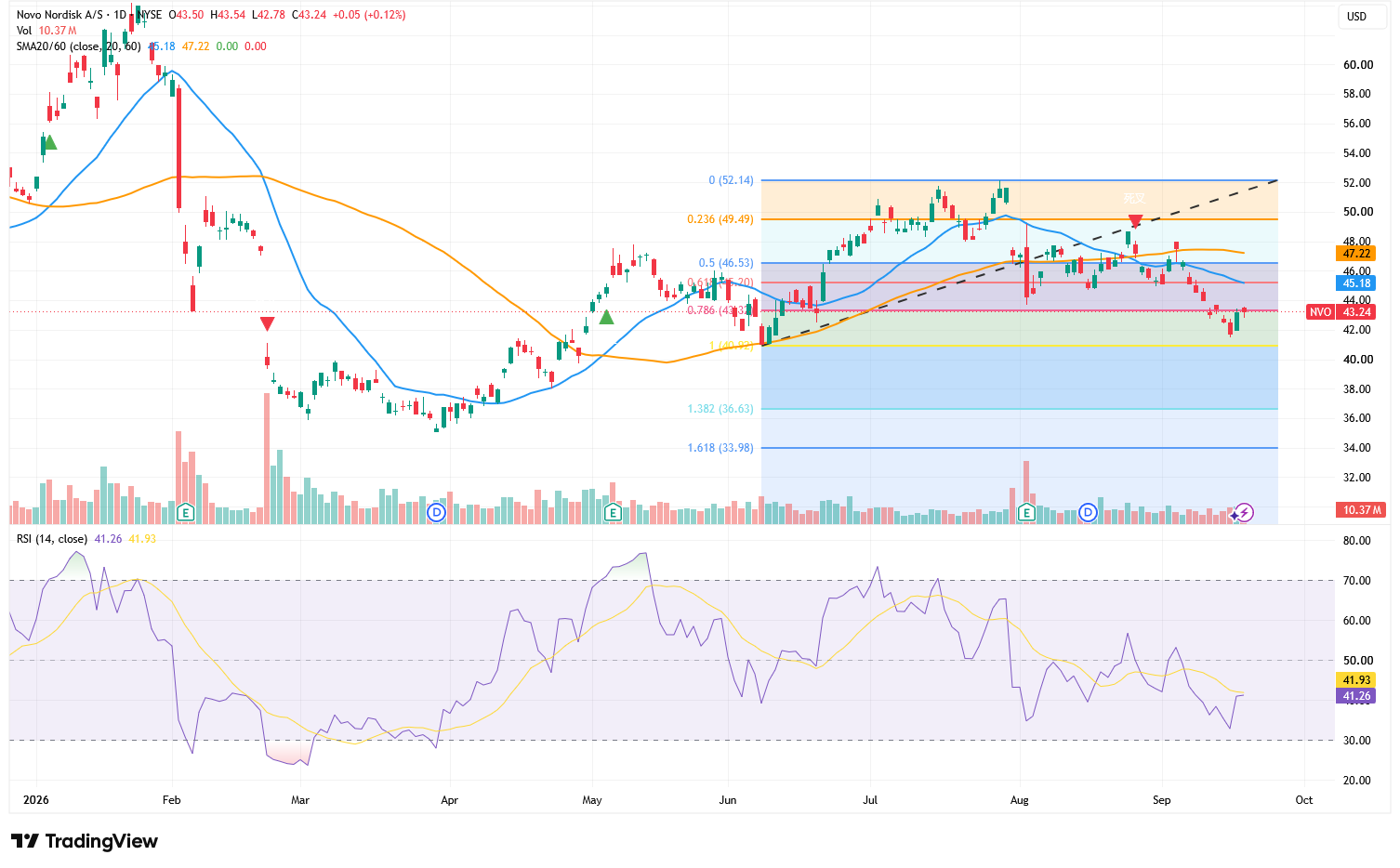
From a technical perspective, Novo Nordisk's stock price has fallen more than 16% year-to-date, closing most recently at $43.24. On the daily chart, the stock has broken below its previous upward trendline and trades below both its 20-day moving average of $45.18 and 60-day moving average of $47.22, indicating that the short-term technical structure remains weak.
The RSI currently stands at 41.26, slightly below the signal line of 41.93, suggesting that bearish momentum still dominates, though it has not yet entered oversold territory. On the upside, initial focus is on $45.18–$45.20; only a further recovery above $46.53–$47.22 would significantly improve the short-term trend.
NVO remains in a weak consolidation phase for now. The $40.92 level serves as a crucial defensive support line; holding above it could trigger a technical bounce, but a breakdown on heavy volume would leave the stock at risk of further downside.
This content was translated using AI and reviewed for clarity. It is for informational purposes only.
Recommended Articles










Comments (0)
Click the $ button, enter the symbol, and select to link a stock, ETF, or other ticker.