


Nearly Four Years Into Nvidia H100 Mass Production, Ornn Data Shows Rental Prices Jump 22% in a Month as Huang Emphasizes GPU Revenue Capability



AI Podcast


On September 7, US Eastern Time, Nvidia H100 rental prices rose up to 22% over a month to $3.28 per hour, according to the Ornn index, highlighting persistent strong demand despite newer architectures like Blackwell and Vera Rubin. SemiAnalysis data further indicated a 38% increase in one-year contract price midpoints from October 2025 to March 2026. This sustained profitability suggests data center operators may reassess GPU economic lifespans and ROI. Meanwhile, Nvidia's recent partnerships aiming to mobilize over $500 billion in infrastructure financing seek to establish AI computing as an institutional asset class driven by continuous revenue streams.
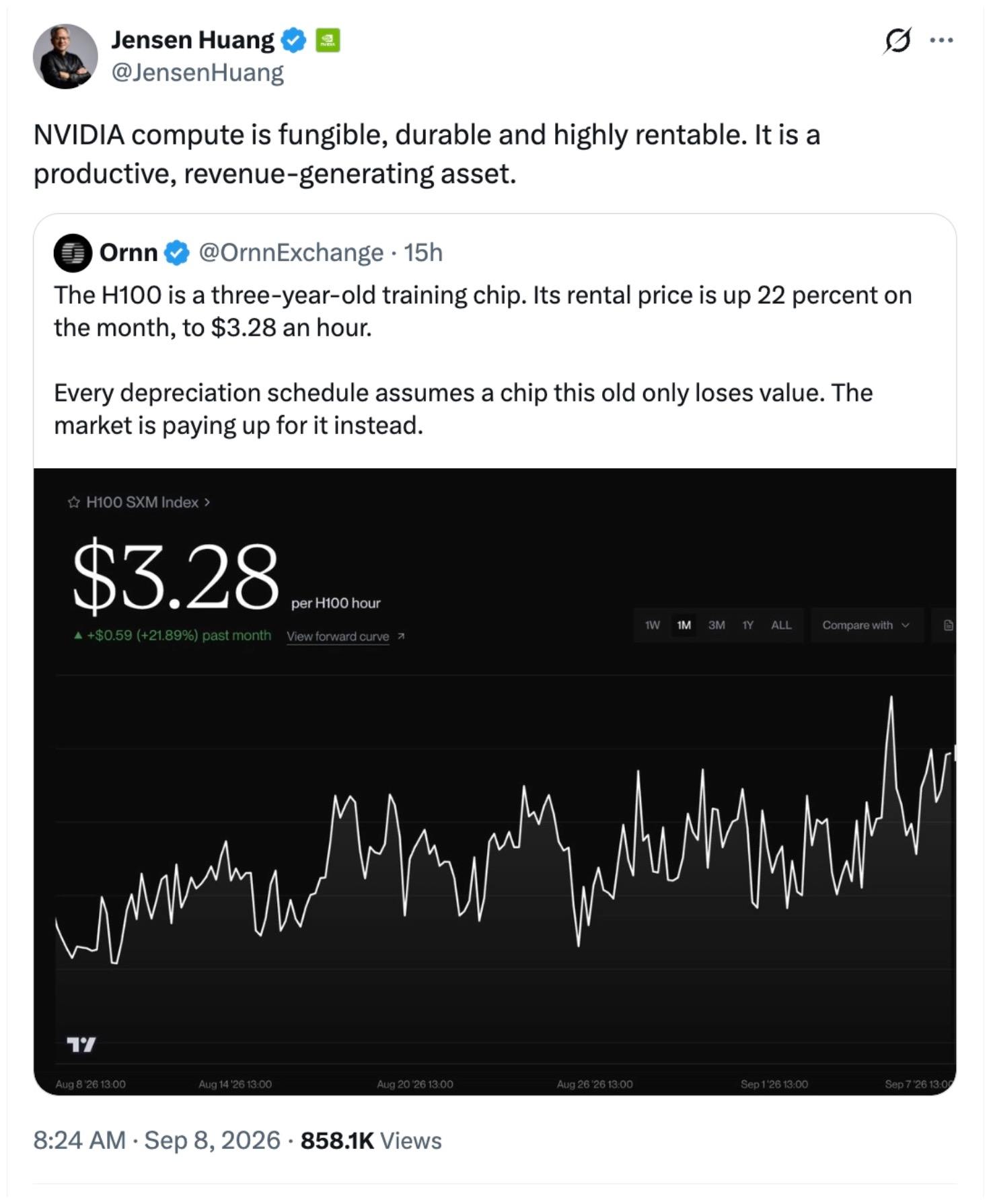
TradingKey - On September 7, US Eastern Time, computing power trading platform Ornn stated on X that Nvidia (NVDA) H100 rental prices have risen 22% over the past month, reaching $3.28 per hour.
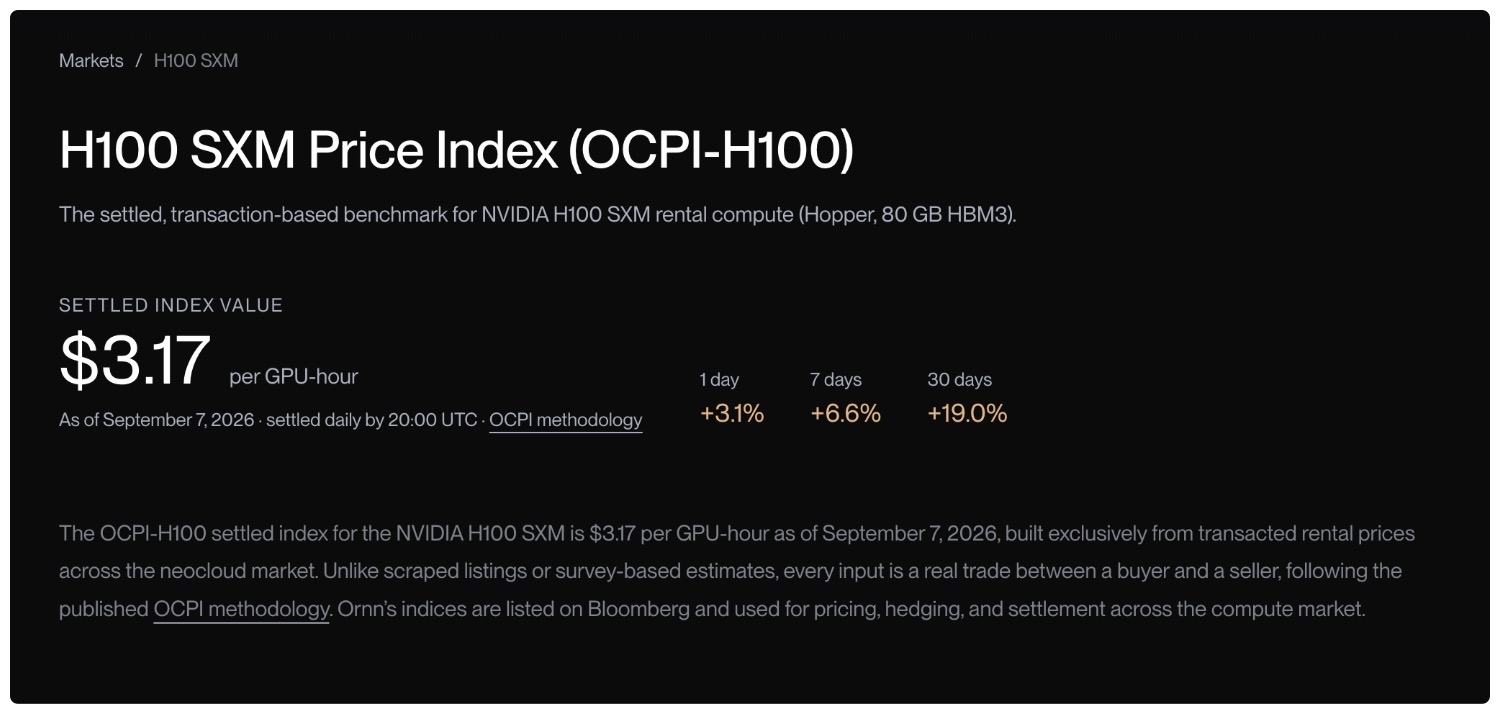
As of press time, according to Ornn's official OCPI-H100 index, the settlement price on September 7 was $3.17 per hour, representing a 30-day gain of 19%.
[Source: Ornn]
Nvidia CEO Jensen Huang subsequently reposted the content. He stated that Nvidia's computing power resources possess versatility, durability, and strong rental capacity, making them "productive assets" capable of generating continuous revenue.
[Source: X]
The H100 was released in 2022 and entered full mass production in the second half of that year, roughly four years ago. Even as Blackwell is being deployed at scale and Vera Rubin enters full mass production, rental demand for the previous-generation H100 remains active.
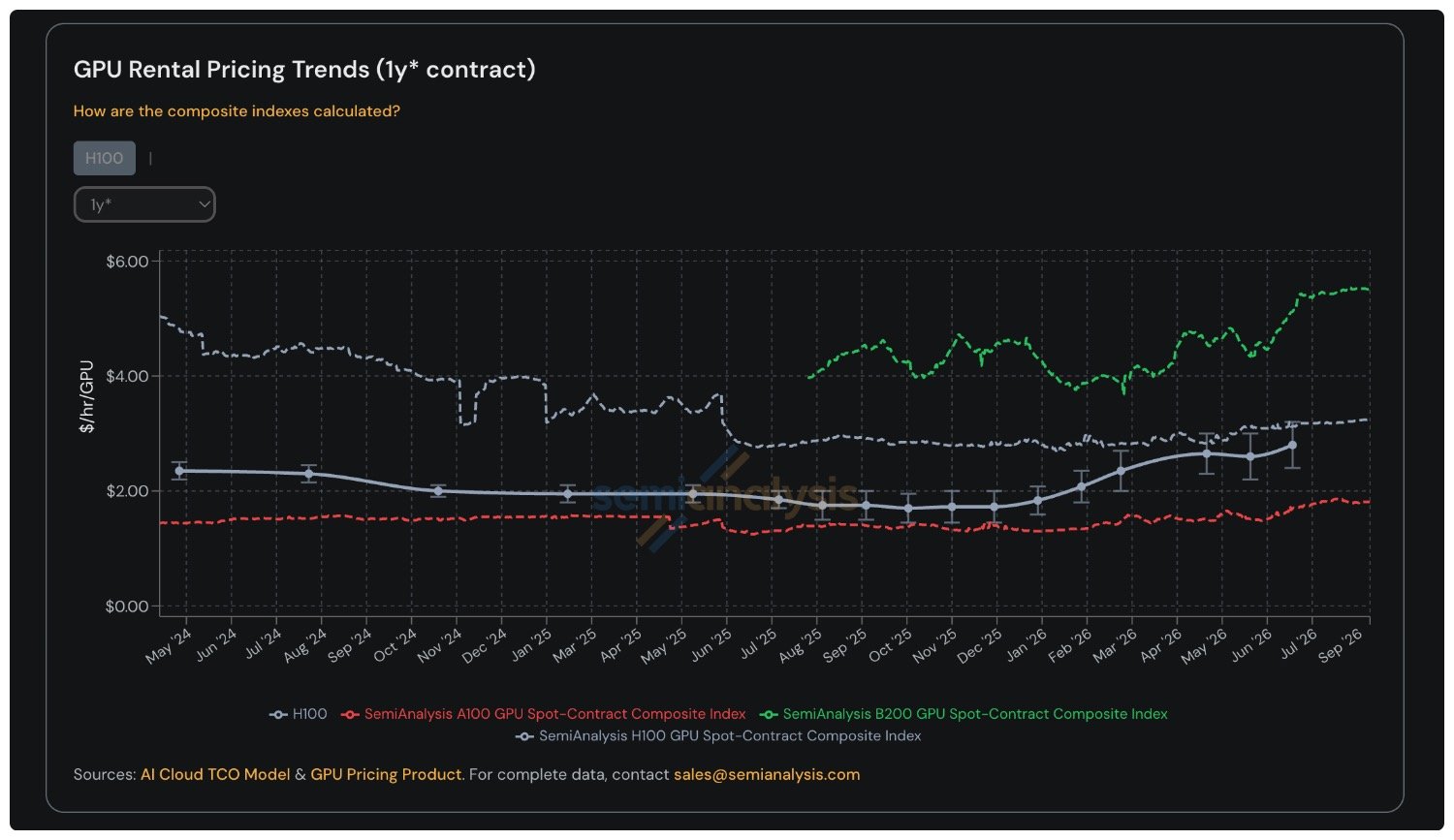
Market data from SemiAnalysis provides another perspective. Its one-year rental price range for the H100 rose from $1.45 to $1.95 per hour in October 2025 to $2.00 to $2.70 per hour in March 2026. Based on the midpoint of the ranges, the price increased from approximately $1.70 to $2.35, a gain of about 38%.
However, this dataset reflects one-year contract price ranges in the market tracked by SemiAnalysis rather than a unified average price for the global H100 rental market, making it better suited as an indicator for observing changes in AI computing supply and demand.
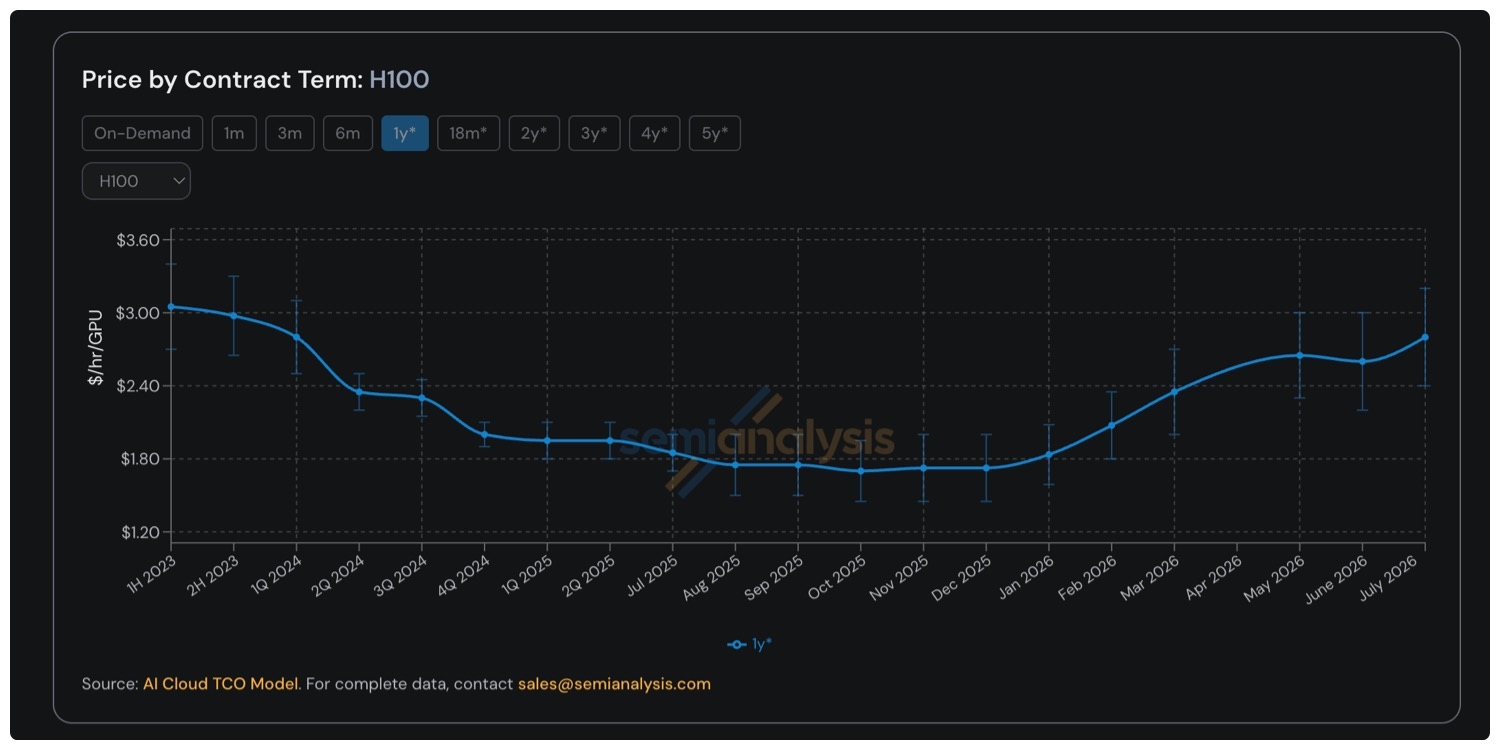
[Source: SemiAnalysis]
This does not mean the H100 has stopped depreciating, but higher rental rates indicate that previous-generation GPUs still possess strong revenue-generating capabilities. If this trend persists, data center operators may re-evaluate the economic useful life and return on investment for GPUs.
In August this year, Nvidia announced partnerships with Apollo (APO), BlackRock, Blackstone, Brookfield, Goldman Sachs (GS), and KKR, planning to establish an AI computing infrastructure financing platform with a goal to gradually mobilize over $500 billion in third-party capital. Nvidia hopes to develop its computing power and full-stack AI infrastructure into an investable asset class and attract institutional capital through long-term, usage-linked revenue streams.
The Ornn index reflects computing power transactions within its covered market rather than a unified global H100 rental price, nor can it be directly used to calculate Nvidia's revenue. However, even as next-generation GPUs continue to ramp up production, H100 rental rates remain high, demonstrating that previous-generation GPUs retain strong commercial value.
This content was translated using AI and reviewed for clarity. It is for informational purposes only.
Recommended Articles









Comments (0)
Click the $ button, enter the symbol, and select to link a stock, ETF, or other ticker.