


Oracle Stock Price Prediction: Drops to $158 Ahead of Earnings, Is ORCL a Buy Now?



AI Podcast


Oracle’s upcoming fiscal Q1 2027 earnings report will test market confidence in its AI strategy amid rising infrastructure costs. Despite a 21% year-to-date stock decline, Oracle anticipates robust sales driven by Oracle Cloud Infrastructure and GPU-as-a-Service demand, with massive remaining performance obligations providing revenue visibility. Technically, the stock exhibits short-term bullish momentum, trading above its 20-day and 60-day moving averages with an RSI of 60.94. Key upside resistance stands between $160 and $166, while primary support concentrates near the $146 to $148 range, highlighting event-driven volatility risks surrounding earnings execution.
TradingKey - Oracle (ORCL) is set to report its first-quarter fiscal 2027 financial results, a report that may serve as a key milestone for the market to reassess its AI strategy.
As of the close on September 4, Eastern Time, Oracle stock was trading at $158.78, down approximately 21% year-to-date and over 50% off its 52-week high of $345.72.
The persistently weak price action indicates that the market is not denying the AI orders Oracle has secured, but rather beginning to weigh the construction costs, financing pressures, and financial returns behind these contracts.
A year ago, after Oracle reported its fiscal first-quarter results, its stock surged 36% in a single day, driven by a 359% year-over-year jump in remaining performance obligations (RPO) to $455 billion.
The large-scale infrastructure partnership with OpenAI was once viewed as a major turning point in the company's transition from a traditional database software vendor to a global cloud computing giant. However, as data center investments have increased sharply, this AI strategy has gradually become the focus of market debate.
Earnings Focus Shifts to OCI Growth and Order Fulfillment
Oracle's AI investments have significantly accelerated revenue growth, with fiscal 2026 revenue increasing 17% year-over-year, well above its average annual growth rate of approximately 5.4% from 2019 to 2025. The company expects fiscal 2027 sales to reach $90 billion, representing an increase of over 30%.
OCI is the core business driving growth. In fiscal 2026, Oracle Cloud Infrastructure revenue reached $18 billion, up 77% year-over-year; in the fourth fiscal quarter, IaaS revenue further grew 93% to $5.8 billion, while cloud revenue including IaaS and SaaS reached $9.9 billion. During the same period, the company's total revenue was $19.2 billion.
The market expects this growth momentum to continue into the new fiscal quarter. Morgan Stanley (MS) believes that Oracle's fiscal 2027 first-quarter cloud revenue growth could approach the upper end of its guidance of around 63%, driven mainly by its GPU-as-a-Service business. As computing capacity built in the previous fiscal year comes online and an additional capacity of nearly 1 gigawatt is expected in the first quarter, Oracle will have more GPU resources to deliver to customers like OpenAI and recognize revenue.
As of the end of fiscal 2026, Oracle's RPO increased from $553 billion in the previous quarter to $638 billion. Such a massive contract backlog enhances future revenue visibility, but it also means the company must complete data center construction as scheduled.
In this earnings report, investors will focus on whether RPO continues to grow, whether OCI growth can approach the upper limit of guidance, and whether newly added computing capacity can be smoothly brought into operation.
Oracle Stock Price Technical Analysis
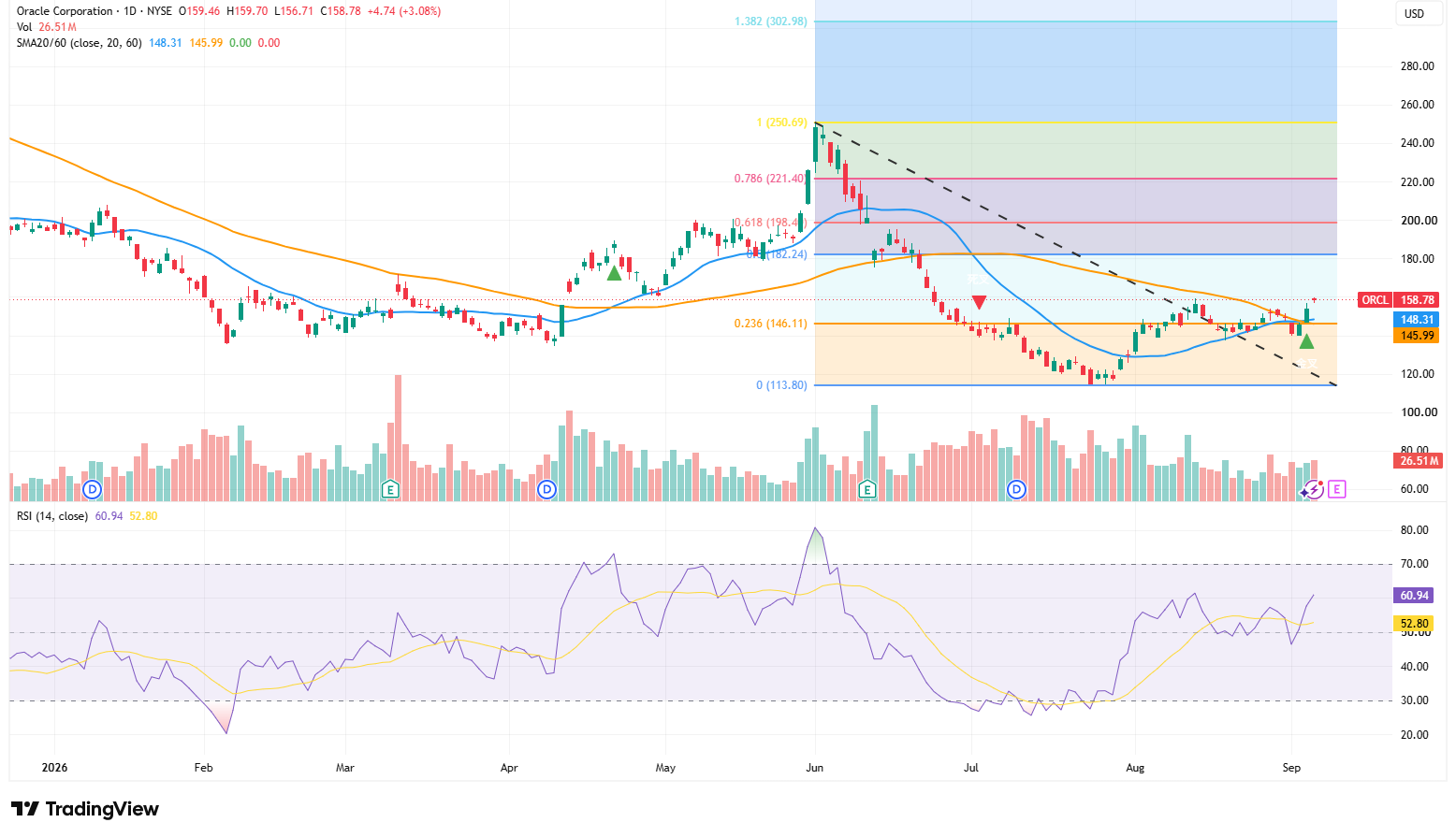
Source: TradingView
On the daily chart, ORCL recently closed at $158.78, rebounding noticeably from its low of $113.80 and breaking above the downtrend line extending from the peak of $250.69. The stock price has also climbed above both the 20-day moving average of $148.31 and the 60-day moving average of $145.99, with the 20-day moving average crossing above the 60-day moving average, signaling a short-term trend reversal from weak to strong.
Regarding momentum, the 14-day RSI has risen to 60.94, above the signal line of 52.80 and the 50 centerline, indicating that buying strength is building while not yet entering overbought territory. However, as the stock price approaches the psychological level of $160, chasing the rally ahead of earnings still entails risk from event-driven volatility.
To the upside, attention should first be paid to the resistance zone between $160 and $166, with $166 aligning near the 0.382 Fibonacci level. If earnings propel the stock to hold firmly above $166 on increased volume, the next target would be $182.24, with a further breakthrough potentially challenging $198.41. Only a reclaim of $198 would confirm a more comprehensive repair of the medium-term downward structure.
To the downside, key support is concentrated in the $146 to $148 range, which converges with the 20-day moving average, 60-day moving average, and the 0.236 Fibonacci level at $146.11. If the stock can hold this area post-earnings, the current rebound structure remains intact; conversely, a high-volume breakdown below $146 could lead to a retest of $135 to $140, with further support at the previous low of $113.80.
This content was translated using AI and reviewed for clarity. It is for informational purposes only.
Recommended Articles







Comments (0)
Click the $ button, enter the symbol, and select to link a stock, ETF, or other ticker.