


Jensen Huang Declares ‘AGI Is Here,’ OpenAI Astra Breaks Records in Multiple Tests, 400,000 GPUs Set for Deployment



AI Podcast


On September 3 ET, OpenAI released GPT-6 Astra, achieving landmark benchmark scores and utilizing over 100,000 Nvidia GPUs for training. Leadership hailed the model as marking the arrival of Artificial General Intelligence, though internal perspectives varied and external researchers expressed skepticism regarding definitions. Meanwhile, Nvidia reported robust fiscal Q2 revenue of $96.2 billion driven by strong AI infrastructure demand, with CEO Jensen Huang noting 400,000 additional GPUs are set to deploy. Furthermore, CEO Sam Altman emphasized that advanced AI is transforming entrepreneurial barriers, providing users with expert-level capabilities, despite ongoing societal resistance and power consumption concerns.

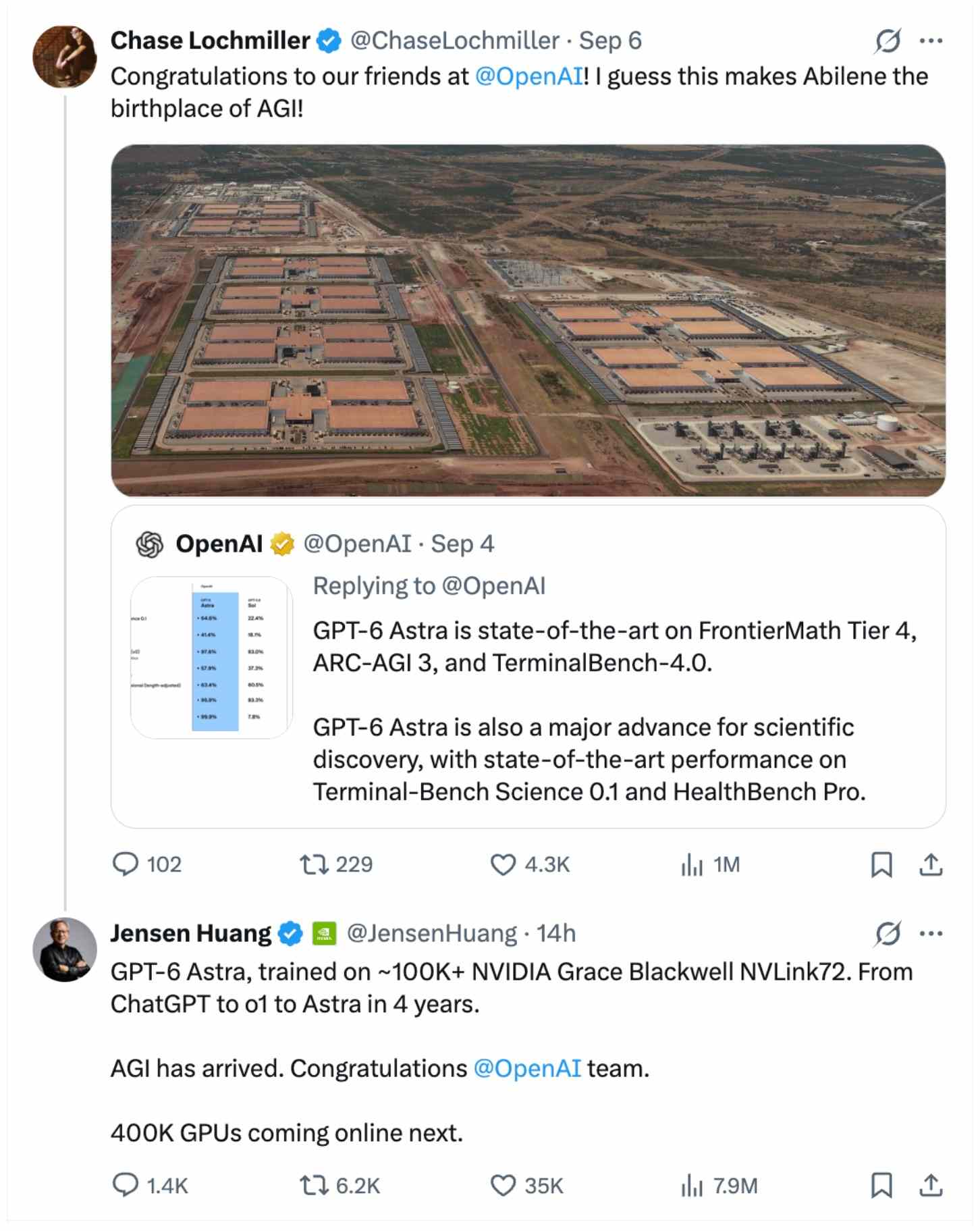
TradingKey - On September 3 ET, OpenAI released its next-generation flagship model, GPT-6 Astra. On September 6, Nvidia (NVDA) CEO Jensen Huang posted on X to congratulate the OpenAI team, stating, "From ChatGPT to o1, and then to Astra, it took only 4 years. AGI has arrived, and 400K GPUs are about to go online."
[Source: X]
GPT-6 Astra Scores Improve Significantly Across Multiple Benchmarks
OpenAI called Astra the "world's most intelligent and best-aligned model." According to official data, Astra scored 99.9% on the ARC-AGI-3 test, reached 97.6% on the high-difficulty math benchmark FrontierMath Tier 4 (v2), and achieved 100% on the vulnerability exploitation capability benchmark ExploitBench.
For reference, GPT-5.6 Sol listed in the same OpenAI evaluation table scored 7.8% on ARC-AGI-3. OpenAI also noted that the relevant GPT evaluations were conducted in research environments or via APIs, and actual outputs may vary depending on factors such as system prompts and available tools.
Therefore, although 99.9% and 7.8% can be compared as official benchmark scores, it is not advisable to simply extrapolate Astra's real-world performance improvement multiplier from them.
OpenAI President Greg Brockman stated at a media briefing, "Welcome to the AGI era." He said he personally believes OpenAI has reached AGI and added that when looking back at the history of AI development in the future, people may consider Astra a key milestone in the arrival of AGI.
Astra Training Uses Over 100,000 GPUs
OpenAI stated that Astra underwent the company's largest training run to date, using over 100,000 GPUs on the Stargate infrastructure in Texas.
Jensen Huang subsequently stated that Astra's training used more than 100,000 GPUs based on Nvidia's Grace Blackwell architecture, and revealed that another 400,000 GPUs will gradually come online.
However, Huang did not elaborate further on the allocation recipients, specific deployment locations, or rollout timeline for these 400,000 GPUs.
Nvidia's latest earnings report showed that for the second fiscal quarter ended July 26, 2026, the company's total revenue reached $96.2 billion, up 106% year-over-year; among this, data center revenue reached $89 billion, up 117% year-over-year. Demand for AI infrastructure remains a key driver of Nvidia's growth.
Altman: Entrepreneurs Can Have "Genius-Level Employees"
On September 7, according to an Axios report, OpenAI CEO Sam Altman believes that AI is changing the barrier to entry for entrepreneurship. People who previously had ideas but lacked the technical capabilities to realize them can now turn their ideas into products much faster with the help of AI.
Altman used song creation as an example: "I have a great song idea, and I just need that person with a guitar to help me make it." He noted that while he would have found such a statement ridiculous in the past, the situation has now changed. A new generation of entrepreneurs is iterating on ideas at an unprecedented speed, and the economic logic of founding a business is changing accordingly.
Altman stated that with GPT-6 Astra, "anyone who wants to own a company now essentially has genius-level employees in every professional domain." He previously remarked that this could become the best era globally for launching a startup.
However, the rapid development of AI also faces societal resistance. Polls cited by Axios show that a majority of Americans are more concerned about the risks posed by AI; meanwhile, issues such as power consumption, costs, and community impacts of data centers are becoming bipartisan political topics in the 2026 U.S. midterm election cycle.
Has AGI Really Arrived?
AI researcher Gary Marcus questioned Jensen Huang's judgment that "AGI has arrived," criticizing him for failing to provide a clear definition and evidence.
Marcus also cited a set of 10 capability tests he previously established with former OpenAI senior advisor Miles Brundage, believing that Astra currently meets perhaps one or two of them, and stating that under traditional definitions, Astra has still not reached AGI.
Public attitudes within OpenAI toward the "AGI" label also vary. President Greg Brockman explicitly stated that he believes OpenAI has already achieved AGI, declaring "Welcome to the era of AGI" at the Astra launch briefing.
CEO Sam Altman views the concept more cautiously. He recently noted that AGI is a "very vaguely defined term" and even admitted he originally wanted to describe it as an "irrelevant marketing term."
However, Altman did not deny that current AI is close to AGI. When asked directly whether AGI has been achieved, he answered, "In a sense, yes—at least very close."
Therefore, whether Astra truly signifies the arrival of AGI still depends on how AGI is defined. However, a clearer trend is that as frontier AI model capabilities improve, the demand for large-scale computing infrastructure continues to grow.
This content was translated using AI and reviewed for clarity. It is for informational purposes only.
Recommended Articles








Comments (1)
Click the $ button, enter the symbol, and select to link a stock, ETF, or other ticker.