


Intel Stock Reclaims $94 as AI Server Demand Puts $97 Breakout in Focus



AI Podcast


Intel closed at $95.80, testing a key $96–$97 resistance level amid a fundamental rebound driven by 25% Q2 revenue growth to $16.1 billion and surging Data Center and AI sales. Strong Q3 guidance and a $20 billion equity raise provide capital flexibility for advanced nodes like 18A and 14A, though equity dilution remains a concern. Technically, the stock exhibits a strong bullish trend with an RSI around 74. While sustaining support at $94.23–$94.33 preserves the near-term upside toward $103–$110, intense competition and high capital intensity pose ongoing operational risks.
TradingKey - Intel closed Friday, September 4 at $95.80, up 4.51% and at the provided $95.81. Intel has taken back some losses and is currently testing the resistance level around $96-$97. Fundamentals are beginning to support a rebound at Intel. Quarterly revenue numbers released on July 23 showed a massive 25% growth and Q3 gave guidance in the range which is higher than the consensus that prevailed at the July earnings release. The main concern is the amount of dilution caused by the $20 billion equity raise.
Q2 Revenue Rose 25% to $16.1 Billion
Intel posted $16.1 billion in revenue for Q2 2026, an increase of 25% over the same period last year. Non-GAAP EPS was $0.42, and non-GAAP gross margins improved to 41.8% from 29.7% the prior year.
In GAAP terms, Intel’s operating income was positive at about $1.8 billion, but the company still reported an $11.0 billion GAAP net loss. Intel also generated $7 billion of operating cash flow, further confirming that there was improvement from last year’s operations.
Data Center and AI Is the Strongest Growth Engine
Data Center and AI revenue accounted for $6.3 billion, an increase of 59% compared to the prior year. Intel Products revenue for the period increased by 28%. Stronger demand for Xeon processors in combination with AI accelerators is now a large part of the recovery.
Intel has no need to displace NVIDIA in the accelerator space. Intel will benefit from the growing trend in AI. Also, there is a need for processors, databases, and other networking services. Intel has also noticed stronger demand and longer term contracts for server CPUs.
Q3 Guidance Keeps the Recovery Intact
For the third quarter, Intel projects revenues of between $15.8 billion and $16.8 billion, amounting to projected non-GAAP EPS of $0.38. At the midpoint of this range, revenue holding steady would leave the company in a better position than their analyst consensus that existed at the time of the July earnings release.
The critical thing to take away from this is that management does not anticipate a steep drop off in AI-linked server demand for quarters to come. Given this position, there is a better underlying foundation for the tech recovery compared to previously.
The $20 Billion Equity Raise Buys Intel More Time
Intel priced a total of 210.53 million shares at $95, or approximately $20 billion, and net proceeds of approximately $19.7 billion. The offering was increased from the $15 billion planned.
The negative aspect is well known: “dilution”. The positive side of the equation is newfound flexibility for Intel to make more investments to fund orders for foundry equipment and clean room capacity, substrates, and other product investment needs, all without having to significantly increase its level of debt.
14A and 18A Keep Foundry Execution in Focus
Intel Foundry had a revenue jump to $5.8 billion in Q2, up 31% from the prior year. Though still the majority of revenue was generated from Intels own divisions.
Management confidence level has been rising regarding the 14A roadmap, with Intel reaffirming volume production around 2028. Additionally, Intel launched their first Intel Xeon 6+ server-class product built on Intel 18A, targeted toward enterprise customers. With power constraints becoming a larger engin parking factor in the AI Data Center, Intel is poised to capture demand among the largest customers for servers with increased performance per watt.
Competition and Capital Intensity Remain the Main Risks
Intel is still dangerously close to AMD in the competition for server CPUs, as well as competition from Arm-based custom silicon, NVIDIA's Arm-based Vera CPU, and hyperscaler deployments.
The debt cycle will be slow unless substantial external demand arises for advanced foundry services. Until Intel is able to drive demand for increased CPUs, as well as improved process technology, Intel will remain dependent on stock diluting capital raises to fund cash flow.
Intel Technical Analysis: $96-$97 Is the Breakout Trigger
INTC finished at $95.80 on Friday, almost exactly at the reference price of $95.81, after bouncing off the $88.31 support zone. Price has recaptured both $94.33 and the moving average around $94.23, placing the stock in direct contact with the falling trendline that has controlled the structure since July.
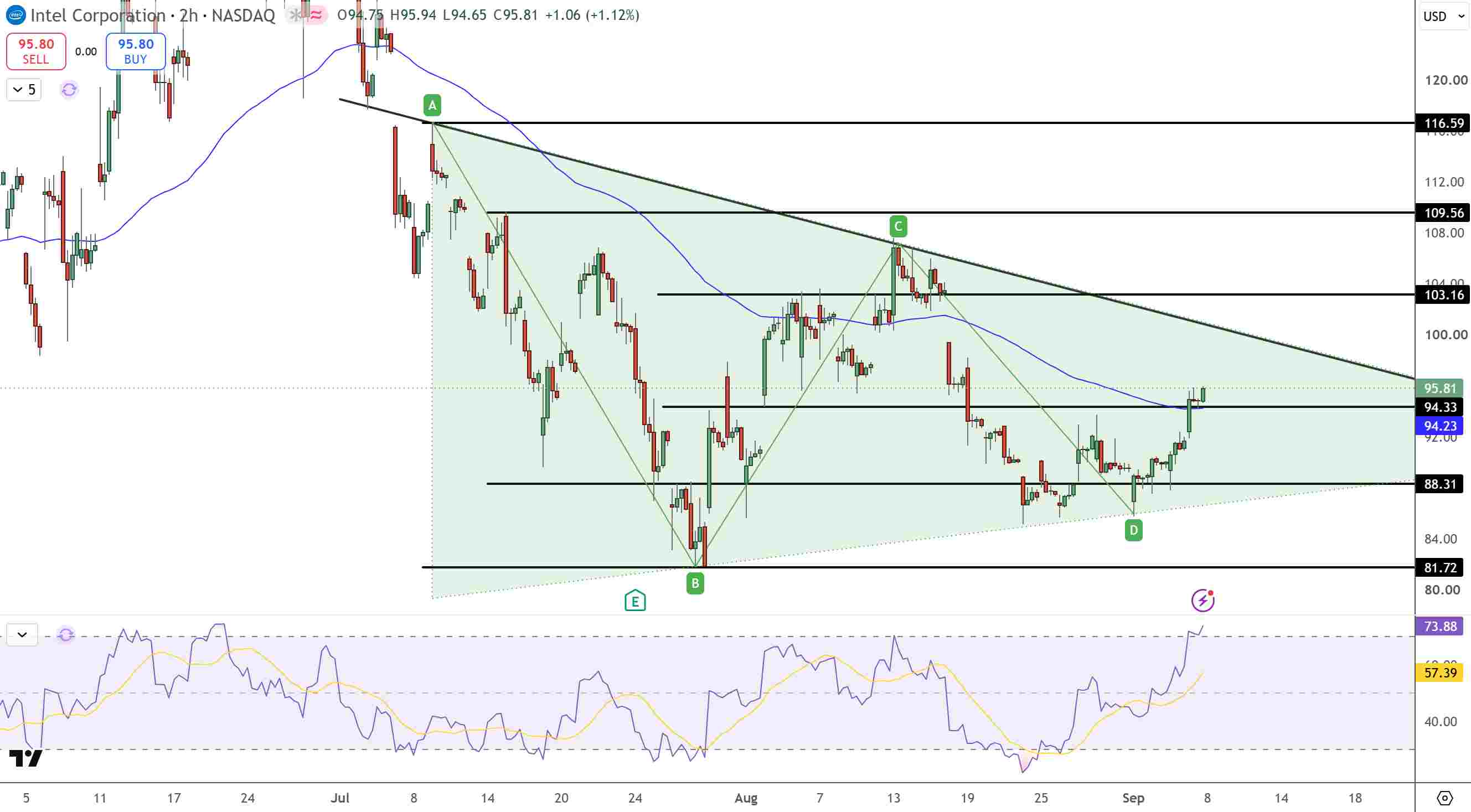
Intel Price Chart - Source: Tradingview
The next few candles will be crucial. If the stock manages to hold a 2 hour candle above $96-$97, we will have an established break out beyond the large contracting range and the stock price can potentially rise to $103.16 and $109.56.
RSI around 74 shows a strong bullish trend but is stretched. Consolidation or a retest is likely. For the bulls, we have $94.23-$94.33. The next support zone under that is $88.31. A break of that support zone will also give bears a chance at $81.72.
Key Levels
· Latest Completed Close: $95.80
· Breakout Support: $94.23-$94.33
· Major Support: $88.31
· Deeper Support: $81.72
· Breakout Resistance: $96-$97
· First bullish Target: $103.16
· Further bullish Targets: $109.56 & $116.59
· RSI: Around 74, overbought
Why is Intel stock in focus?
Improved demand for AI server CPUs is boosting revenue, improved margins, improved 18A/14A roadmap, and a stronger balance sheet after the $20B equity raise.
What level confirms another INTC breakout?
A breakout would be confirmed by a sustained 2-hour candle above $96 - $97.
Bottom Line
While Intel's dramatic turnaround does appear to be realizing at least some lingering skepticism around Intel will likely remain until these strategies are executed. Positive drivers include growing server demand driven by AI, improving margins, and progress with advanced nodes. In contrast, high dilution, heavy capital spending, and high competition present high risks. INTC maintains a bullish view while the range of $94.23 to $94.33 holds; above that is $96 to $97, which must be broken before the bullish trend is confirmed and $103 to $110 becomes the next target.
Recommended Articles






Comments (0)
Click the $ button, enter the symbol, and select to link a stock, ETF, or other ticker.