


NVIDIA Beat Revenue and Guided to $108B - Can NVDA Hold Its Post-Earnings Breakout?



AI Podcast


NVIDIA reported robust fiscal Q2 revenue of $96.2 billion, up 106% year-over-year, alongside strong Q3 guidance of $108 billion, driven by surging Data Center demand. Strategic expansions, including a major AWS deployment agreement and a reported Hugging Face acquisition, bolster its growth outlook. However, risks persist regarding gross margins, component costs, and customer financing structures. Technically, the post-earnings rally broke above the $214–$215 resistance zone. Sustaining this breakout targets $221 and $229, whereas failing to hold this level risks reviving the prior bearish trend toward the $209 pivot.
NVIDIA Beat Revenue and Guided to $108B - Can NVDA Hold Its Post-Earnings Breakout?
TradingKey - On August 26, NVIDIA closed at $209.66, down 1.6% for the day. Even before earnings were released, buyers had already started to come back into the stock. For the current fiscal year's second quarter, total revenues increased by 106% year-over-year to $96.2 billion, Data Center sales increased by 117% to $89.0 billion, and management guided for a $108 billion revenue target in the current fiscal year’s third quarter. NVIDIA’s results serve to confirm the growing demand for AI services. With NVIDIA's results still fresh, the key focus for many traders will be if the post-earnings market action will help establish the upside break of what was, prior to the release of the earnings, a classic downtrend.
Q2 Beat Confirms AI Demand Is Still Accelerating
Fiscal Q2 2027 numbers came in at $96.2 billion, representing 18% sequential growth and 106% growth year-over-year. Data Center sales grew to $89.0 billion and were up 117% year-over-year. GAAP EPS was $2.46 and non-GAAP EPS was $2.22, both GAAP and non-GAAP gross margins were 75.0%. NVIDIA clearly beat expectations and surprised the market with strong results in both revenue and guidance.
In the market's view, however, the real surprise was provided in the new guidance. NVIDIA’s management said that they expect NVIDIA’s revenues for the next fiscal year ending January 2028 to grow by about 70%, which translates into a growth rate for the year that is substantially higher than the 44% growth rate that analysts forecasted. This establishes a new dominant concern for the market’s new focus: whether or not NVIDIA can manage to satisfy the growing demand for their services at growing revenues while at the same time protecting its margins.
AWS, Rubin and Hugging Face Expand the Growth Story
AWS and NVIDIA have announced that they will deploy an additional 2 million NVIDIA GPUs to AWS datacenters during 2027 and 2028. The agreement spans Blackwell Ultra, Rubin and Rubin Ultra GPUs, Vera CPUs, networking solutions, Nemotron open models and workloads that integrate physical and AI. One of the first examples to show that hyperscaler AI spending will remain high even with increased spending and energy costs.
Vera Rubin is the next major product cycle and they are ramping Rubin into full production. NVIDIA relies on rapid architectural changes to keep customers buying their products rather than forgetting to buy the next generation.
On August 27th, Reuters reported, citing The Information, that NVIDIA has agreed to buy Hugging Face for $12.9 billion. NVIDIA and Hugging Face had not released statements of their own confirmation at the time of writing and the deal would still be consider a report rather than a closure. If the news is confirmed, it will expand NVIDIA beyond hardware to include AI models, datasets and developer tooling.
Margins and AI Financing Are the Main Risks
This earnings beat does not eliminate NVIDIA’s major concerns. Rapidly increasing memory and component costs and NVIDIA’s own supply constraints mean strong demand gives the company pricing power, potentially pressuring gross margins as Rubin systems scale.
NVIDIA is also becoming financially tied to the infrastructure purchasing its chips, and large financing commitments, lease-support structures and investments mean customers can expand capacity. However, such structures increases the investors' concerns about whether AI data centers will generate the returns they deserve. For example, China is also still uncertain because of export restrictions that limit Data Center compute revenue from that region.
Technical Setup: Earnings Move Challenges the Descending Channel
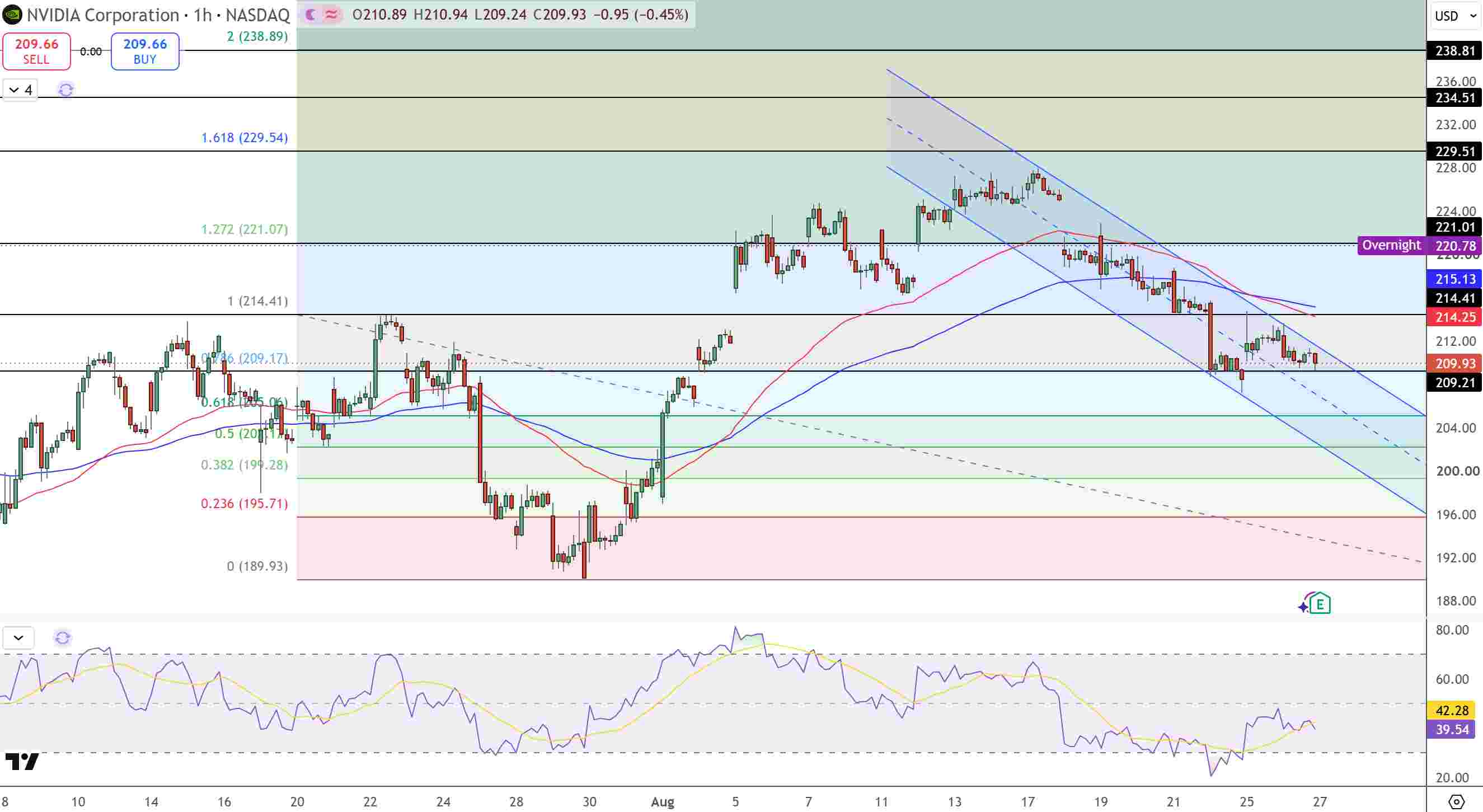
Per the 1-hour chart, NVDA was in a descending channel at the $209.93 level, with the $209.17-$209.21 area acting as support and the 78.6% Fibonacci retracement level. This was valid until the close on August 26 at $209.66, however the post earnings rebound changed the dynamics of the channel as NVDA moved above the resistance zone of $214 to $215 in after hours trading.
NVIDIA Price Chart - Source: Tradingview
If NVDA holds this morning's breakout after the open, the prior bearish channel structure will have been lessened, and $221.01 becomes the first major level of interest. This will be followed by $229.51. If NVDA starts to fall after the positive post-earnings reaction fades after the opening bell, selling pressure will resume, and $209.21 will again be the key pivot.
A breakdown of $209.21 will indicate bearish pressure, and expose $205.06-$202.11, and $199.28. RSI in the pre-earnings chart, at around 40, shows pressure and is not oversold, but because of the earnings gap, we will need to see where the stock is trading during normal trading sessions to assess the momentum..
Key Levels
- Latest regular close: $209.66
- Immediate pivot: $209.17-$209.21
- Breakout confirmation: $214.25-$215.13
- First upside target: $221.01
- Higher resistance: $229.51
- Near support: $205.06-$202.11
- Deeper downside levels: $199.28 and $195.71
- Pre-earnings RSI: Around 40, bearish but not oversold
Why did NVIDIA stock move after earnings?
NVIDIA has reported $96.2 billion revenue for Q2 and guided Q3 sales to $108 billion. Management's longer-term outlook, combined with the Data Center growth of 117%, shows that management expects AI infrastructure spending to remain strong.
Is NVDA still bearish below $215?
The pre-earnings chart was bearish below $214-$215. NVDA has rallied in the extended hours and has broken above this zone. A continued hold above $214-$215 in the regular session would alter the bearish channel. Failure to hold above this would restore the previous bearish trend and bring $209 back into focus.
Bottom Line
NVIDIA had the Q2 results to sustain the valuation for the AI focus. The growth of Data Center sales reached $89 billion and was the first time Q3 guidance crossed above $100 billion. The combination of AWS's purchase of 2 million GPU and the reported acquisition of Hugging Face and the support of Rubin, have created a positive value for NVIDIA's stock. Investors and traders should pay close attention to the $214-$215 price zone. Holding above the zone would create an earnings rebound and support the breakout toward $221 and $229. Failure to hold above this price zone would open the $209-$202 price zone and create a support zone for NVIDIA's stock.
Recommended Articles












Comments (0)
Click the $ button, enter the symbol, and select to link a stock, ETF, or other ticker.