


Nvidia Plans to Acquire This AI Platform for $12.9 Billion: What Is Hugging Face?



AI Podcast


On August 26, US Eastern Time, reports indicated Nvidia agreed to acquire open-source AI platform Hugging Face for $12.9 billion. This strategic move secures a vital developer touchpoint, reinforces Nvidia’s open-source ecosystem, and expands its software services. However, the hefty valuation—86 times annual revenue—poses cash flow pressures and balance sheet risks. Furthermore, critics question Nvidia's aggressive AI investments, raising circular financing concerns, while potential losses in platform neutrality and cultural integration challenges remain key hurdles for the acquisition's long-term success.
TradingKey - On August 26, US Eastern Time, according to the latest report from The Information, people familiar with the matter said that Nvidia (NVDA) has agreed to acquire Hugging Face for $12.9 billion. If finalized, this would become one of Nvidia's largest acquisitions in recent years.
What Kind of Company Is Hugging Face?
Hugging Face is the world's largest open-source AI model aggregation platform. The company was co-founded in New York in 2016 by Clément Delangue, Julien Chaumond, and Thomas Wolf.
In 2018, the team open-sourced the Transformers natural language processing library, after which the company shifted its focus toward hosting and collaboration for open-source models.
The company's core product, Hugging Face Hub, allows developers to upload, download, fine-tune, and compare various open-source AI models. According to official disclosures and related reports, as of early 2026, the platform had over 13 million registered users, hosting approximately 2.5 million models and 950,000 datasets.
In terms of business model, enterprise users requiring private deployment, advanced security, or dedicated support must pay for subscriptions. Currently with over 2,000 paying customers, its annualized revenue surpassed $150 million in the first half of 2026. Major tech companies including Google (GOOGL), Amazon (AMZN), and Microsoft (MSFT) are among its investors or key partners.
At the end of 2025, Hugging Face rejected a $500 million investment offer from Nvidia, when the company was valued at approximately $7 billion, citing concerns that a controlling investment by Nvidia would compromise its neutral stance.
Why Nvidia Wants to Acquire Hugging Face
The strategic value of Nvidia's acquisition of Hugging Face goes far beyond $12.9 billion.
First, it secures a critical touchpoint with AI developers. The Hugging Face platform brings together the world's most active community of AI engineers. Following the acquisition, Nvidia can integrate its chips and software toolchains more tightly into the platform, guiding developers to favor Nvidia's hardware solutions in their daily work. These habits and reliance built from the development side serve as a crucial foundation for Nvidia's continued dominance in the AI computing market.
Second, it counters competition from closed-source vendors. Nvidia management has repeatedly stated publicly that a thriving open-source model ecosystem is beneficial to its hardware business. Open-source models lower the entry barrier for small and mid-sized developers and research institutions, while the vast majority of platforms where these models run most efficiently remain Nvidia's GPU and CUDA software ecosystem.
As a result, even if some big tech companies invest resources to develop proprietary AI chips, as long as the mainstream toolchains in the open-source community remain deeply tied to Nvidia, a vast number of developers will prioritize Nvidia's platform rather than switching to immature alternatives.
Third, it rounds out its software and services segment. In recent years, Nvidia has clearly transitioned from a chip supplier to a comprehensive AI service provider. In 2026, the company continued to scale up investment in the AI software domain, including licensing technology from AI programming startup Poolside for $6 billion.
Acquiring Hugging Face provides simultaneous access to its developer platform and enterprise customer resources, far outweighing the time and resource costs required to build a platform from scratch.
Jensen Huang Directly Responds as 'Circular Financing' Controversy Heats Up
In addition to Hugging Face, Nvidia's investment footprint in the AI sector continues to expand. According to a report by The Information on August 24, Nvidia is in talks to participate in a new funding round for AI search startup Perplexity, which could value the latter at over $30 billion post-money.
Nvidia's aggressive investment strategy has also drawn scrutiny. Critics argue that Nvidia provides funding to AI startups, which then use the capital to purchase Nvidia GPUs. This pattern could artificially inflate market demand for Nvidia's products, leaving its revenue growth partially dependent on a self-created investment loop.
This controversy flared up again following the release of Nvidia's Q2 fiscal 2026 earnings report. During the earnings call, Nvidia CFO Colette Kress responded that Nvidia's investment decisions are based on independent commercial judgment, and portfolio companies purchase Nvidia products based on their own technical requirements, with no tie-in sales or mandatory procurement clauses between the two.
Jensen Huang further pushed back against this criticism on CNBC's "Mad Money." He noted that AI startups are the first generation of enterprises that require tens of billions of dollars in capital investment just to get off the ground, as training large models requires massive computing power—unlike any tech startup model in the past.
Huang believes the risks of these investments are manageable because the core assets of the portfolio companies are GPU compute clusters. Even if a company is poorly managed, this computing power can be reallocated to other customers without resulting in wasted resources.
What Does Acquiring Hugging Face Mean for Nvidia's Stock Price?
In the short term, the acquisition news was released concurrently with Nvidia's second-quarter financial results. Nvidia reported revenue of $96.2 billion for the quarter, up 106% year-over-year, with its after-hours stock price rising about 4.7%. However, because the price gain resulted from the dual impact of earnings and the deal, it is impossible to separate their respective contributions.
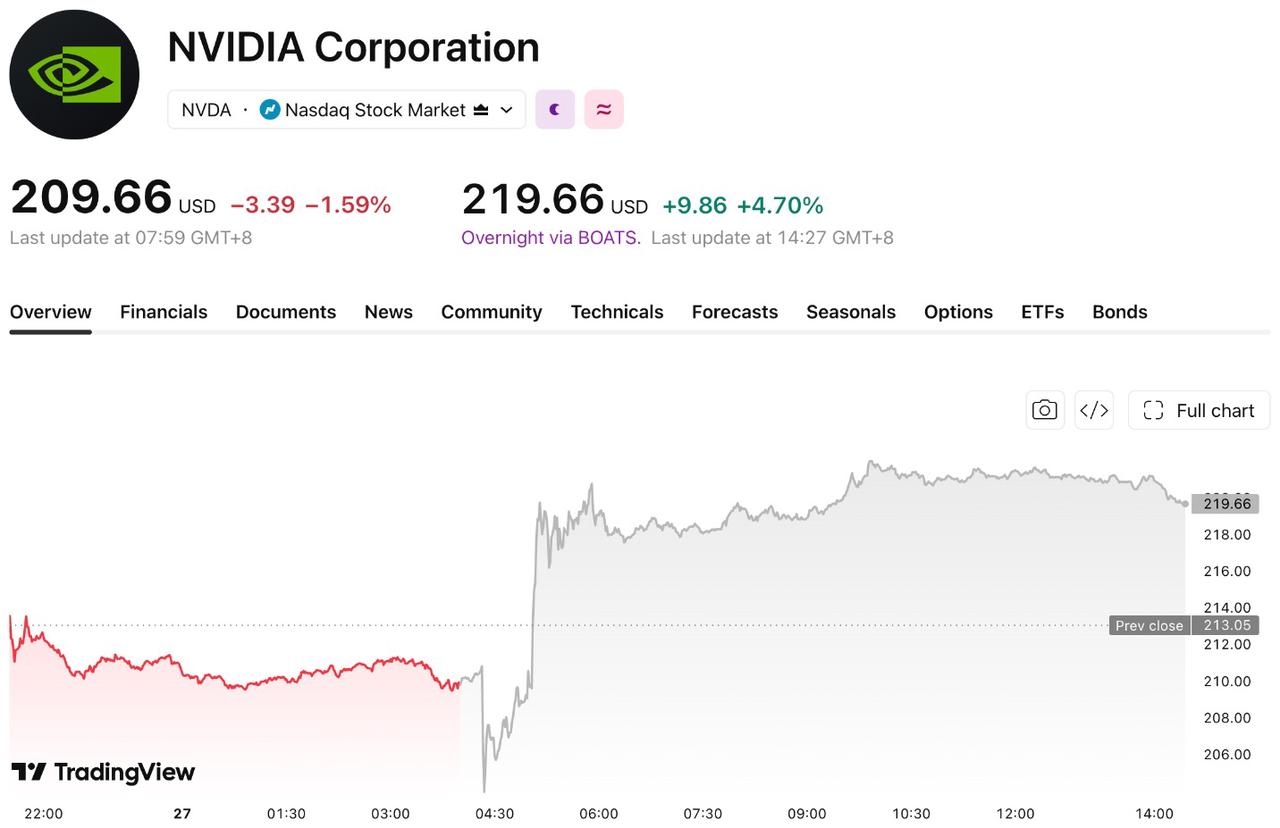
[Source: TradingView]
From a financial perspective, the $12.9 billion acquisition price represents 86 times Hugging Face's annual revenue ($150 million)—a hefty cost that will inevitably put pressure on Nvidia's cash flow and balance sheet.
Nvidia's willingness to pay a high price highlights the value it places on Hugging Face's strategic position within the developer ecosystem. Hosting over 3 million models and serving 13 million developers, the platform has become a key hub for open-source AI model distribution.
However, market concerns persist: if Hugging Face comes under Nvidia's controlling stake, its neutrality could be compromised, thereby affecting the willingness of other cloud computing vendors and chip companies to continue collaborating with it.
Furthermore, the founding team had previously rejected a $500 million investment offer from Nvidia, showing a firm commitment to independent operations, which poses cultural integration challenges following the acquisition.
In the medium to long term, if the acquisition is completed, Nvidia will extend its presence from the chip business to developer platforms, achieving broader coverage across the industry chain. However, whether the stock price can continue to benefit depends on whether the platform can retain developers and the approval stance of regulatory authorities.
As of publication, neither party has issued an official statement regarding the matter.
This content was translated using AI and reviewed for clarity. It is for informational purposes only.
Recommended Articles








Comments (0)
Click the $ button, enter the symbol, and select to link a stock, ETF, or other ticker.