


Nvidia Shares Fall Then Rise Over 4% Post-Earnings: What Signals Does the Wild Volatility Send?



AI Podcast


On August 26 Eastern Time, Nvidia experienced severe post-earnings volatility, initially dropping 3% before surging over 4% to near $220. While Q2 financial metrics exceeded expectations, Q3 revenue guidance fell short of the most optimistic forecasts, triggering short-term profit-taking. However, management’s optimistic outlook on AI demand and chip production during the earnings call drove a strong rebound. Analysts note that solid fundamentals remain intact, with the price swing acting as a sentiment-driven shakeout. Technically, bulls hold the advantage near the upper band, with a breakthrough above $228 required to signal a trend reversal toward all-time highs.
TradingKey - Nvidia Staged a V-Shaped Post-Market Reversal After Initial Drop: What Signals Does the Intense Volatility Send?
On August 26 Eastern Time, Nvidia (NVDA) experienced sharp volatility following its earnings release, initially plunging about 3% close to the $200 level before rapidly surging over 4% to near $220, not only erasing its losses for the week but also setting a new high since August 20.
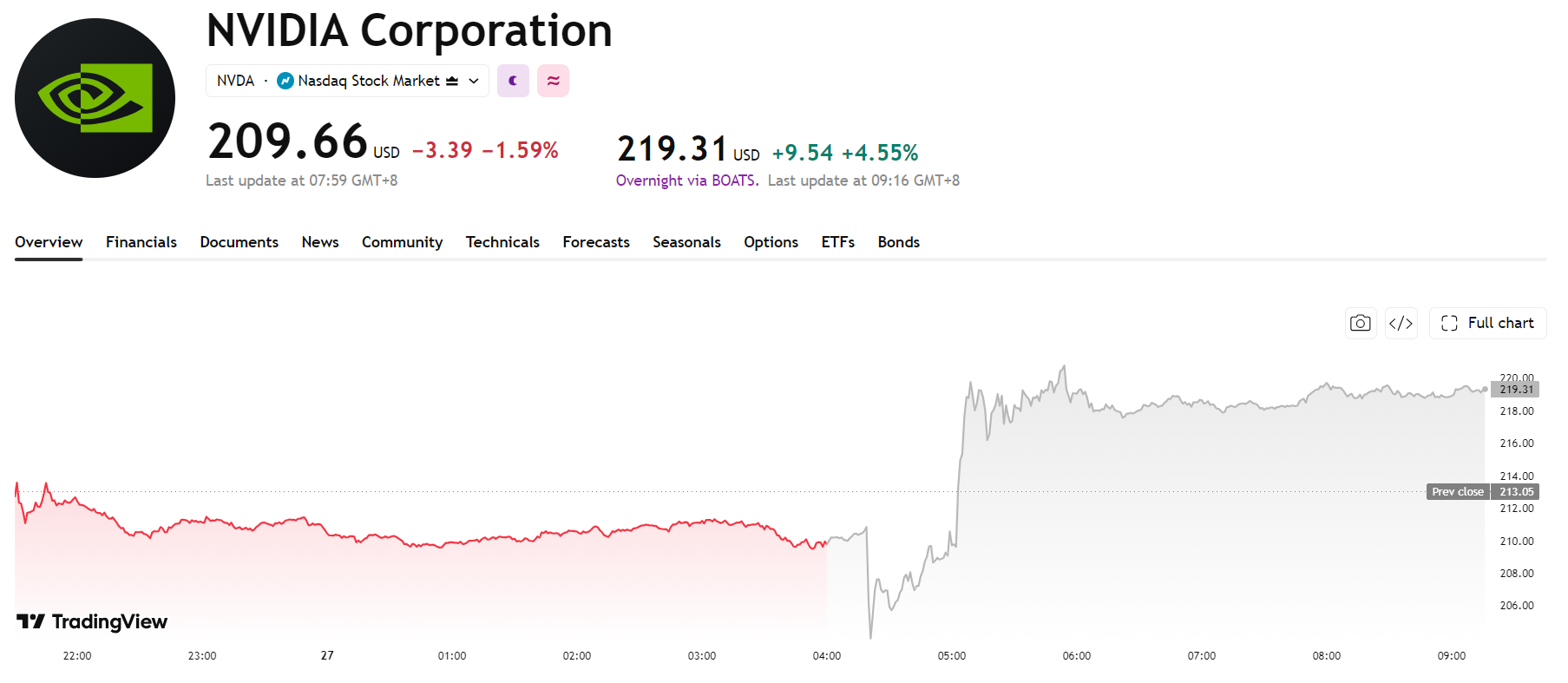
Nvidia Stock Price Chart, Source: TradingView
According to the released earnings report, key financial metrics including second-quarter revenue, data center revenue, and adjusted earnings per share all exceeded expectations, but third-quarter revenue guidance fell short of the most optimistic forecasts. Reportedly, the company expects third-quarter revenue to reach $108 billion, above the market consensus of $105.2 billion but below some expectations of $110 billion. This prompted some short-term capital to take profits immediately upon the data release, sending the stock price rapidly lower right at the open of after-hours trading.
However, as the earnings conference call began, executives including CEO Jensen Huang and the CFO reassured investor confidence with strong revenue guidance for the next quarter (Q3) and the full year, progress on the production ramp-up of next-generation chip architectures, and positive statements regarding the continuous expansion of AI demand, driving bargain-hunting buyers to enter and lift the stock.
The sharp "drop-first, rally-later" volatility in Nvidia's stock after earnings is not uncommon among high-profile mega-cap tech stocks, but excessively high market expectations have placed immense pressure on Nvidia. Analysts pointed out, "The challenge facing the company is no longer just delivering strong results, but outperforming performance that investors already expect to be stellar. In this scenario, beating Wall Street expectations is practically just the price of admission."
Currently, Nvidia's AI growth fundamentals remain solid, with no substantive fundamental inflection point emerging in the market. The sharp drop in stock price was primarily a short-term shakeout driven by sentiment and positioning, flushing out hot money chasing highs and short-term speculative capital during the dip, which is actually beneficial for the stock to continue rising.
From a technical analysis perspective, Nvidia's stock price rising to $220 places it in the upper band region with bulls holding the advantage, suggesting potential to continue rebounding in the short term. If it breaks through the previous high of $228, it would signify a trend reversal, helping bulls leverage the momentum to push toward the all-time high of $236.54 set on May 13 this year. However, if it fails to break through $228, it indicates that bulls remain concerned about its future, making the outlook for the second half of the year unoptimistic.
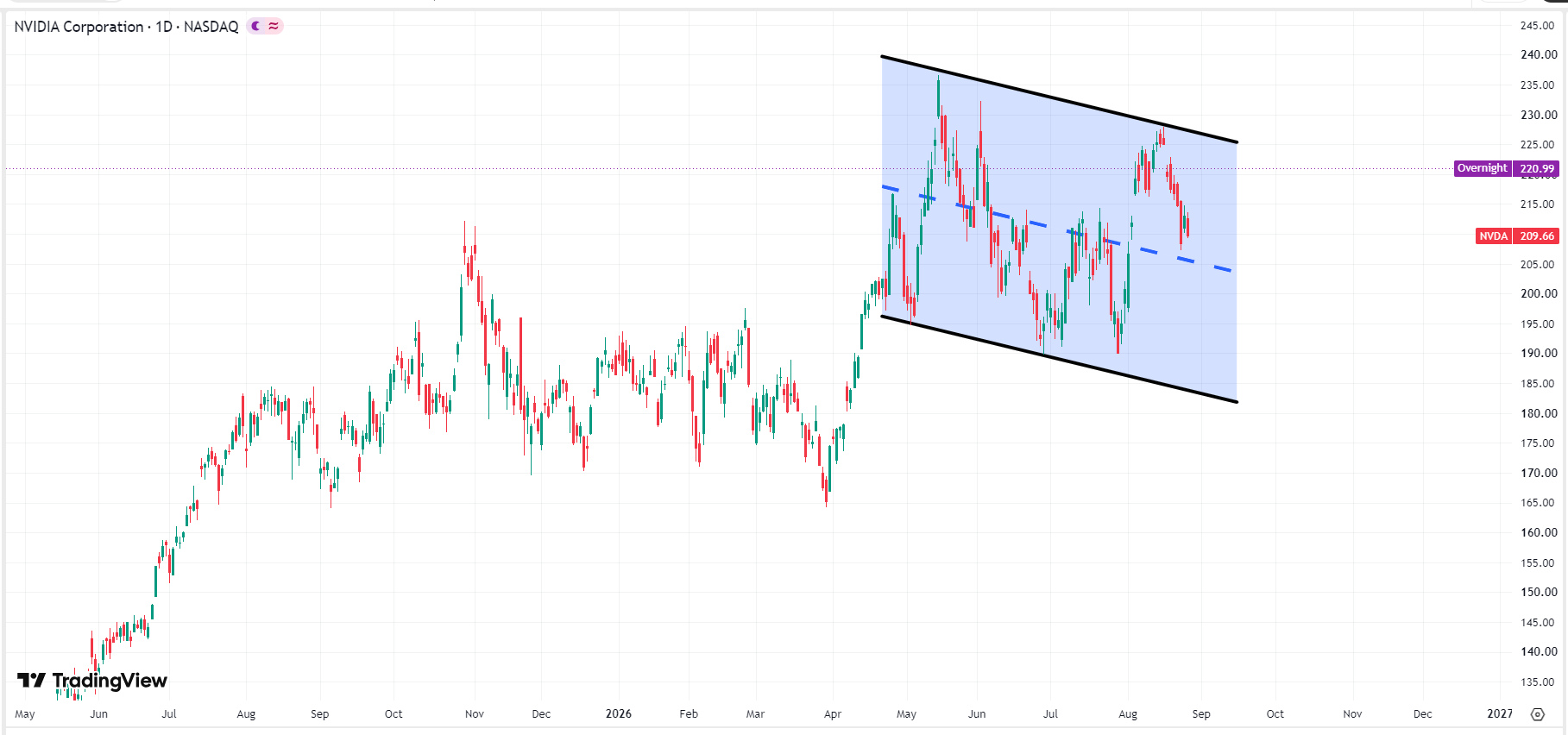 Nvidia Stock Price Chart, Source: TradingView
This content was translated using AI and reviewed for clarity. It is for informational purposes only.
Recommended Articles











Comments (0)
Click the $ button, enter the symbol, and select to link a stock, ETF, or other ticker.