


Why Masayoshi Son Put 67% of SoftBank's US Stock Portfolio Into Intel? INTC Stock Upside Potential Analysis



AI Podcast


SoftBank has become Intel’s largest U.S. stock holding, with Masayoshi Son capitalizing on a significant paper profit from an initial $23 per share entry. This investment aligns with SoftBank's strategic focus on physical AI infrastructure, leveraging Intel's unique domestic manufacturing and advanced process capabilities. While a recent $20 billion stock offering relieves financial pressure for fab expansion, it dilutes equity and pressures near-term valuation. Technically, INTC remains in a corrective downtrend, with $95–$97 acting as critical support. Long-term value depends on 18A mass production, external customer adoption, and translated profitability, suggesting retail investors should prioritize cautious position sizing.

TradingKey - Masayoshi Son is betting on the recovery of Intel (INTC) with a sizable investment.
According to SoftBank's 13F filing, as of June 30, 2026, Intel accounted for approximately 66.81% of SoftBank's disclosed U.S. stock portfolio, with 86,956,522 shares held and a market value exceeding $12 billion. It has completely surpassed Symbotic (about 9.85%) and T-Mobile US (about 9.23%) to become SoftBank's largest U.S. stock holding.
Notably, SoftBank did not begin its position after Intel's stock price surged. Intel previously disclosed to the SEC that it issued approximately 86.96 million shares to SoftBank at $23 per share in September 2025, for a total transaction value of $2 billion.
As of August 18, Intel's stock price closed at $96.69, down 6.58% on the day, but still up more than 155% year-to-date. Based on the initial investment cost of $23, SoftBank has already gained massive paper profits. Masayoshi Son has not trimmed his position to date, prompting the market to rethink: Is Intel's strategic value still not fully priced in?
Why Masayoshi Son Chose to Bet Big on Intel
Masayoshi Son has long favored companies that control the gateways to critical technology infrastructure. In the past, he bet on telecom networks, the mobile internet, and Arm chip architecture. Entering the AI era, his investment focus has gradually shifted toward underlying infrastructure, including computing power, wafer fabrication, advanced packaging, and data center chips.
From this perspective, Intel's investment value lies not only in its traditional CPU business. The company spans chip design, advanced process technology, wafer fabrication, and packaging technology, while boasting substantial domestic U.S. semiconductor manufacturing capacity.
Nvidia dominates the AI accelerator market, and TSMC commands world-leading foundry technology. What sets Intel apart is that it is one of the few U.S. semiconductor companies that simultaneously possesses advanced process R&D, large-scale production capabilities, and its own computing product lines. Such assets are difficult to replicate in the short term and align with SoftBank's strategic direction of positioning around "physical AI infrastructure."
More importantly, Intel is continuing to boost its capital investment. The company has already raised its 2026 capital expenditure forecast to over $20 billion and expects 2027 spending to be significantly higher. For a company that once struggled under the drag of its manufacturing business, this signifies that Intel is pouring massive capital into advanced process nodes, fabs, and packaging capabilities to compete for manufacturing orders that are becoming increasingly vital in the AI era.
$20 Billion Share Sale: Opportunity or Risk for Intel's Transformation?
Intel's recently completed $20 billion stock offering further reflects the massive capital required for this turnaround.
The company originally planned to issue approximately $15 billion in stock, but amid strong market demand, it ultimately upsized the offering to about $20 billion, priced at $95 per share. According to reports, the transaction generated over $100 billion in demand.
The large-scale stock offering increases the number of shares in circulation and dilutes existing shareholder equity, which is one of the main reasons Intel's stock price has come under pressure recently. However, from a long-term perspective, the fresh capital can alleviate the financing pressure from constructing fabs and advanced nodes, reducing the risk of the company relying excessively on debt financing.
At a critical stage when 18A needs to ramp up production and 14A needs to secure external customers, ample cash reserves may be more important than short-term earnings per share. Institutions such as UBS believe that this capital raise helps alleviate investor concerns over Intel's financial condition and provides support for the continued expansion of its foundry business.
Of course, the financing itself does not guarantee Intel's success. If fab construction continues to burn cash without securing orders of sufficient scale, the newly raised capital could instead become a burden on long-term returns.
Intel Stock Technical Analysis: How Much Further Can INTC Rise?
Source: TradingView
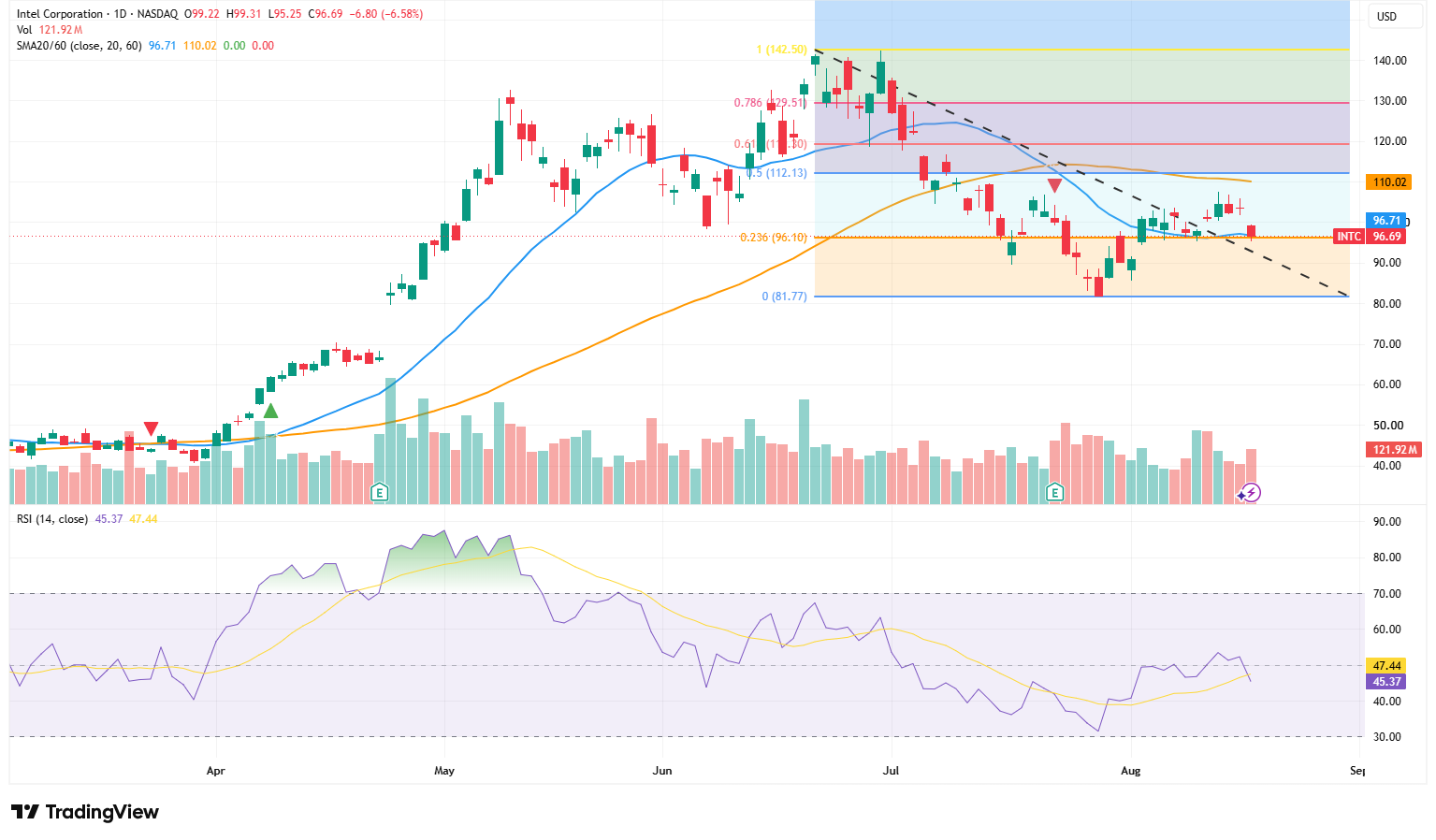
Looking at the daily chart, INTC has continued to pull back after touching a high of $142.50, forming a downtrend structure with lower highs and lower lows. The stock price recently rebounded from $81.77 to around $105, but failed to break above the downward trendline, and subsequently retreated again to $96.69 on the 18th. This indicates that the previous advance was still a corrective move within a downtrend, and a medium-term reversal has not yet been confirmed.
The most critical level currently is $95–$97. The 23.6% Fibonacci retracement level stands at $96.10 and the 20-day moving average is at $96.71; both closely align with the current price to form a short-term support zone. If the stock can hold this area, it could rebound toward $100–$105 again; if it decisively breaks below $95 on the daily chart, it may slide further to retest $90 or even the previous low of $81.77.
The moving average structure remains weak. Although the 20-day moving average has flattened, the stock price stays below the 60-day moving average of $110.02, which continues to slope downward, indicating that medium-term market cost bases are still falling. Only if the stock price breaks back above $105 and the downward trendline, and further establishes a firm footing above $110–$112, will the overall trend show clear signs of improvement.
Initial resistance above is concentrated at $100–$105, with around $105 corresponding to the 38.2% Fibonacci retracement level and the previous bounce high. A breakout on heavy volume could open the door to $110–$112; upon a further breakthrough, the stock is poised to challenge $119.30 and $129.51.
Summary: Is Intel Stock Worth Buying Now?
Intel still holds long-term investment value, but following this year's stock rally, now may not be a low-risk entry point to chase the gains.
Masayoshi Son's heavy position in Intel is a bet on its long-term strategic value in U.S. advanced process nodes, AI chip manufacturing, and packaging industries. SoftBank's entry cost of around $23 provides a high margin of safety, but for retail investors buying near $100, the risk-reward structure they face is markedly different.
Whether Intel's stock price can continue to rise mainly depends on the progress of 18A mass production, external customers for 14A, fab utilization rates, gross margins, and free cash flow. If the foundry business smoothly secures orders, the $20 billion financing could serve as a momentum driver for transformation; if capital expenditures continue to rise without translating into profitability, share dilution and valuation pressures will become even more prominent.
Therefore, rather than replicating SoftBank's concentrated position, retail investors are better served managing their position sizes and waiting for operational improvements to truly translate into sustainable cash flow.
This content was translated using AI and reviewed for clarity. It is for informational purposes only.
Recommended Articles









Comments (0)
Click the $ button, enter the symbol, and select to link a stock, ETF, or other ticker.