


Meta Q2 Strong But FCF Collapses 91%: Youth-Safety Trial Begins Today as Iris Chip Ramps September



AI Podcast


Meta reported strong Q2 revenue of $60.8 billion, driven by robust advertising fundamentals. However, aggressive capital spending on AI infrastructure caused a 91% collapse in free cash flow to $784 million and compressed operating margins to 31%. Management raised full-year capex guidance to $130B–$145B, committing heavily to data centers and custom silicon like the upcoming Iris chip. Compounding these financial pressures, Meta faces a significant youth-safety trial involving 29 U.S. states, threatening potential product changes and regulatory penalties. Technically, the stock remains in a bearish structure, testing critical support at $560 amid waning investor confidence.
TradingKey - Meta (META) posted $60.8B in second quarter revenue, a 28% increase over last year’s results. The upward trend in the Family of Apps advertising engine is impressive, but plummeting free cash flow from $7.8B to $784M sheds light on growing capital spending for AI. Management now forecasts full year capital spending at $130B-$145B, more than double most companies in the Fortune 500. Beginning August 18, Meta will face a large, potentially precedent setting, U.S. trial to address youth safety concerns for which 29 states have aligned. Investors know that Meta has outperforming ad revenue. The concern now is if Zuckerberg’s record breaking $130B+ investment in AI over the next 12 months will impact Meta’s ability to fund its superintelligence initiatives and metaverse. There will be a chip providing AI functionality, called Iris, launch in September. Additionally, there is a likely drop in investor confidence considering the frustrating lack of progress in the execution of Meta’s ambitious plans, especially after the Jackson Hole Symposium, which will be held from August 21-22.
Q2 Advertising Fundamentals Remain Exceptional: +28% Revenue, +14% Impressions, +12% Price
At $60.8B, an increase of 28% year over year, Meta outperformed shipping Q2 revenue expectations. Almost the entirety of Meta’s revenue comes from advertising. Th business helped Meta improve ad impressions by 14% and ad pricing by 12%. The Family of Apps Active People totaled 3.60B, a 3% year over year increase. Expectations for Q3 revenue are in the $61B to $64B range, with a midpoint of $62.5B, which sustains the momentum for strong growth.
The bull case, distilled: Meta continues to own one of the world's biggest digital advertising networks reporting almost 60 billion cash flow per quarter. Impression growth at 14% and price growth at 12% are unique because Meta can continue to monetize and grow its advertising inventory at scale.
But Expenses Jumped 55%: Operating Margin Compressed to 31% From 43%
The big problem: total expenses for Q2 came in at roughly 42 billion, down 8% from the operating income to 18.8 billion and an osrrising operating margin from 31% to 43%. An 14% net income fell to 15.85 billion and diluted EPS fell 13% to 6.18. This structural problem stems from the fact that revenue growth of 28% has outpaced 55% growth in expenses. This is not viable math and eventually management must either truly have significant commitment to once in a lifetime growth in infrastructure whereby CapEx will grow exponentially and reversibly for a brief period; OR, preferably, operate with the hope that earnings growth will return and reaccelerate.
Free Cash Flow Collapsed 91%: $784M Q2 (vs. $8.55B YoY)
Free cash flow fell 91% from $8.55 billion to $784 million in Q2, and capex spending of $31.1 billion in Q2 explains this decline. As his top priority, Zuckerberg funnels nearly all of the incremental cash generation to AI infrastructure. Management increased their projected full-year capex spending to be in the range of $130B to $145B, an increase from their previous range view of $125B. Putting that into context, this means capex spending will be around 2 to 2.4x of revenue per quarter, which is extreme for any technology company.
The Real Commitment: $279B Uncommenced Leases + $68B July Additions
Metas reported spending on capex significantly underestimates the real spending on the company's infrastructure. $279 billion of uncommenced operating and finance lease commitments and Reuters reporting that $68 billion of data-center leases signed in July, increased the company's obligations even higher, fully commits Meta to obligations that will nearly ensure the supply of power, land, and buildings for many years, as well as Chips and networking, all before the money is spent.
Iris Custom AI Chip Production Starts September: September Catalyst
Meta has targeted September 2026 for the mass production of its "Iris" custom AI accelerator. Part of Meta's MTIA division, development of the chip was done in collaboration with Broadcom and manufacturing was contracted to TSMC. Meta is said to be developing a new in-house AI processor every 6 months or so until 2027. The idea is not to supersede NVIDIA and AMD permanently, but to consolidate some of the tasks done by said vendors and reduce dependence on merchant suppliers. Custom silicon is a major component of Meta's return-on-capital story.
Hyperion Louisiana Data Center: 5GW, $50B+, Doubles to 14GW by 2027
Meta's Hyperion data center in Louisiana has reached 5GW of computing capacity and reached US $50B+ in investment. 5GW of computing capacity corresponds to consumption at the level of a metropolis. Meta projects that by the end of 2026 they will have 7GW of computing capacity, and by 2027, they will have 14GW. That 5GW growth in less than two years would be unprecedented in the industry. Cash outlays will continue to be significant as14GW of computing capacity requires the fastest expansion of AI infrastructure.
Youth-Safety Trial Opens TODAY (August 18): 29 States Seeking Product Changes
The most timely of the other risks is that Meta, along with 29 U.S. states, begin a lawsuit on August 18, which will be the largest case to date that will decide whether social media companies have aided the harm of young users. The states will be seeking to force Meta to make product changes including age filters and limit features such as endless scrolling. The damages for Meta could total US$ 1.4 trillion, although no state attorney general's office has set a dollar value to their claims.
In New Mexico a recent case determined Meta pay US$ 567 million and make product changes. The larger state case may influence changes beyond the financial penalties. If courts force significant product changes, participation and advertising economics would be impacted.
AI Is Already Improving Advertising, But Monetization Is Years Away
Meta's AI bet isn't a complete gamble. AI-based recommendation systems decide what users see in their feeds for both Instagram and Facebook as well as Meta’s newly launched Threads. Better recommendations lead to users spending more time on the apps. Meanwhile, Meta has also been developing AI tools for advertising. With a 14% growth in impressions and a further 12% growth in cost per impression (CPI), which can be interpreted as a successful advertising campaign, we imagine that these tools must have been utilized to some extent.
That said, the massive construction of AI-based systems (estimated at 14 GW in 2027) will not create profit until years after the infrastructure is fully built. While Meta waits for new revenue streams from custom silicon and cloud computing to be sold, as well as potential profit streams from AI products, they still have to eat the construction costs with a less than stellar return on investment (ROI) in the near future.
Technical Analysis: META at $568.91, Testing $560 Support, Bearish RSI 39
On the 4 hour chart, META is trading at $568.91. Recently, META formed a rejection off the descending trendline. Below, META has been trading with lower highs since the peak at $680 in July. Support is located at $560.23. A break of this level would open $541.45 and $524.93. Price action must hurdle $594-600, which is a critical level of confluence for the major moving averages, to put an end to the bearish structure in the short term. The RSI is at a low level of 39, below the signal level of 48, pointing to a lack of demand, but not yet oversold. The bias remains bearish below the critical level of $594-600.
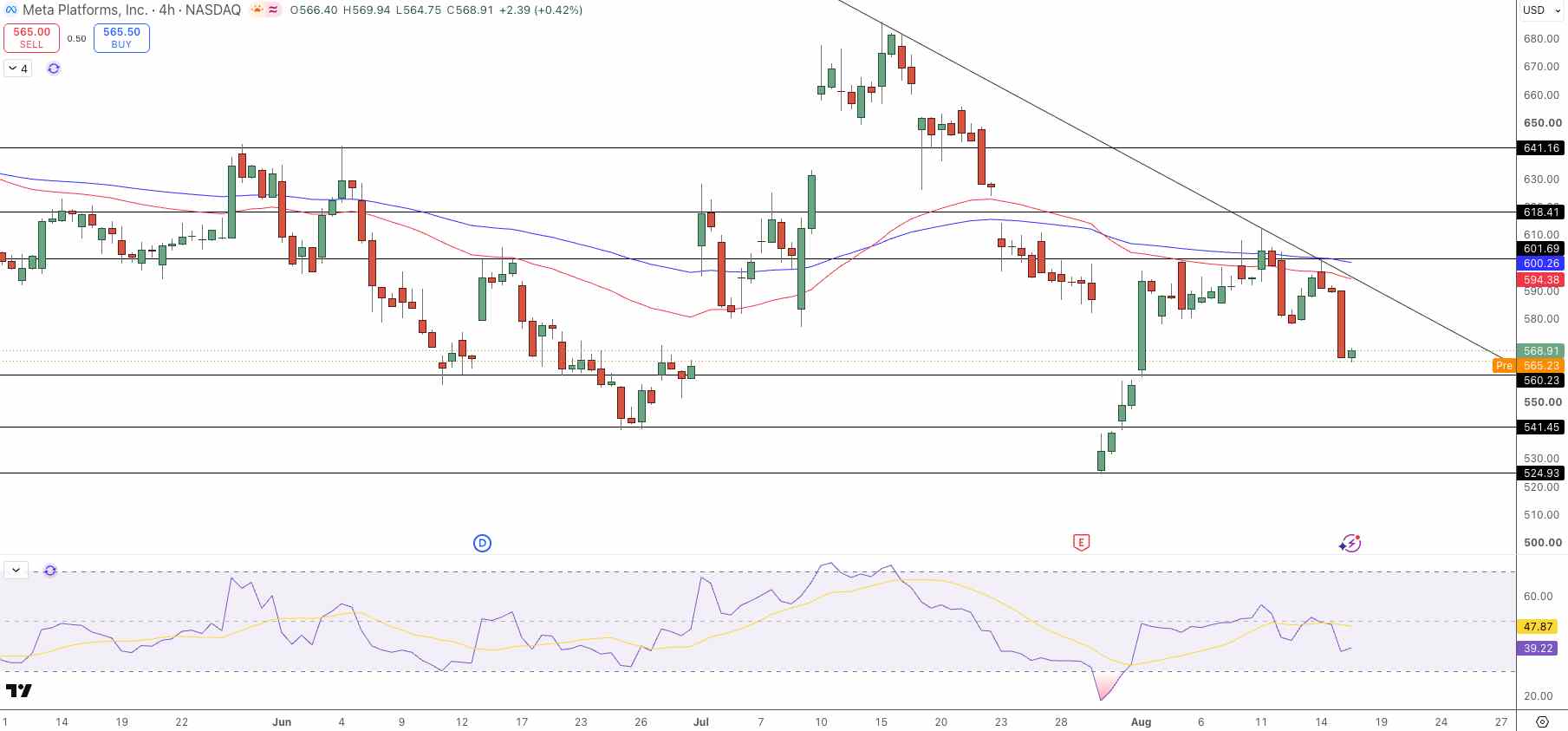
meta Price Chart - Source: Tradingview
Key Technical Levels (Through September & Jackson Hole)
Support is located at $560.23. A break of this level opens $541.45 and $524.93. To change the sentiment from bearish to neutral, price action must hurdle the resistance in the $594-$600 moving average cluster, with further resistance levels above at $601.69, $618.41, and $641.16. The RSI is currently at 39, below the signal at 48.
Bottom Line (Aug 17, Sunday Perspective)
Meta Q2: $60.8B revenue (+28%), impressions +14%, price +12%, DAP 3.6B. Advertising engine very strong. Expenses +55%, FCF -91% to $784M, capex $130-145B, $279B lease commitments. Iris chip launches September. Youth-safety trial opens today (Aug 18) — 29 states seeking product changes. Technical: META at $568.91, testing $560, bearish RSI.
Meta's years of businesses subsidizing advertising spending could predictably slow their AI buildout. The safety test for teens could fuel adjustments in their products. A launch in September will show if product custom silicon solutions cut costs. By next August we will know if the confidence to spend on the company has lasting effectiveness.
For investors: The strong advertising fundamentals that Meta relies on for growth are legitimate, however, the contradiction of high levels of spending capital and the growing claim in fast cash returns (cash flow) will be the focus, especially in September. The advertising safety test for the teen accounts will determine the spending trends for the fall if product changes do not happen. Investing in META should be avoided until the funding issues become more clear because of the potential downward pressure on the price of the stock.
Recommended Articles







Comments (0)
Click the $ button, enter the symbol, and select to link a stock, ETF, or other ticker.