


Lumentum Stock Forecast: Can Nvidia Demand Push LITE Above $1,000?



AI Podcast


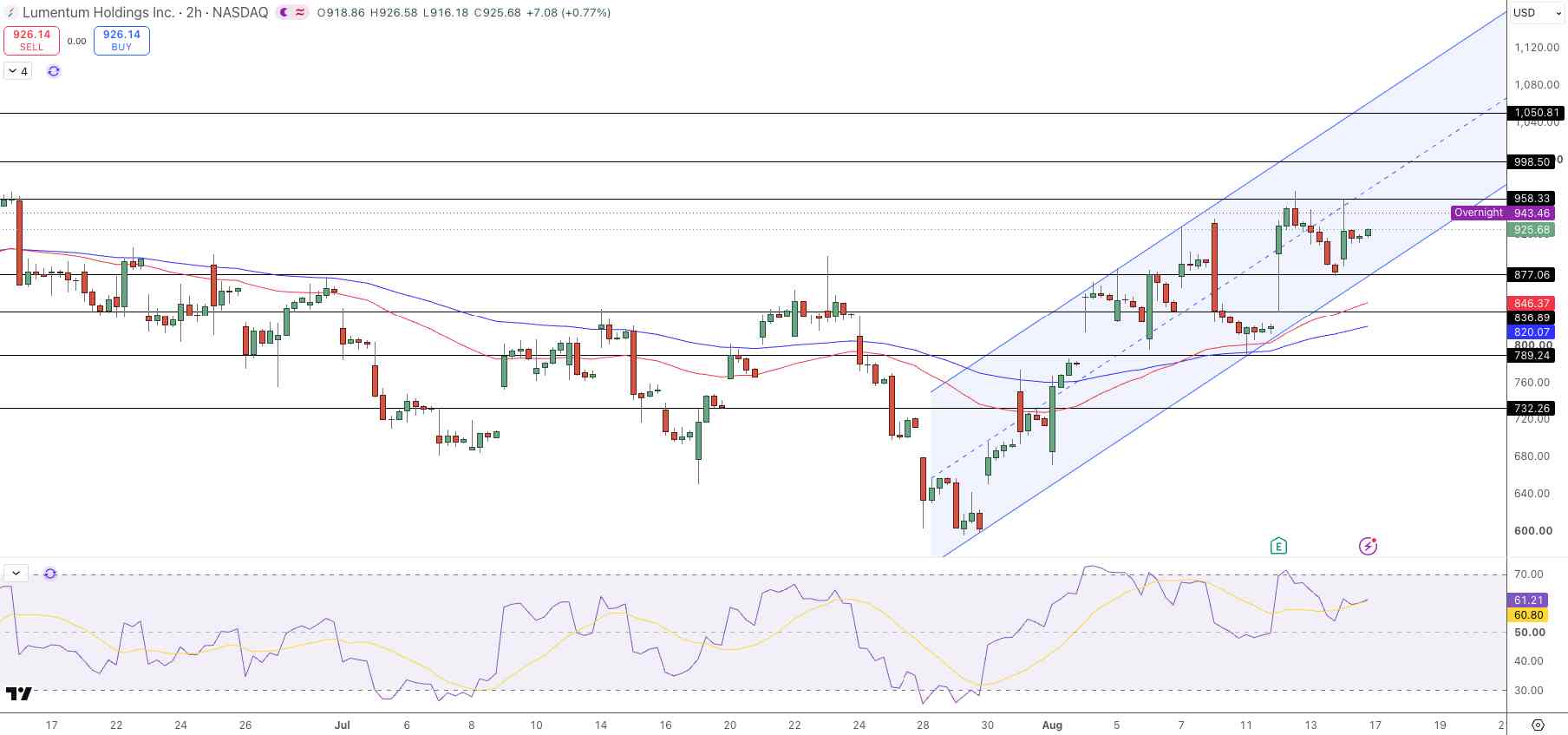
Lumentum Holdings reported robust fiscal Q4 results, with revenue surging 109% year-over-year to $1.006 billion and adjusted EPS jumping 267% to $3.23, driven by explosive AI infrastructure demand. Strong guidance for the upcoming quarter highlights momentum in 1.6T transceivers and a strategic $2 billion partnership with Nvidia. Despite margin outperformance, key risks involve production capacity constraints, raw material supply restrictions, and high customer concentration. Technically, the stock is testing a major resistance at $958.33, with a potential breakout targeting $998.50, while strong foundational support remains near $877.06.

TradingKey - Lumentum Holdings (LITE) reported WM FY22 Q4 results that confirmed optical networking is a foundational segment of AI infrastructure. Revenue for the period was $1.006 billion, representing a 109% YoY increase. Adjusted EPS for the period also increased by 267% to $3.23.
Management expects to also report another sequential increase for WM FY23 Q1, guiding to revenue of approximately $1.25 billion. Nvidia has confirmed the positive outlook for the industry with their recent $2 billion extension of their technology partnership with Lumentum, as well as their large purchase commitment.
LITE has recovered from almost $600 on late July to almost $925 and is now approaching a major resistance at $958.33. The company is growing quickly, but the current valuation is projecting Lumentum can exponentially grow production, secure needed components, and retain major customers.
Q4 Revenue and Margins Exceeded Expectations
Fiscal Q4 revenue was reported at $1.006 billion, representing a 109.3% YoY increase and a 24.5% sequential increase. This not only surpassed the consensus of approximately $988 million, it also exceeded the expectations of investors. Adjusted EPS of $3.23 surpassed expectations of $2.97 and was a large improvement from the $0.88 EPS reported for the same period a year prior.
GAAP gross margin was reported to be 47.4%, an improvement from the prior year’s 33.3%. Non-GAAP gross margin was reported at 50.4% as compared to Non-GAAP gross margin of the prior year at 37.8%. Adjusted operating margin was reported at a strong 36.6% as compared to 15%, the prior year’s adjusted operating margin.
Lumentum previously stated they would reach a 50% gross margin when quarterly revenue reached approximately $2 billion. Reaching that goal with revenue reported at approximately $1 billion also suggests that management may have underestimated the potential for pricing, manufacturing efficiency, and the shift to higher-value optical products.
Fiscal Q1 Guidance Points to Continued Growth
Lumentum anticipates fiscal Q1 2027 revenue to be between $1.225 billion and $1.275 billion. At the midpoint of $1.25 billion, this is above the analyst consensus of $1.16 billion and would indicate a 24% jump from the year prior.
Analysts expect adjusted earnings for the quarter to be around $3.61, but Lumentum has provided guidance of $4.05 to $4.35 along with a non-GAAP operating margin of 39.5% to 40.5%.
For fiscal 2026, revenue grew by 83.2% to $3.014 billion from $1.645 billion. Within this revenue growth, systems sales grew about 91% compared to a 80% growth in component sales.
Based on the guidance, the strong demand that characterized last year's sales has apparently continued into this year as well. Lumentum will have to balance strong orders and margins with the challenges of increasing production and meeting high order volume.
Nvidia’s Investment Addresses an Infrastructure Constraint
Nvidia invested $2 billion into Lumentum in early March via a $2 billion investment in preferred stock. In addition, the two companies entered a long-term contract for advanced optical technologies and capacity, as well as a significant obligation by Nvidia to purchase from Lumentum.
Nvidia is supporting Lumentum’s research and manufacturing as well as U.S. manufacturing of a planned fabrication facility. The collaboration is beneficial to Nvidia because large AI systems require large numbers of accelerators connected by even faster and more efficient systems.
Electrical copper connections begin to show signs of diminishing returns as the distance and power requirements increase. Optical systems transport data via light and consume much less energy while transferring data over longer distances and with higher bandwidth.
By making a direct investment in Lumentum, Nvidia is helping to expand the supply of components for its Blackwell and Vera Rubin systems. For Lumentum, the agreement provides demand certainty while Nvidia has much more confidence of availability of optical capacity.
NPO and CPO Could Expand the Market
Moving beyond conventional transceivers that connect data center rack, Lumentum has begun to fulfill initial orders of external laser source modules and is working on many projects for near-packaged optics or NPO.
CPO or co-packaged optics, move optical components even closer to networking silicon and accelerators, which improves bandwidth consumption and power efficiency.
Should optical components move along racks and get even closer to individual processors, the number of optical components in a single AI system can potentially grow exponentially. This would significantly increase the addressable market for Lumentum even if the overall accelerator shipment growth rate begins to slow.
They are all early-stage technologies. Potential investors must understand the differences between current revenue streams from existing optical products and longer-term opportunities that include customer qualification and scale manufacturing.
1.6T Transceivers Drive Current Demand
The first and most obvious reason for the short-term demand is the shift from 800 gigabit to 1.6 terabit optical transceivers. Greater needs for networking speed from hyperscalers arise from rapidly growing AI clusters and subsequent increased GPU inter-communications.
A high-performance accelerator provides little benefit if the networking system is too slow to move data. As GPU performance increases, clients eventually have to replace switches, transceivers, lasers, and other optical components.
Lumentum provides transceivers, lasers, and other related modules. This exposes the company to both the number of AI systems deployed and the increased optical content per system.
Capacity and Materials Could Limit Growth
Lumentum's production capacity may currently be insufficient to meet demand. The company is building its manufacturing capacity, which will include a new facility in Greensboro, North Carolina, that is expected to begin production in the middle of 2028, with Nvidia expected to become a customer of that facility.
Lumentum Stock Forecast Price Chart - Source: Tradingview
Limited capacity is good for the pricing and margins of the company, but long waiting periods may disadvantage the company and allow competitors to fulfill the orders first. UBS maintained a Neutral rating due to the obstacles associated with supply may limit the extent to which Lumentum can meet demand.
Indium phosphide is another concern. Chinese export restrictions have created concerns about the supply of this material to Western photonics companies.
The planned U.S. facility is expected to improve supply chain in the long run, but it will not remedy the issue of insufficient supply at this time. Investors should keep an eye on the yield of production, material supply, and the progress of construction.
Customer Concentration Remains Significant
Any regulatory filings related to previous quarters indicate that two of their customers represented 26% and 12% of their revenue line. In the case of the first nine months of fiscal 2026, two customers provided 24% and 16% of the revenue line.
While large contracts retain visibility, they also introduce a lot of uncertainty. A customer delays their purchasing decision, decides to re-architect their purchasing decision, or decides to purchase from a direct competitor. The Nividia partnership also means that Lumentum has increased exposure to one specific AI platform. As such, the importance of Nividia's product release schedule and their planned capital projects is increased.
LITE Tests $958.33 Resistance
Lumentum is consolidating in its ascending channel after recovering approximately $600. It is currently consolidating around $925.68 after testing $958.33. A confirmed breakout above $958.33 would target $998.50 and potentially extend to $1,050.81.
A positive momentum trend with RSI near 61 suggests that further upside is possible without being overextended. The first significant support can be found at $877.06. Below these levels, the 50-period EMA at $846.37, along with horizontal support at $836.89, can provide added support and be protected at $820.07.
Bottom Line
Lumentum’s strong earnings and revenue growth coupled with expanding margins in optical networking with AI infrastructure serve to confirm the growing demand for its services. The growth of the business is evidenced by 1.6T transceivers and the acquisition of Nvidia, and the longer-term contracts are confirmed by NPO and CPO.
The primary risks would still be supply capacity, IPT, and the high level of concentration among customers. Nvidia’s August 26th earnings could sustain or change the demand outlook.
Technically, $958.33 is resistance and a breakout would target $998.50 and $1,050.81. Conversely, failure to breakout could mean a return to $877.06, and this is not financial advice.
Recommended Articles












Comments (0)
Click the $ button, enter the symbol, and select to link a stock, ETF, or other ticker.