


SK Hynix Stock Forecast: Can HBM4 Demand Drive a Breakout Toward $194?



AI Podcast


SK Hynix reported record Q2 revenue of 79.3187 trillion Korean Won ($65.5B) and a 76% operating margin, driven by robust AI memory demand and HBM4 mass shipments. Despite a post-earnings selloff, the stock rebounded nearly 30% amid sustained tech spending and long-term customer supply contracts that enhance demand visibility. Valuation and short-term momentum hinge on breaking the $168.56 resistance level and macroeconomic catalysts from the upcoming Jackson Hole Federal Reserve comments. Key risks include intense market competition, yield execution during manufacturing expansion, and potential contractions in AI infrastructure spending by major hyperscalers.
TradingKey - SK Hynix (SKHY) is trading volatile memory chip stock this month after strong second-quarter results caused a 9.6% selloff. Stock prices rebounded and surged almost 30% until hitting a key resistance level at $168.56. There is a lot of conflict surrounding the memory market itself. Bears believe that a peak in cyclical production has occurred. Bulls argue in favor of a new kind of demand for memory on account of large longer-term investments in AI, and nonsurprisingly in conventional memory cycles.
With 257% year-over-year revenue growth, an operating margin of 76% and the start of mass shipments for HBM4, each of these markers gives merit to the bull case. Stock behavior will ultimately be decided by breaking the $168.56 barrier, the Jackson Hole federal reserve comments on the 21st to the 22nd of August, and how the market decides to interpret the comments.
Q2 Results Show Exceptional Pricing Power
SK Hynix hit a big milestone during the second quarter with a record revenue of 79.3187 trillion Korean Won ($65.5B) up 257% from last year, and an impressive operating profit of 60.5426 trillion won ($50.3B USD), up 557% from last year. The operating margin reached an exceptional 76%.
The company brought in over 100 trillion won for the first time in company history. In addition to a price increase in DRAM and NAND, SK Hynix improved sales for high band memory, AI Server DRAM, Enterprise Solid State Hybrid Drives (SSHD) and Enterprise Solid State Drives (SSDs), which carry improvement over the previously sold memory with more attractive margins.
A 76% operating margin is incredibly high for semiconductor manufacturing. Despite increased costs with tighter supply and high demand for specialized AI components, this number is impressive. Investors have good reason to ask if current profits will last. An average improvement in industry supply will create much more competitive prices, especially in memory and similar commodity products.
HBM4 Is Central to the Valuation
During the second quarter of this year, SK Hynix began the mass shipment of HBM4. SK Hynix projects an expansion of mass production of HBM4 in the second half of 2026. HBM4 provides the bandwidth and power efficiency for advanced AI accelerators, but it is a more complicated process to manufacture and package HBM4 than with conventional DRAM.
Samsung is still in the qualification process with SK Hynix’s major customers, while SK Hynix controls market dominance with about 58% of the global HBM market in the first quarter. SK Hynix’s customer base consists of AI chip and data center customers.
Price is justified at the increased product value of HBM4. Conventional memory supply is less constrained, but customers are more than happy to pay a premium price for power efficient and reliable HBM4, as it differs in performance and delivery. The execution risk is still present with expansion of production. Yields must be improved during mass production. SK Hynix must also maintain the same customer qualification process while competitors invest in HBM4.
Contracts Improve Demand Visibility
About 10 major customers have long supply contracts with SK Hynix. Compared to the spot market that previously caused cyclicality in memory earnings, this provides better visibility of demand. The long contracts show customers are reserving capacity of SK Hynix at least a few years in advance due to their high AI infrastructure needs. There will still be cyclicality, but this can reduce the short-term price variability.
These agreements become even more critical as SK Hynix continues to invest in additional production. Having the capacity to increase contract coverage allows management to plan capacity determined by contracted demand, as opposed to leaving capacity to the whims of volatile, future market prices. There are, however, certain terms of these agreements that may not warrant the same level of revenue protection, and thus, some level of exposure, therefore the contract duration, pricing, and purchase contract terms should still be monitored.
Why the Stock Fell and Then Recovered
After earning results were released, the market declined on fears the company would fall short of expectations for HBM4 volumes and that profitability may have peaked. With significant market expectations already set, the probability for a positive surprise was limited.
Following this, the market directionally reversed Hynix's stock by roughly 30% after evidence surfaced that large tech companies are continuing to spend heavily on AI and AI infrastructure. The stock price strengthened as the market digested Samsung’s warning of a possible memory supply shortage and Amazon’s longer-term spending outlook as evidence of continued demand outpacing supply.
While sentiment has slightly improved, valuation risk has (slightly) de-escalated, and the risk of a contraction in AI spending would negatively impact sentiment the most.
Jackson Hole Adds a Macro Test
Fed Chair Powell is scheduled to give a speech at Jackson Hole on the 22nd. This is expected to impact inflation, economic growth, and rate forecasts. Since semiconductor stocks have rallied, their impact will be significant. There is potential for the market to see a more optimistic stance or easing indication resulting from a policy that supports the economy. The opposite stance will likely cause investors to pull back from holding cyclical stocks. Fed policy will not necessarily dictate the orders of HBM. However, Jackson Hole will provide a catalyst for SK Hynix’s earnings in the short term.
SK Hynix Tests $168.56 Resistance
SK Hynix traded down to $133.80 post earnings, but is now trading around $165.70 on the 2 hour chart. This move reclaimed Fibonacci levels and restored SK Hynix to its previous swing high of $168.56. A confirmed break of $168.56 would confirm this as a bullish move, ultimately placing $177.90 as the next resistance. Another Fibonacci level is located at $185.21, along with the 52-week high at $194.08.
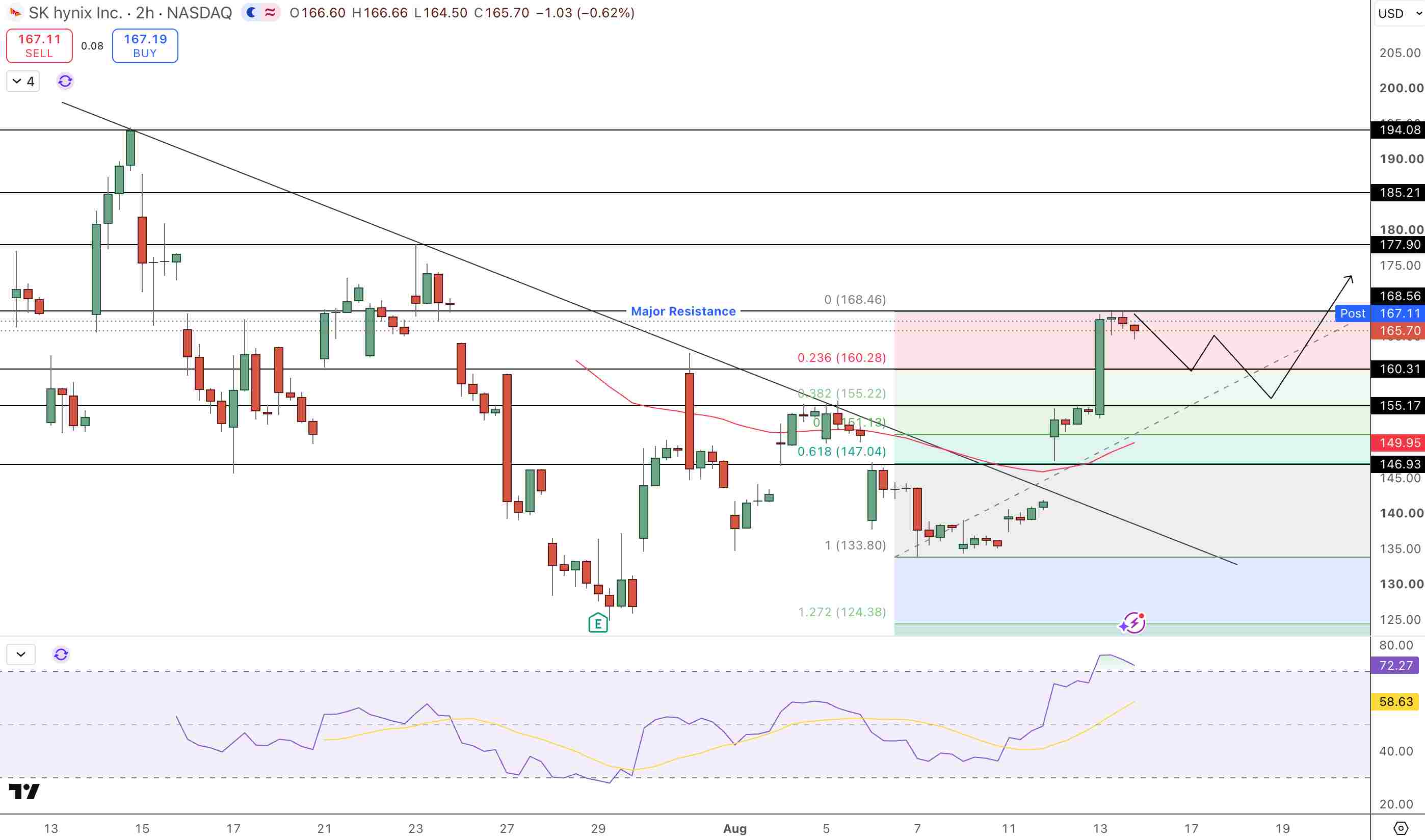
SK Hynix Stock Price Chart - Source: Tradingview
A move back to $168.56 would place the next resistance at $160.28 to $160.31, lower than that at $155.17 to $155.22. Below that would place $150 and $146.93 as the next areas to watch. The $133.80 post-earnings low would remain the structural support.
Bottom Line: August 17 Weekend Outlook
The outcomes of SK Hynix's recent Q2 earnings can potentially indicate how AI memory demand can contribute to reshaping the economics of their business. SK Hynix’s revenues increased by 257%, and their operating margin had reached 76%. They had begun shipments of HBM4, and there were improvements in the long-term customer contracts, providing better visibility for demand.
The primary risk is that the market has largely anticipated most of this strength. There is competition for HBM, and there is increased capacity, as well as slowing of the hyperscalers' spending, which could affect the margins and the company’s stock.
The level of $168.56 is the crucial level. A breakout above this would allow for $177.90, $185.21, and $194.08. $160.28 and $155.17 would come into play should this level hold resistance. Jackson Hole might dictate some market reactions for the short term, while the production of HBM4, and the orders from customers and pricing would determine the longer-term case for the company's earnings. This is pure analysis and shouldn't be construed as investing advice.
Recommended Articles









Comments (0)
Click the $ button, enter the symbol, and select to link a stock, ETF, or other ticker.