


SpaceX Beat Revenue at +92% and Reclaimed $135 IPO Price — Can SPCX Hold $154.36 Breakout?



AI Podcast


SpaceX stock has recovered to $146.24, reclaiming its $135 IPO price following a strong technical breakout above a descending channel. Q2 fundamentals showed 92% YoY revenue growth to $7.81 billion, driven by surging Starlink subscribers and a 250% increase in AI services revenue. SpaceX remained loss-making on a GAAP basis. Capital expenditure also surged, including $15.828 billion invested in the AI segment. Technically, the stock is testing critical resistance at $154.36, with an RSI of 67 indicating strong momentum. However, potential near-term risks include upcoming share lockup expirations and sustained funding requirements for heavy capital investments.
An earlier version of this analysis incorrectly stated that for the second quarter, SpaceX reported $3.54 billion in adjusted EBITDA with a 63% margin and positive $1.22 billion free cash flow. In fact, SpaceX generated a adjusted EBITDA margin of approximately 45.3% with massive capital expenditures. The analysis has since been updated.
TradingKey - SpaceX (SPCX) stock reclaimed its $135 IPO price, and has staged a powerful recovery to $146.24 following one of Wall Street's most volatile post-IPO stretches this year. SpaceX stock has broken out of a descending channel, retraced 50% of the price move with the prior key level of $139.04, and is currently targeting important resistance around $154.36. Q2 earnings showed 92% YoY company growth and impressive Starlink subscriber growth with 12 million subscribers (doubling last years growth), in addition to the company offering AI services that posted 250% YoY growth and $2.56B in revenue. There is a great deal of interest surrounding the possibility that Musk's AI services could be the largest revenue producing services for SpaceX by the end of September. For traders, a breakout above $154.36 would target $163.36 and $172.14 in the near-term. For investors, the August 20 lockup expiration leaves the question if the 92% growth, $14.1B contracted AI sales, and Starlink growth is real, or just a brief relief.
The Rebound: From Post-IPO Crash Back to IPO Price
SpaceX peaked around $225.64 in early June. After its $135 IPO, the stock crashed to ~$105.75 late July. Concerns with post-IPO valuations and finally the capital intensive growth spurred the post-IPO crash. The stock has recovered from the $105.75 level (38%) to $146.24, reclaiming the IPO price and breaking the descending linear channel.
The recovery structure is showing higher lows, price is above the 50% Fibonacci retracement at $139.04, and with an RSI of 67, there is room for price to go higher. The stock has broken key technical levels, demonstrating that institutions believe the bearish trend is losing strength.
Q2 Fundamentals: 92% Revenue Growth Across All Segments
SpaceX beat revenue expectations in Q2 2026 with $7.814 billion in reported revenue, up 92% from $4.071 billion in the same quarter last year. Growth was broad-based across all three operating segments. Connectivity, which includes Starlink, generated $4.291 billion in revenue, up 66% year over year. AI revenue surged 247% to $2.561 billion, while the Space segment generated $962 million, up 29%.
Adjusted EBITDA climbed 191% to $3.538 billion, implying an adjusted EBITDA margin of approximately 45.3%. However, SpaceX remained loss-making on a GAAP basis, reporting a $143 million operating loss and a $541 million net loss. Capital expenditure also surged to $18.369 billion during the quarter, including $15.828 billion invested in the AI segment, highlighting the enormous amount of capital SpaceX is deploying to expand its AI infrastructure, Starlink network and Starship programme.
Starlink: 12M Subscribers Doubled YoY, 22M Via Mobile Partners
Starlink hit approximately 12 million subscribers of traditional broadband services, doubling last year's numbers. The company reported that its mobile partner network through wireless providers has extended to about 22 million subscribers. This new network allows SpaceX to better penetrate rural areas to offer a direct-to-cell satellite based mobile connectivity as a means to take customers from Verizon, AT&T and T-Mobile. This new strategy requires a significant amount of investments in spectrum, regulatory approvals and network deployments to compete in the mobile directly connectivity segment.
AI Is Becoming the New Growth Engine — But at Enormous Cost
One of the biggest developments since the release of Q2 earnings has been the rapid expansion of SpaceX’s AI business. During an August company-wide meeting, Elon Musk reportedly told employees that he expects AI revenue to surpass SpaceX’s other business lines as early as September. The company has also disclosed roughly $14.1 billion in contracted cloud-service sales, while Musk has targeted approximately 10 gigawatts of AI-related compute capacity by the end of 2027.
The investment required to support that expansion is substantial. SpaceX spent approximately $18.4 billion on total capital expenditure during Q2, with around $15.83 billion directed toward AI-related infrastructure. That level of spending highlights both the scale of SpaceX’s ambitions and the financial risk attached to them.
Rather than producing positive free cash flow at this stage, the company is operating through an extremely capital-intensive investment cycle. The key question is whether growth in AI services, Starlink subscriptions, government contracts and launch activity can eventually generate enough operating cash flow to support continued infrastructure expansion without creating excessive financing pressure. For now, the AI business is growing rapidly, but the economics of that growth will depend on how efficiently SpaceX converts its large contracted backlog into recognised revenue and sustainable cash generation.
Government Contracts Add Recurring Revenue Diversification
SpaceX shared details of the over $6 billion worth of contracts, spanning numerous launches, secure launch communications, and delivery of the Starlink systems. Contracts of this nature minimize the company’s revenue exposure from consumer-based and launch cycle services. These contracts create a virtually impenetrable barrier for competitors as very few can go as vertically integrated as SpaceX.
SpaceX Technical Setup: Cleared Channel, Testing $154.36 Breakout
On the 4-hour chart, SpaceX has recorded strong bullish reversal following a clean escape from a descending channel. The recovery from the support at $105.75 has cleared the 50% Fibonacci retracement level of $139.04 and is currently trading at the 61.8% Fibonacci retracement level at $146.85. The next relevant level will be the $146.85 - $154.36 zone.
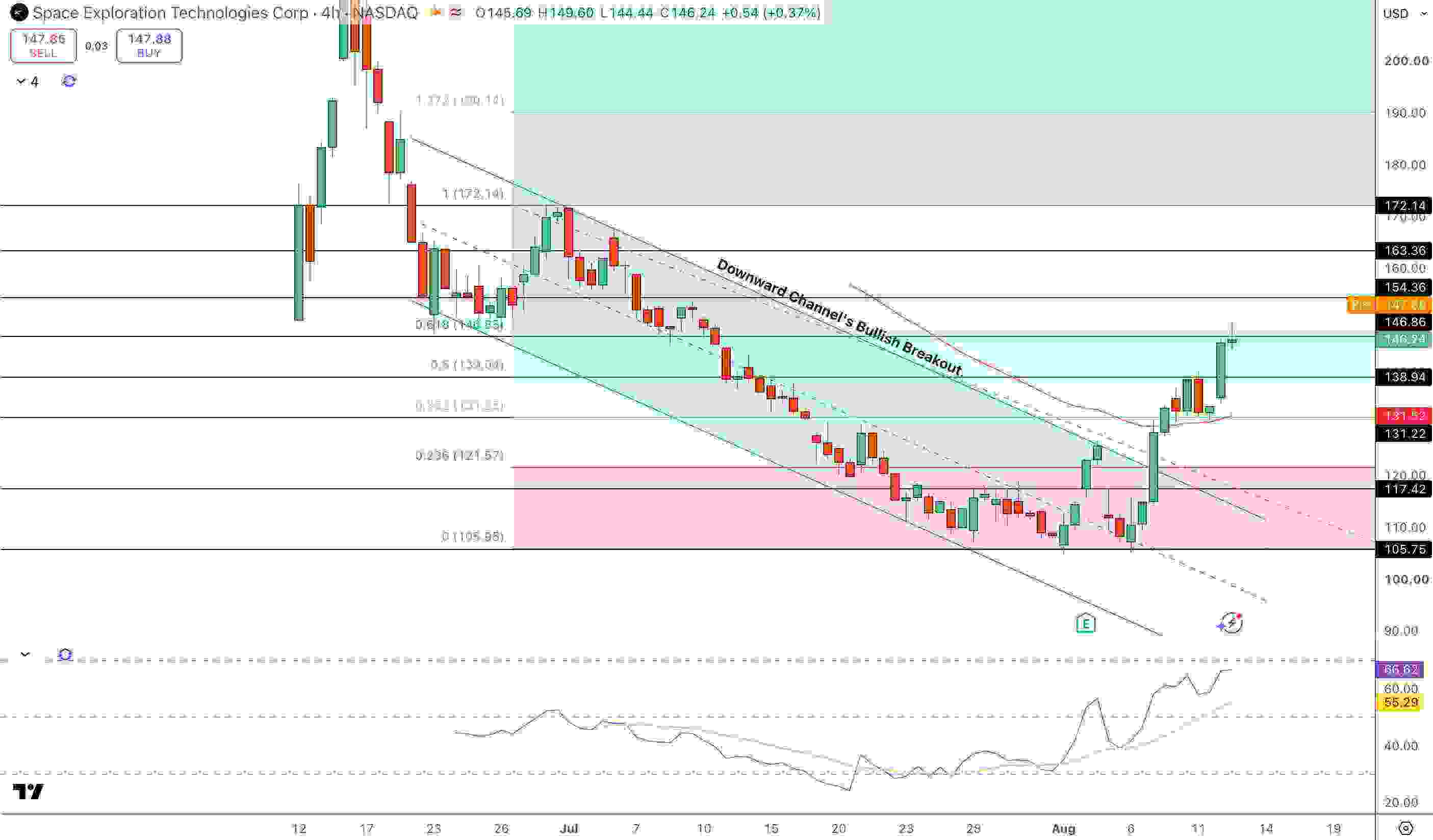
SPCX Price Chart - Source: Tradingview
Above $154.36 there is a strong likelihood of additional gains in the reversal. The RSI is currently at 67 and is above its signal line at 55, and is positioned at an area of overbought, highlighting considerable buying pressure. However, the rapid advance increases the probability of a minor pause. Below $154.36, the next important support level is $139.04 with a stronger support zone of $131.52 - $131.23.
Key Levels (Aug 13)
- Immediate resistance: $146.85 (61.8% Fibonacci)
- Key breakout level: $154.36 (critical test)
- Extended targets: $163.36, $172.14 (if breakout holds)
- First support: $139.04 (50% Fibonacci)
- Support cluster: $131.52, $131.23
- Deeper support: $121.57 (Fibonacci)
- Current price: $146.24 (inside breakout zone)
- RSI: 67 (strong momentum, near overbought)
The Lockup Risk Remains on August 20
Around 20 August, further tranches of post-IPO shares will be eligible for trading. The first lockup expiry (6 August) saw the release of approximately 911.5 million shares to the market which was absorbed fairly well. Ongoing share unlocks could create pressure on valuation, particularly if employees and early investors who have large unrealized gains decide to sell. This continues to be a near-term technical risk, irrespective of trading performance.
The Bottom Line
Since the post-IPO sell-off, SpaceX shares have recovered above the $135 IPO price to around $146.24. Fundamentally, second-quarter revenue increased 92% year over year, while Starlink reached roughly 12 million traditional broadband subscribers and about 22 million mobile users through telecom partnerships. SpaceX’s AI business generated approximately $2.56 billion in Q2 revenue, up 247% year over year, while the company also disclosed around $14.1 billion in contracted cloud-service sales.
From a technical perspective, SPCX has cleared the descending channel and the 50% Fibonacci at $139.04. Currently, SPCX is testing the breakout level of $154.36. RSI at 67 is supportive and strong, but approaching overbought, so there is potential to continue moving up should the level of $154.36 be broken. A close above $154.36 would be targeted at the $163 - $172 range. Support at $139.04 must hold on any pullback.
For tactical traders: $154.36 is a key confirmation level. If that level breaks, $163-172 becomes a possible target. For investors: the 92% growth, $14.1B contracted AI sales, and Starlink scaling are all reasons to invest at crash lows. However, the August 20 lockup expiration is a risk. Trade above $154.36 with the expectation to take profits above $163-172. Volatility around the lockup date is an expected risk. This is analysis, not investment advice.
Recommended Articles








Comments (0)
Click the $ button, enter the symbol, and select to link a stock, ETF, or other ticker.