


Microsoft's Azure Turbo: Beat on Revenue and Earnings, Raised Growth Guidance, Stock Jumped 15%



AI Podcast


Microsoft’s fiscal fourth-quarter report, published July 29, triggered a record $450 billion market cap surge, driven by revenue of $90.01 billion and adjusted EPS of $4.74, both exceeding consensus. Growth was headlined by a 32% increase in Intelligent Cloud revenue. Management raised fiscal guidance, forecasting 45% Azure growth, while maintaining disciplined capital expenditures through improved efficiency. Rapid AI monetization, evidenced by a 50% jump in Copilot seats, distinguishes Microsoft as a leader in value-accretive AI investment. Despite potential margin contraction in fiscal 2027, the company remains positioned for growth, currently testing resistance at $511.80.
TradingKey - Microsoft(MSFT)'s fourth-quarter fiscal report, published July 29, describing record earnings and revenue, has led to an increase in stock price on the order of 15%, and an approximate of $450 billion dollars of market cap added to its stock, which previously established the record for markets. This report is a welcome anomaly during a week of generally dismal stock performance, which was characterized by negative stock appreciation.
The Quarter Was a Genuine Beat and Raise
The report showed quarterly revenues of $90.01 billion, 18% year on year (YoY) and $2.42 billion (2.7%) greater than consensus estimates of $87.62 billion. Adjusted earnings per share also beat earnings estimates by approximately 12% at $4.74. The remaining segments also reported increased revenues. The report shows revenues for the Intelligent Cloud (Azure) segment of $39.31 billion and a YoY increase of 32% with Azure reporting a 43% YoY increase and $100 billion net annual revenue.
Revenues for the Productivity and Business Processes segment (Office + Copilot) also reported an increase to $37.85 billion and a YoY increase of 14%. The report showed an increase in guidance with Azure forecast to increase 45% in fiscal Q1 2027 and the consensus of Azure forecasted revenues at approximately 41%. The report showed management guidance of double-digit revenue and operating income increases for the fiscal year. This is clearly a case of raising guidance and not a case of decreasing or cutting guidance.
The Capex Story That Surprised
The biggest relief did not occur in the quarter, but in capital expenditures. Investors were anxious in the report that Microsoft would follow the lead of Alphabet and increase its own capital expenditures in response to surging AI infrastructure. Instead, CFO Amy Hood said the company is keeping its calendar 2026 capital expenditures at approximately $175 billion.
She said the company has moved some data-center and office-building lease accounting from capital expenditures to operating leases, which is a 15 to 25 year shift, and therefore moved some costs off the capital expenditures with no actual reduced commitment. The market read this as Microsoft operating its cloud much more efficiently than was previously expected, and the relief was immediate.
The AI Monetization Signal
Microsoft's endeavor to earn from AI, rather than spending indiscriminately, is one factor that gives the beat lasting weight. As of July, Copilot paid seats (i.e., paid usage-based micro-subscriptions for AI on Microsoft 365) jumped from about 20 million to 30 million, a 50% increase in 90 days, with the company noting net seat additions more than doubled quarter-on-quarter. GitHub Copilot also had 50 million users, and commercial remaining performance obligations (i.e., contracted future revenue) jumped 84% to $678 billion. The metrics indicate Microsoft's enterprise customers are not spending money on AI for 'fun', but rather committed Microsoft AI spend for the foreseeable future.
Why This Mattered When Everything Else Didn't
Datadog lost 20% of its market value after beating quarterly expectations but missing on the guidance, while HubSpot lost 20%, the worst one-day market value loss in its history, after beating quarterly expectations but lowering guidance and slowing customer growth.
AMD beat on expectations, increased guidance, but lost value because of high capex. The market awarded Microsoft with the largest one-day market value increase in history because of their good controls on capex, as they beat on the quarter and increased guidance.
The Remaining Questions
With some of Microsoft's gains, the stock is approaching $500, testing the resistance at $511.80 seen in the chart, having recovered from a 19% year-to-date loss which pressured the stock throughout most of 2026. The valuation multiple has compressed to the 20-22 range, which is fair for a company with double-digit earnings growth and strong growth in the share of the AI market.
Remaining concerns relate to the prospects for Azure and its ability to maintain 45% growth with a larger base, for Copilot seats to continue growing at 50% per quarter, and the company’s ability to maintain growth in operating margins with high levels of R&D expenditure.
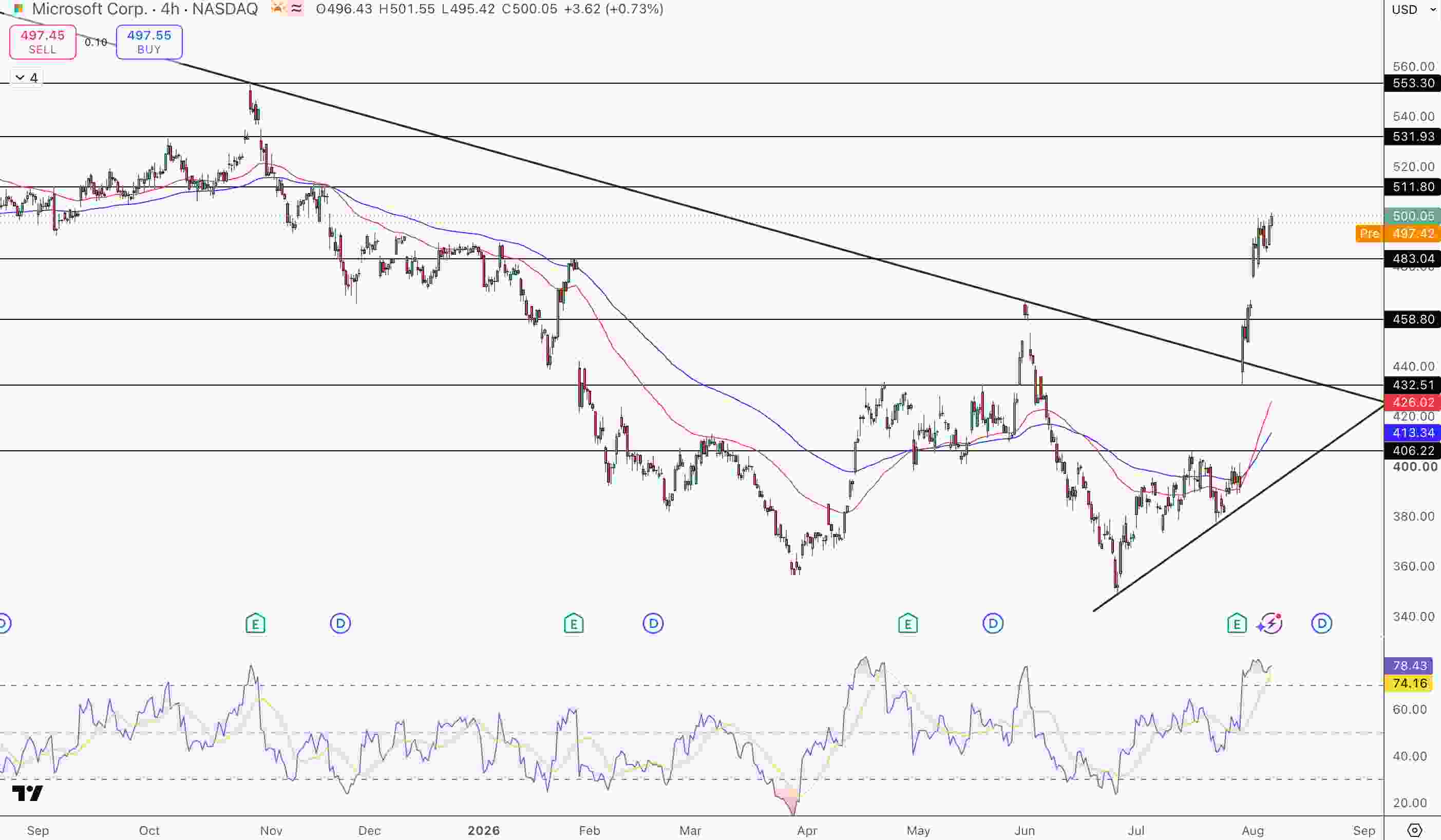
Microsoft Price Chart - Source: Tradingview
Management indicated margins would contract in FY2027, and so expectations are aligned. Meanwhile, the market is viewing Microsoft as the only large-cap tech company that has answered the question of whether AI-related expenditures will be value-accretive.
Key Levels
- Resistance: $511.80; $531.93; $553.30
- Support: $483.04; $458.80; $432.51
- 50 EMA: $426.02
- 100 EMA: $413.34
- Post earnings high: $464.72 (current close near $500, likely to make new highs)
Why did Microsoft stock jump 15% after earnings?
Microsoft’s earnings significantly beat expectations, increasing guidance for Azure’s growth to 45%, strong AI (with monetization via Copilot seats increasing 50% in 3 months), and keeping flat guidance for capex (indicative of improved efficiency for the Cloud). After a week of the market punishing stocks for beating earnings, Microsoft’s execution and guidance rewarded the company for the largest single-day increase in market cap.
Is Microsoft stock a buy after the rally?
Microsoft is trading at roughly $500 after a jump from below $390. The jump has factored much of the valuation recovery with the stock trading 20–22 times expected earnings, a fair multiple for a strong double-digit growing company with increased share of AI. The question is if Azure and the fast growing Copilot will sustain, and where resistance breaks occur in the chart at $511.80 and $531.93. These are not buy recommendations.
Bottom Line
Microsoft executed and exercised control this week. It won us over this quarter, increased its estimating most relevantly (to us, it is all about Azure and AI seats), and kept capex constricted even with demand multiplying. For the shareholders concerned that AI spending would either go nowhere, or lose them money, this was the report to quell their fears. This was a moneymaker meeting, earning them a 15% profit and a $450 billion profit overall. The next milestone is the $511 mark.
After that, it is expected to reach $550, as long as the spike in demand is kept, with Azure’s earnings remaining over 40% (or more and beyond). The consensus, for now, is that MSFT is the only megacap stock that delivered a beat and raise, with most others missing while they beat.
Recommended Articles









Comments (0)
Click the $ button, enter the symbol, and select to link a stock, ETF, or other ticker.