


SpaceX Q2 2026: Revenue Up 92%, but Capex and an Aug 6 Lockup Push SPCX Below Its IPO Price



AI Podcast


SpaceX reported strong quarterly revenue of $7.8 billion, a 92% year-over-year increase, driven by its profitable Starlink segment. However, significant capital expenditures in AI and space divisions continue to weigh on earnings. Investors remain cautious as the company struggles with heavy cash burn and the August 6 lockup expiration, which potentially triples the public float. Currently trading below its $135 IPO price, the stock faces volatility amid supply pressure and divergent analyst outlooks. Until capital spending stabilizes and the impact of insider selling becomes clear, share performance will likely be driven by market sentiment rather than fundamentals.
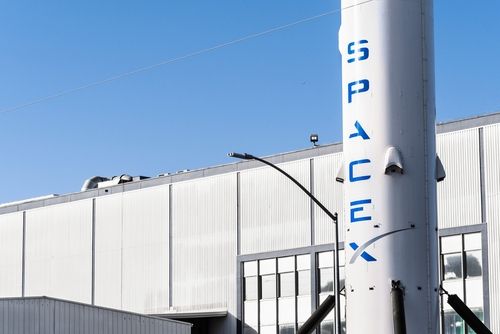
TradingKey - Space Exploration Technologies (SPCX) publicly disclosed its quarterly performance results for the first time as a publicly traded company on August 4, and the key top-line numbers looked encouraging. Revenue more than doubled by 92% from the year prior to $7.8 billion and beat forecasts. SpaceX noted its first round of public equity financing on Tuesday, and shares of the company traded as high as $182 on Tuesday as SpaceX shares traded on the over-the-counter (OTC) market. As of the close of markets on Wednesday, shares of SpaceX were trading at $168 on the OTC market. So why the gap between results and share price? There are two key reasons.
A Strong Quarter on the Top Line
Results from the quarters are encouraging with clear improvement from prior quarters. Revenue for the quarter came in at $7.8 billion, a year over year increase of 92%, and a beat on analyst consensus estimates. SpaceX announced its first public equity financing on Tuesday, and shares of the company traded as high as $182 on Tuesday as SpaceX shares traded on the over-the-counter (OTC) market. As of the close of markets on Wednesday, shares of SpaceX were trading at $168 on the OTC market. Why the gap between results and share price? There are two key reasons.
Space Exploration Technologies (SpaceX) went publicly exchanged on August 4. The top line results for the quarter looked good. Revenues for the quarter were $7.8 billion. This was a year over year increase of 92%. Analyst consensus estimates were also exceeded. SpaceX announced its first public equity financing on Tuesday, and shares of the company traded as high as $182 on Tuesday as SpaceX shares traded on the over-the-counter (OTC) market. As of the close of markets on Wednesday, shares of SpaceX were trading at $168 on the OTC market.
Three Segments, One Profit Engine
SpaceX relates revenues to three streams, of which only one is profitable. The bulk of Starlink connectivity reported revenue of $4.291 billion, an increase of 66% from the prior year, and produced an operating income of $1.656 billion. Starlink subscribers increased to 12 million from the prior year. This is the only segment of the company from which profits arise.
The AI segment (newly added segment) reported revenue of $2.561 billion, an increase of 247% from the previous year, but suffered an operating loss of $1.257 billion. (This operating loss was a narrowing of the previous quarter’s operating loss.) The space segment (launch services and Starship) reported revenue of $962 million, an increase of 29% from the previous year, and was a loss of $542 million.
In summary, Starlink has a fast-growing, profitable utility service, while the AI and space sectors still maintain a capital-intensive, cash-draining structure.
The Spending That Worried Investors
SpaceX's capital spending for the first half of 2026 was around $28.5 billion. There are several factors that contribute to the heaviest capital spending worry investors. SpaceX's estimated capital spending for the first half of 2026 was approximately $28.5 billion. SpaceX's planned capital spending for the first half of 2026 was approximately $28.5 billion. Investors are concerned about total capital spending at SpaceX.
The Bigger Near-Term Risk: the August 6 Lockup
As of now, the biggest near-term stock market lockup risk happens to be the August 6 Lockup. SpaceX had a initial trading lock up of 180 days. As of August 6, holders of insider stock in SpaceX may begin selling their shares. The SpaceX initial public offering, or IPO, brought SpaceX's extensive stock of shares to SpaceX. The number of SpaceX shares that are trading on the public stock markets is currently less than 280 million shares. In other words, currently, there are fewer SpaceX shares trading on stock markets than there are in SpaceX. At present, all of Elon Musk's SpaceX stock are restricted from trading until June 2027. If only a small percentage of Elon Musk's stock of SpaceX shares are sold, the number of SpaceX shares holding stock on the public markets would still be greater than the number of SpaceX shares on the public markets.
SpaceX Technical Analysis; Valuation and the Analyst Split
After the slide, SpaceX stock price fell to $110. This places it below its initial public offering (IPO) price of $135 and represents a 30% drop from its post-listing all-time high. One indicator suggests that these levels may represent a market capitalization of $1.7 trillion. This would represent about 90 times the revenue that the space company produced in total over the past year, and it would happen for a space company that has no profit. That is why most analyst opinions are so divided.
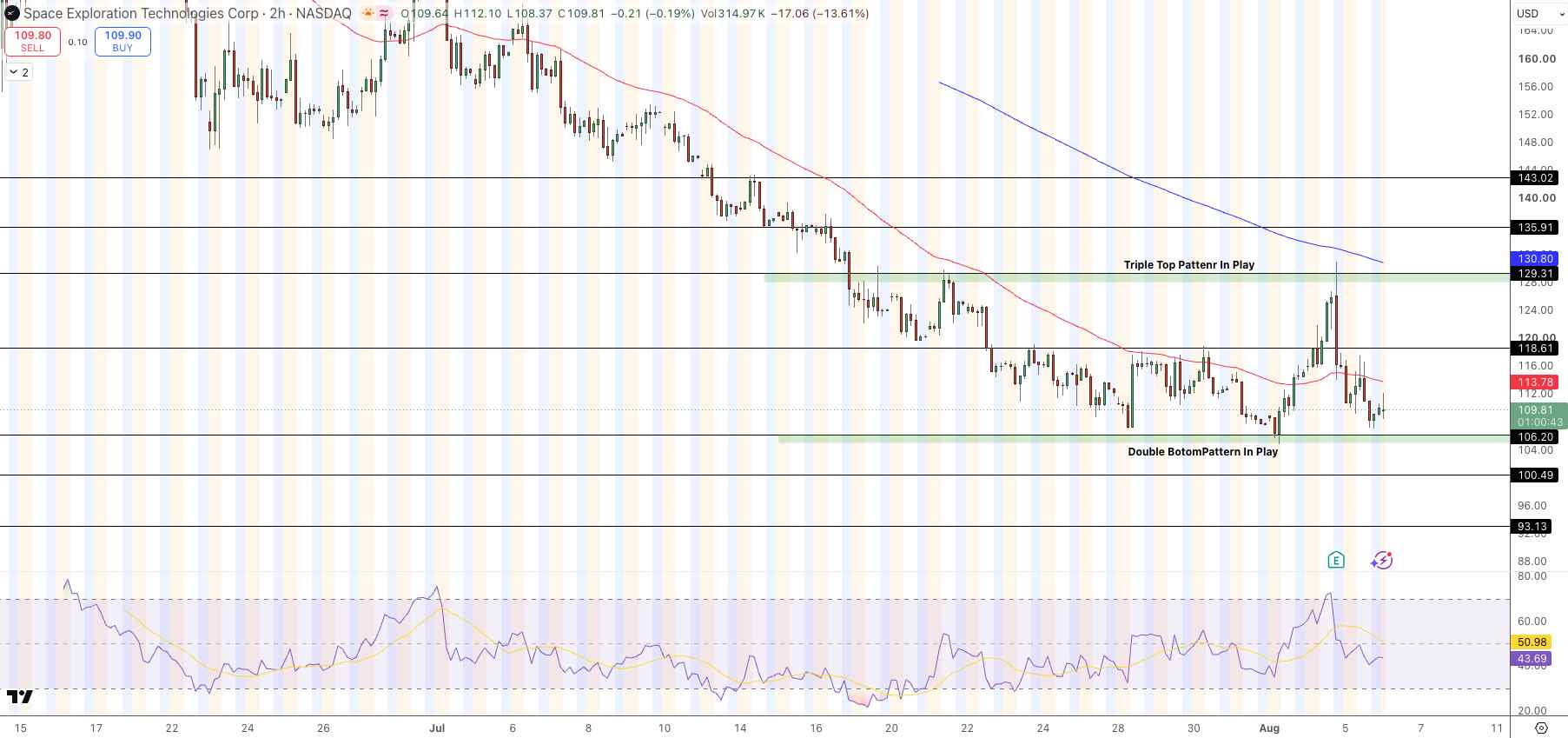
SpaceX Price Chart - Source: Tradingview
Morgan Stanley has an Overweight rating and $300 target for this. SpaceX is Morgan Stanley's opinion unique, as they claim that most of SpaceX's near and far future launches will be funded by the broadband and AI arms of the company. They say that when SpaceX's stock price dropped to $100, they believe that it would effectively ignore SpaceX's AI funding.
Other analysts have recommended selling the stock, and some investors expect further declines to happen as the company's shares unlock. History offers a mixed guide: companies that fall below their IPO price early have often recovered afterward, but that is an average, not a promise. A space company like SpaceX has a balance sheet, at least, that is strong. It has about $100 billion in cash along with a $47.5 billion backlog.
Key Levels
- Resistance: $113.80, $118.61, $129.31, $135.91
- Support: $110.00, $106.20, $100.49
- 50 EMA: $113.80 (immediate overhead resistance)
- 100 EMA: $130.80 (well above the current price)
- Double-bottom: $106.20 (the level buyers are defending)
- IPO price: $135 (the stock trades below it)
- RSI: 46, neutral-to-bearish
Why is SpaceX stock falling this week?
Traditionally, the end of a lockup would need to be considered. This occurred on August 6, and makes about 911.5 million of the participating insiders’ shares available to sell, more than three times the current public float. Supply pressure is created by the uncertainty of this much new supply. The end of this lockup and the resulting increased supply of SpaceX stock has pressured the stock this week.
Is SpaceX stock a buy after the drop?
The increase in SpaceX stock this week might give reasons to think this stock is a buy. But potential significant stock growth, rather than major stock growth, is probably the most important factor to consider when thinking SpaceX stock is a buy after the recent drop in SpaceX stock. It is also important to consider significant potential loss, rather than possible loss, SpaceX stock is a buy after the recent drop in SpaceX stock. Major potential loss, rather than potential major loss, SpaceX stock is a buy after the recent drop in SpaceX stock.
Bottom Line
As a newly public company for Q1, SpaceX demonstrated strong company growth and profits from Starlink, while the overall loss decreased. During this period, however, two countertrends affected SpaceX stock. Firstly, SpaceX is currently running a large deficit related to building its AI capacity. Investors have reacted very badly to this deficit in multiple companies. Secondly, at the most timely coincidence, SpaceX faces a massive lockup expiration on August 6, which should significantly add to SpaceX's small public share float.
Until the market understands what insiders will actually sell, and until capex spending starts to cash, the shares will continue to trade on supply and sentiment as much as on results. For now, SPCX sits near $110, below its $135 IPO price, defending support at $106 with resistance overhead at $118 and $129.
Recommended Articles








Comments (0)
Click the $ button, enter the symbol, and select to link a stock, ETF, or other ticker.