


AMD Stock Price Forecast: Shares Slump 9% After Earnings; Where Is the Next Support Level?



AI Podcast


AMD shares fell nearly 9% on August 5, Eastern Time, following a "sell the news" reaction to Q2 results. Despite beating revenue and earnings forecasts, the stock dropped as guidance failed to meet extreme market expectations. This decline reflects broader sector cooling and skepticism regarding AI return on investment rather than fundamental deterioration. With the stock breaking the $500 support level, technical analysis suggests further downward pressure. Investors are advised to avoid aggressive buying, instead waiting for price stabilization and volume contraction within the $460–$480 range before considering entry, with primary support identified at $430.

TradingKey - AMD's guidance falls short of highest expectations, triggering a 9% stock plunge; short-term downward pressure likely to persist.
On August 5, Eastern Time, Advanced Micro Devices ( AMD) saw its stock plunge nearly 9% in pre-market trading, losing the $500 psychological barrier to trade around $474.51, in a classic 'sell the news' reaction. This drop in AMD's stock price is not due to deteriorating fundamentals; rather, the core catalyst is the high bar of expectations, with deeper reasons rooted in the cooling semiconductor sector and concerns over AI ROI.
AMD released stellar second-quarter financial results, with both revenue and earnings per share exceeding market expectations. However, its guidance failed to reach the extreme expectation of $14 billion, as shown below:
Financial Metrics | AMD Official Data | Market Expectations |
Total Revenue | $11.54 billion | $11.42 billion |
Adjusted EPS | $1.66 | $1.58 |
Q3 Revenue Guidance Midpoint | $13.0 billion | $12.85 billion |
Prior to the earnings release, AMD's stock had staged a strong rebound, breaking through the $500 mark and narrowing its recent drawdown from 26% to around 10%. Once the better-than-expected earnings report was officially released—especially with guidance failing to meet the most optimistic projections—it triggered profit-taking pressure from the bulls.
While AMD's earnings triggered the sell-off, two other contributing factors should not be ignored: cooling sentiment in the semiconductor sector and concerns over AI ROI. The Philadelphia Semiconductor Index (SOX) has recently experienced a sharp correction, with a maximum drawdown of around 30%. Impacted by volatility in the memory segment and the macroeconomic environment, overall chip stock valuation multiples have been compressed. Furthermore, Wall Street is scrutinizing the actual monetization capacity of major cloud service providers' massive AI capital expenditures with a magnifying glass, making the market more cautious about the pace of AI chip procurement.
Currently, AMD's stock price has lost the $500 psychological level and broken below the minor support level of $490 (0.236 Fibonacci retracement). The next line of defense is at $430, which serves as the primary buy support and represents the lowest point of the pullback from the recent all-time high. A large volume of dip-buying interest has accumulated in this zone, providing strong support.
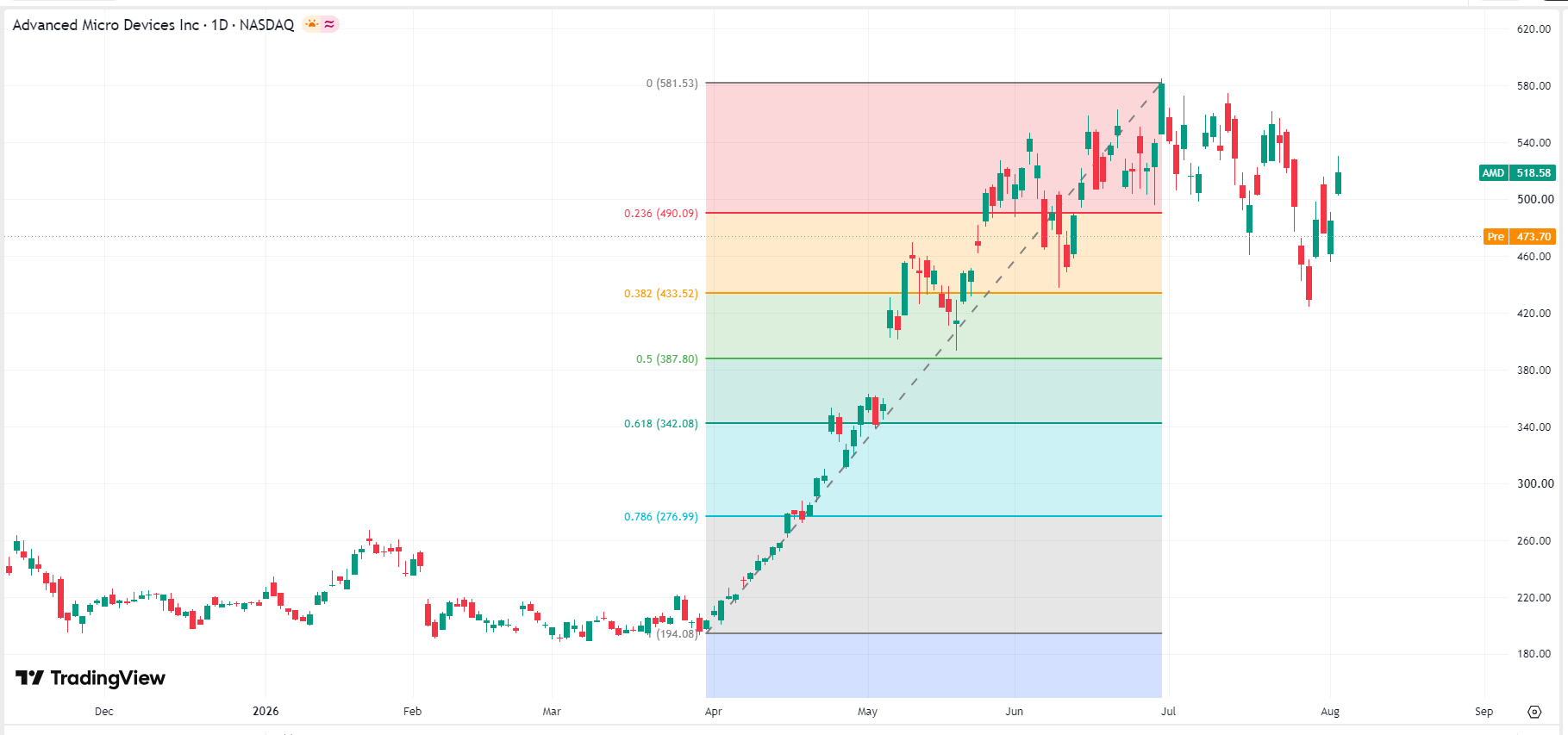 AMD stock chart, Source: TradingView
AMD's sharp drop this time does not represent deteriorating fundamentals, but rather reflects the market's pessimistic sentiment toward the broader sector. Therefore, investors should avoid blindly chasing highs or buying the rebound immediately. Instead, they can wait for the stock price to show signs of stabilizing on declining volume within the $460–$480 support zone and close with a positive daily candle before making tentative entries.
This content was translated using AI and reviewed for clarity. It is for informational purposes only.
Recommended Articles











Comments (0)
Click the $ button, enter the symbol, and select to link a stock, ETF, or other ticker.