


Oil Prices Surge as Brent Jumps Over 6% Following Houthi Tanker Attack and US-Saudi Strikes in Iraq



AI Podcast


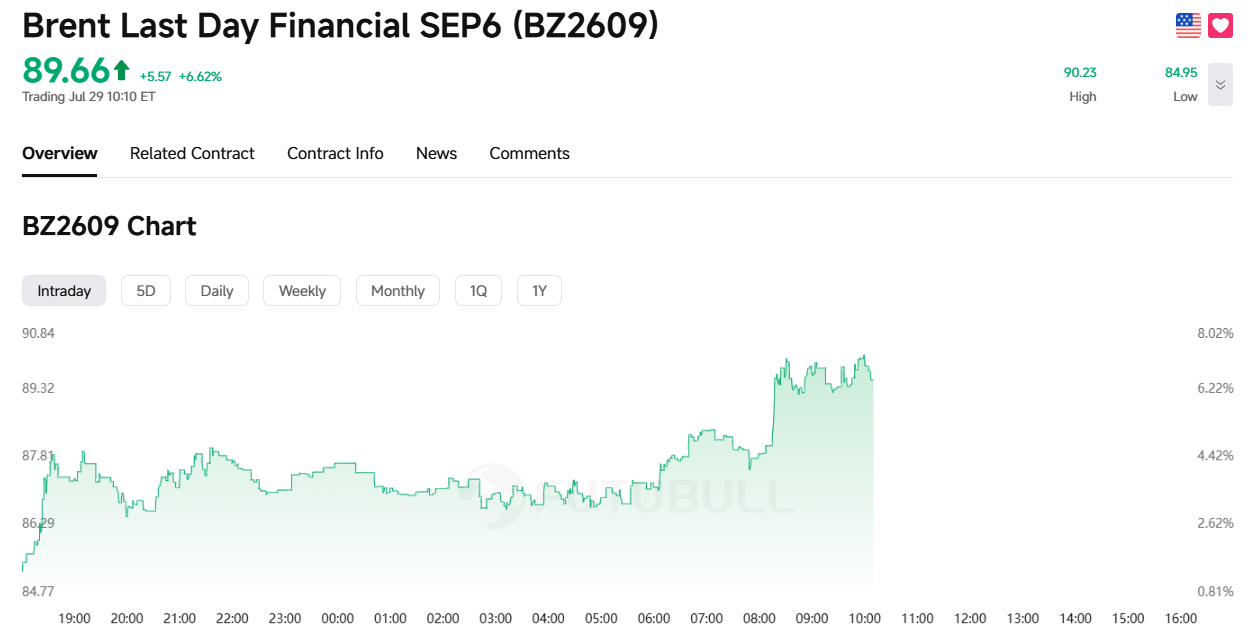
On July 29, Eastern Time, international crude oil prices surged as geopolitical tensions in the Middle East intensified, threatening global supply chains. Brent crude climbed 6.64% to $90, while WTI crude rose 6.61% to $84.5. Heightened conflict involving Yemen’s Houthi rebels, pro-Iranian militias in Iraq, and US-Saudi military responses has pressured critical shipping routes, including the Strait of Hormuz and the Red Sea. This geopolitical risk premium has become the primary driver of current price volatility. Ongoing instability and potential conflict escalation remain the critical variables for future oil price movements and broader global inflationary pressure.

TradingKey - On July 29, Eastern Time, driven by the continuous escalation of geopolitical conflicts in the Middle East and a significant increase in risks to the global energy supply chain, international crude oil prices reversed their recent downward trend and rose once again.
Events such as Yemen's Houthi rebels attacking a Saudi oil tanker and joint US-Saudi strikes against pro-Iranian militants in Iraq have continued to ferment. With two key shipping lanes, the Strait of Hormuz and the Red Sea, under pressure simultaneously, market concerns over crude oil supply disruptions have rapidly escalated, driving oil prices stronger again.
As of press time, Brent crude ( UKOIL) rose 6.64%, returning to the $90 mark; WTI crude ( USOIL) rose 6.61% to $84.5.
[Source: FutuBull]
Yemen's Houthi rebels announced on Tuesday that they had launched a missile attack on a Saudi oil tanker, marking the latest incident in the group's recent expansion of strikes against Saudi energy and shipping targets, and further intensifying concerns over the Middle East conflict spilling over into the global energy supply chain. The Houthis stated that the attacked vessel was the Saudi-flagged tanker "NCC Ghazal," which had previously ignored multiple warnings, leading to the attack and forcing it to alter its course.
The Saudi Ministry of Defense further disclosed on Wednesday that the Saudi military, in coordination with the US Central Command, carried out "precision strikes" against pro-Iranian militants in Iraq suspected of launching drone attacks. The US side stated that the operation stemmed from more than 30 drone attacks targeting US military and Saudi energy facilities over the past 72 hours.
Market analysis suggests that the clashes among Saudi Arabia, pro-Iranian militants in Iraq, and the Houthis indicate that the US-Iran conflict is spreading from direct military confrontation to energy infrastructure and transportation networks. Previously, Saudi Arabia and the Houthis maintained a relatively fragile ceasefire; although the two sides have not resumed full-scale war since 2022, tensions have risen significantly recently due to disputes over Yemen's Sana'a International Airport and Iran-related flights.
In response to the allegations, Iran denied any involvement in the attacks targeting Saudi targets. An Iranian military source stated via state television that attributing all actions in the region targeting US interests to Iran is a "serious miscalculation." Iraqi Prime Minister Ali Al-Zaidi had previously requested an investigation into the drone attacks against Saudi Arabia and stated that Iraqi territory would not be allowed to be used to attack neighboring countries. However, pro-Iranian militias in Iraq have long maintained a high degree of independence, and their relationship with the central government remains complex.
Hardline remarks from US President Trump have further heightened market concerns about an escalation of the situation. Trump stated on Wednesday morning local time that the US would respond strongly after the US military intercepted a ballistic missile attack launched by Iran against Jordan that night. He said the US military had only minutes to respond to this sudden attack and intercepted all incoming missiles before they could hit their targets. Trump also confirmed that the strikes launched overnight by the US military and Saudi Arabia against Iran-backed Iraqi Shia militia groups were carried out after coordination with the Iraqi government. He referred to these militia groups as "a cancer on the world" and indicated that the US is considering issuing further warnings to Iranian proxy groups.
Currently, Middle East energy transportation security still faces high uncertainty. As the two key shipping lanes, the Strait of Hormuz and the Red Sea, face pressure simultaneously, the geopolitical risk premium is rapidly rebounding, becoming the core driving force behind this round of oil price increases, while also further adding to global inflationary pressures. Market analysis suggests that any further escalation of the conflict could drive international oil prices higher, and the subsequent evolution of the regional situation will be the core variable determining the direction of crude oil prices.
This content was translated using AI and reviewed for clarity. It is for informational purposes only.
Recommended Articles









Comments (0)
Click the $ button, enter the symbol, and select to link a stock, ETF, or other ticker.