


Broadcom (AVGO) Price Forecast: $389 Resistance, Hyperscaler Earnings This Week



AI Podcast


Broadcom shares have corrected 21% from their June peak, primarily due to sector-wide valuation compression rather than internal operational weakness. In fiscal Q2 2026, the company reported robust growth, with revenue reaching $16.75 billion and AI semiconductor sales climbing 46% to $6.1 billion. Strong margins and a $30 billion Apple partnership highlight continued financial stability. Market focus remains on upcoming hyperscaler earnings, which are expected to confirm sustained AI infrastructure investment. Supported by strong technicals near $359, Broadcom remains well-positioned for growth as its custom silicon strategy deepens relationships with major cloud providers.

TradingKey - Broadcom (NASDAQ: AVGO) sits at about $381.50, or roughly 21% below its June peak of $480.77, despite just posting another quarter of solid financial results. The drop owes less to any slowdown at Broadcom itself than to a broader compression in valuations among AI-themed tech stocks. For fiscal Q2 2026, the company delivered 20% year-over-year revenue growth to $16.75 billion and AI semiconductor revenue up 46% to $6.1 billion. Its adjusted EBITDA margin came in at 69% and free cash flow at $6.8 billion, and it guided for $17.2 billion in revenue for the third quarter.
Why AVGO Is Down 21% From Its High With This Business
Broadcom is still benefiting from demand for AI networking chips, custom AI accelerators, and its VMware business. VMware delivered about $6.6 billion of revenue in the quarter, while more than 87% of VMware’s top enterprise accounts are now using VMware Cloud Foundation. Broadcom also revealed a $30 billion long-term custom silicon arrangement with Apple to bolster its multi-year stream of recurring revenue.
In contrast with big tech cloud providers plowing billions into AI data centers, Broadcom is a fabless business that doesn’t have to deploy similar capital outlays to produce big free cash flow. It was just that earnings strength that is helping Broadcom through a broader re-assessment of AI prices in the tech sector.
This Week's Hyperscaler Earnings Are the Catalyst
The biggest catalyst this week comes from earnings reports by Microsoft, Meta and Amazon, three companies investing aggressively in AI infrastructure and key customers for Broadcom's networking and custom silicon products. Following Alphabet's decision to increase planned AI capital expenditure, investors will be looking for similar commitments from the remaining hyperscalers. The more we hear about continued or rising spending on AI infrastructure, the stronger the case for Broadcom for the remainder of fiscal 2026.
On the custom AI chip front, management confirmed that it is already making progress on three hyperscale customers with its chips and working with four others on a next-generation processor, which could yield $60-$90 billion in opportunity in fiscal 2027.
There was some focus on insider selling of late but it likely isn’t a major red flag because some executives are often selling shares as part of pre-planned transactions while some big institutions continue to add shares despite the recent weakness in price.
The selling is coming on the back of good earnings, rising AI demand, and increasing large customer relationships. The decline in the price is likely more about a shift in market sentiment than anything.
The Insider Sale and What It Means
One of Broadcom’s top leaders unloaded roughly $10 million of shares, sparking some discussion about whether there’s upside for insiders to gain after an impressive run in the stock price. Although, insider sales often occur for big-name tech companies. It usually means they are selling through their 10b5-1 rule trading program, so there’s no indication it’s a discretionary trade which really doesn’t tell us anything in the way management feels about the company.
However, a more interesting occurrence took place during the same timeframe: More buying was done by institutions. One of the larger buyers was investment advisory firm Bartlett & Co. which ramped up its stake in Broadcom by over 89k shares. That seems like a bullish view. It means it’s a potential bargain buy from investors who may be holding on longer term for a longer-term view.
AVGO Technical Setup
Shares are trading near $381.50 at press time. It is above the uptrend since March. It is also near the 200d ema near $359, creating an important support zone, while the 50d ema at $389.32 remains the first resistance level.
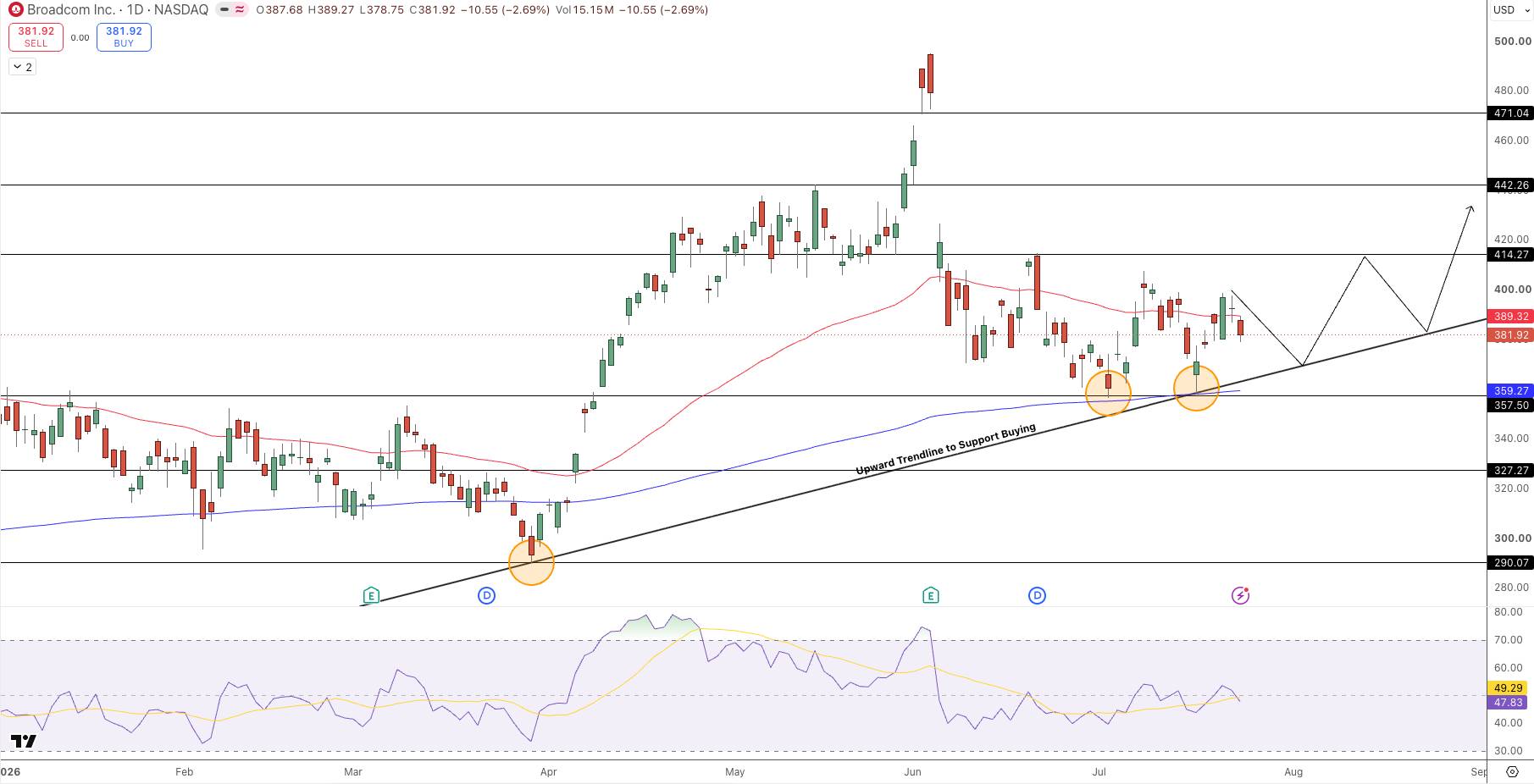
AVGO Price Chart - Source: Tradingview
The RSI has been hovering just under 49, implying neutral. From here it could go either way. Breakout above $389.32 and you have an opportunity to target $414.27 and $442.26. However, a close beneath $359.27 is a break in trend. Then it would look to test support near $327.27.
Key Levels
- Current Price: $381.50
- Q2 AI Revenue: $6.1B (+46% YoY)
- Q3 Guidance: $17.2B revenue with a 69% adjusted EBITDA margin
- Apple Partnership: $30B multi-year custom silicon agreement
- Next Catalysts: Microsoft, Meta and Amazon earnings
- Resistance: $389.32, $414.27, $442.26
- Support: $359.27, then $327.27
What Is Broadcom's Custom XPU Business and Why Does It Matter?
Broadcom is betting big on custom AI accelerators (XPUs), a segment that should drive most of the company's long-term growth. Whereas Nvidia sells general-purpose GPUs to everyone, Broadcom builds chips for the particular AI needs of each cloud provider. Google TPUs are among the best-known examples of such custom AI chips.
Today, Broadcom serves three hyperscale customers with custom chips in production, and it's developing next-gen custom AI chips for four additional hyperscale customers. According to company executives, that gives Broadcom a $60 billion to $90 billion serviceable addressable market in fiscal 2027.
Since custom chips are tailored to a cloud provider's specific software and infrastructure, they tend to result in a deeper customer relationship. It's hard for cloud providers to switch vendors once they've deployed chips at scale, giving Broadcom greater revenue certainty than just selling chips that will be used only once.
How Does Alphabet's $195-205B Capex Guidance Affect Broadcom?
Alphabet helped further cement Broadcom's bullish thesis by raising its capital expenditure (capex) outlook to $195 billion to $205 billion in 2026, after seeing capex of $44.9 billion in the June quarter. Much of that spending will flow into building out AI data centers, where Broadcom provides switching silicon and networking chips as well as its custom AI processors.
Alphabet is already one of Broadcom's largest customers in networking, using Broadcom's Tomahawk Ethernet switches and Jericho networking processors to build huge AI clusters. If other cloud providers, like Microsoft, Meta, and Amazon, follow Alphabet's capex lead, Broadcom's networking business will probably do fine.
Bottom Line
Even with its stock price now about 21% off its recent June peak, Broadcom continues to make great progress operationally. Its AI chips business is surging, with $6.1 billion in sales up 46% in the second quarter, and the company's free cash flow was $6.8 billion. It's also still saying that demand is outpacing supply. Next up, we'll see reports from Microsoft, Meta, and Amazon. More growth in hyperscale AI capex would be a big vote of confidence for the semiconductor firm, helping push it back above $389. Support is found at $359.
Recommended Articles






Comments (0)
Click the $ button, enter the symbol, and select to link a stock, ETF, or other ticker.