


Tesla Shares Slump to Near One-Year Low, Technical Warning Signals Potential for Over 30% Further Drop



AI Podcast


Tesla shares dropped 14.52% on Eastern Time July 23, closing at $319.69 after disappointing Q2 earnings and negative free cash flow. Down over 30% year-to-date, the stock faces a structural downtrend driven by declining EV profitability, intense competition, and high capital expenditures in AI and robotics. Having breached the $340 support level, the technical outlook suggests a potential head-and-shoulders breakdown. While short-term rebounds are possible near the $300 psychological barrier, the stock faces significant resistance at $340, with primary support zones identified between $210 and $220, representing further potential downside risk.

TradingKey - Tesla shares plummeted over 14% post-earnings, breaking below key support at $340, with significant downward pressure ahead.
On July 23, Eastern Time, Tesla ( TSLA) experienced panic selling after the opening bell, plunging sharply during intraday trading to hit a low near $315, and finally closed down 14.52% at $319.69, marking a new low since August 2025.
At the end of December last year, Tesla's stock price surged close to the $500 mark, peaking at $498.83, breaking the 2024 record of approximately $490 to hit a new all-time high. However, since entering 2026, Tesla's stock has generally trended downward, falling more than 30% year-to-date.
Tesla's stock price has steadily weakened over the past seven months. This is not due to a single factor, but rather the intersection of dual conflicts: pressure on core business profitability and massive cash burn in AI/robotics. This has led Wall Street to strictly re-evaluate its high valuation logic, which is also the driving force behind short sellers dumping the stock.
Currently, Tesla faces multiple headwinds, including declining profitability in its legacy business (EVs) amid competition from Chinese new energy vehicle makers, uncertainty in the monetization timeline of its new businesses (AI and Robotaxi), and massive AI capital expenditures (CapEx). Simply put, while Tesla generates significant revenue, it spends even more, exerting massive pressure on its profits and cash flow.
Prior to the earnings release, Tesla's stock price remained above $340. However, as Q2 earnings per share (EPS) fell far short of expectations and free cash flow turned negative, Tesla lost this defensive line, and the technical setup is poised to form a large head-and-shoulders top breakdown pattern. Based on measured targets and volume distribution, the next high-volume support zone will fall directly between $210 - $220, representing a further downside of approximately 31% - 34% from the current level.
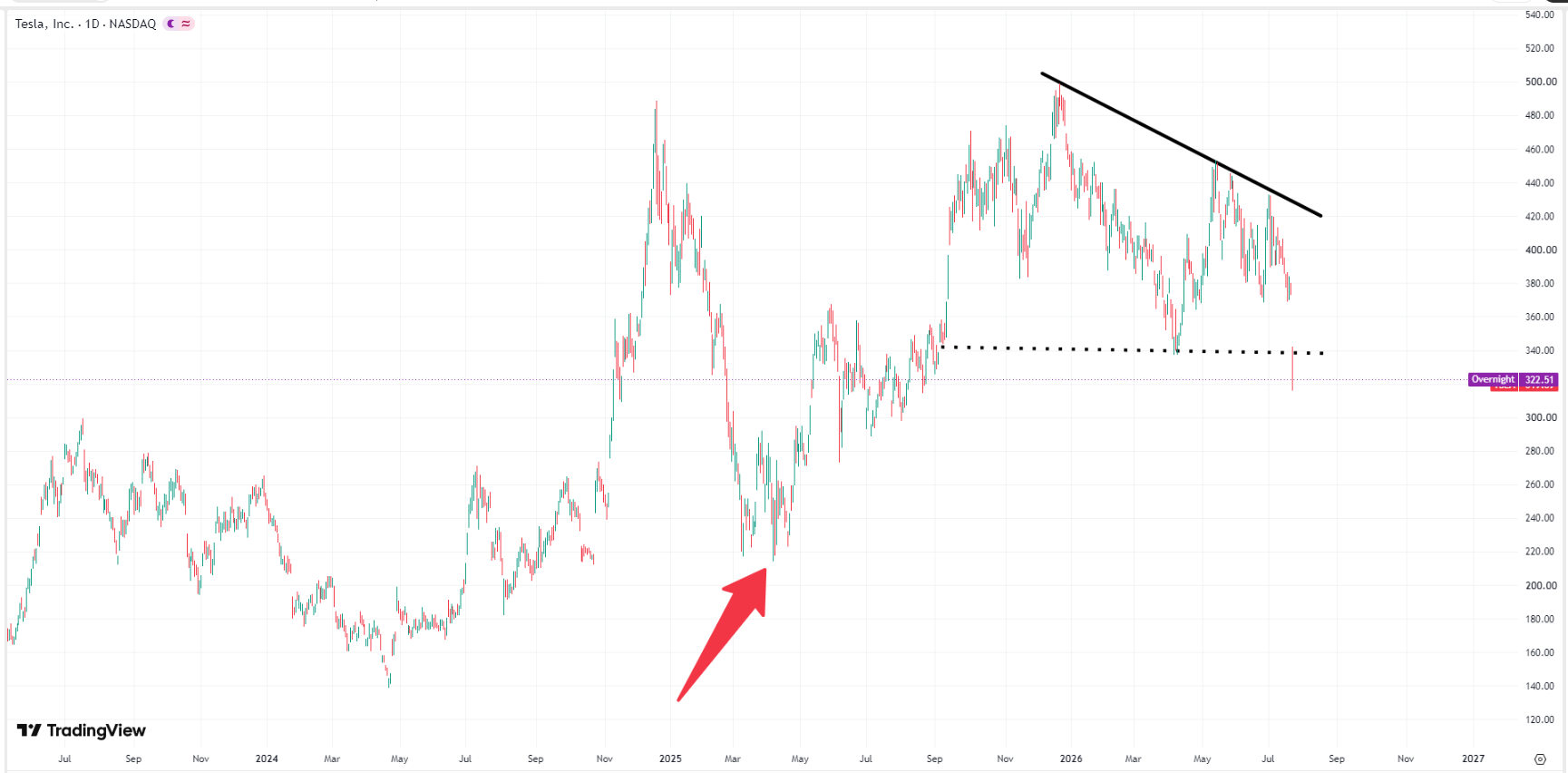
Tesla stock chart, Source: TradingView
Although Tesla's stock price has broken below key support, it does not mean it will drop directly to the next support level. During the decline, Tesla's stock will likely see some rebounds; in particular, a bullish counterattack could easily be triggered near the psychological $300 level, though it will face resistance at $340.
This content was translated using AI and reviewed for clarity. It is for informational purposes only.
Recommended Articles











Comments (0)
Click the $ button, enter the symbol, and select to link a stock, ETF, or other ticker.