


Micron (MU) Hits $1,000 on Three Catalysts - Google Capex, Vera Rubin, NAND Shortage



AI Podcast


Micron shares rose 4% to $1,000 on July 23, driven by three major catalysts: Alphabet and Tesla’s massive Q2 capital expenditure surge, Nvidia’s new Vera Rubin platform, and a projected 2026 NAND Flash supply shortage. These developments reinforce strong demand for DRAM, HBM, and NAND. Micron’s $22 billion in non-cancellable HBM contracts through 2026 provides significant revenue visibility. Technically, the stock cleared key resistance at $992.71, with the RSI at 59.8 suggesting further upside potential. With a consensus price target of $1,486, analysts view the recent recovery as a validation of sustained AI-driven infrastructure demand.
TradingKey - Micron (NASDAQ: MU) jumped around 4% to $1,000 in Thursday July 23 trading to reclaim the 4-digit level for the first time since the late June selloff. It wasn’t any Micron-specific news, but rather the alignment of three simultaneous tailwinds. Alphabet’s Q2 earnings released the night before announced $44.9 billion in quarterly capex. So did Tesla’s Q2 call. That’s more capex = more servers = more memory and HBM for all those data centers.
Nvidia also announced its Vera Rubin platform. That means even more HBM per chip. And TrendForce released a potential NAND Flash supply shortage forecast for 2026. The chart note’s resistance level of $992.71 has been cleared.
Three Catalysts That Moved MU Today
The first and most direct catalyst was Alphabet’s Q2 earnings report released Wednesday night. The company said it was going to spend $44.9 billion in capex for 1 quarter. That’s nearly double the $22.4 billion in Q2 2025, all driven by the AI infrastructure investment. Google Cloud grew 82% to $24.8 billion. That dollar in capex goes toward servers. Servers need DRAM, HBM, and NAND. When the world’s biggest cloud spender doubles its capex in a single quarter, it flows directly through to Micron’s order book.
Even Tesla earnings released that same evening said a lot about a spike in Cybercab manufacturing and AI computing capex. Two of the largest tech capex spenders both saying they were going to double down in a single evening was enough to move memory names across the board.
Another catalyst came from Nvidia’s announcement of its Vera Rubin platform. Vera Rubin is Nvidia’s next-gen AI accelerator. It succeeds Blackwell. Each Vera Rubin chip requires more HBM than Blackwell. This is the result of larger model sizes and longer context windows that result from the chip requiring more bandwidth.
Micron, alongside SK Hynix, is one of the main HBM suppliers. Vera Rubin moving on Nvidia’s product roadmap means HBM demand is pushed out into 2027-2028 compared to what the prior gen alone would have driven. It also reinforces why Micron says it’s 16 strategic customer agreements that lock in $22 billion plus of non-cancellable HBM with all the supply sold out through 2026.
The final catalyst came from TrendForce predicting a potential NAND Flash supply shortage into 2026 because of the server demand and capacity constraints for manufacturing NAND. This is separate from HBM, as both the product and customers are different. But, in a tight memory market, NAND shortages help keep pricing firm. Better NAND prices add one more margin boost for Micron, which makes DRAM as well as NAND, on top of the HBM story, which is the main story at present.
Where $1,000 Sits in Micron's Broader Recovery
Micron's 52-week range is $103.38 to $1,255. Today's $1,000 price represents recovery from the $848 level hit on July 17. Six trading days saw Micron recover 17.9%. The recovery has been caused by a rotation from the fear that fueled the selloff, specifically CXMT's $8.5 billion DRAM IPO as well as potential HBM export limitations, to the demand confirmation from Google, Tesla, and Nvidia.
Morgan Stanley called the selloff a buying opportunity. Bank of America put out research showing open-source AI models increase memory demand, not decrease it. On July 21, Micron joined Wall Street's best investment ideas. The $1,000 price level is psychological because it puts the stock above the range before the CXMT and export restriction story came out.
Michael Burry still has a short position in Micron. The idea that the memory cycle will reverse, CXMT will add supply, and margins will be squeezed hasn't changed. What has shifted this week was the demand confirmation by the largest buyers in the market. A Motley Fool piece published this week saw $1,400 for Micron by 2027.
Cited were the increased HBM content per Nvidia GPU generation and a non-cancelable contract structure, which provides earnings visibility to 2026. The 45-analyst consensus target is $1,486, 48% upside from $1,000.
SMCI Technical Setup
On the four-hour chart, Micron at $996.20 has broken above the 200-period EMA ($906.97), reclaimed the descending channel, and is now attempting to break $992.71, which had been the key level. Today's $1,000 move cleared resistance intraday. The 59.8 relative strength index is positive, but not overbought.
The next resistance levels are at $1,060.38, followed by $1,123.76. Support lies at $952.49, which is the 50-period EMA (the level is dynamic now), and $906.97, which is now the EMA floor. Below that, it's the $23 billion non-cancelable contract anchor and the 22 analysts with an average target of $1,486.
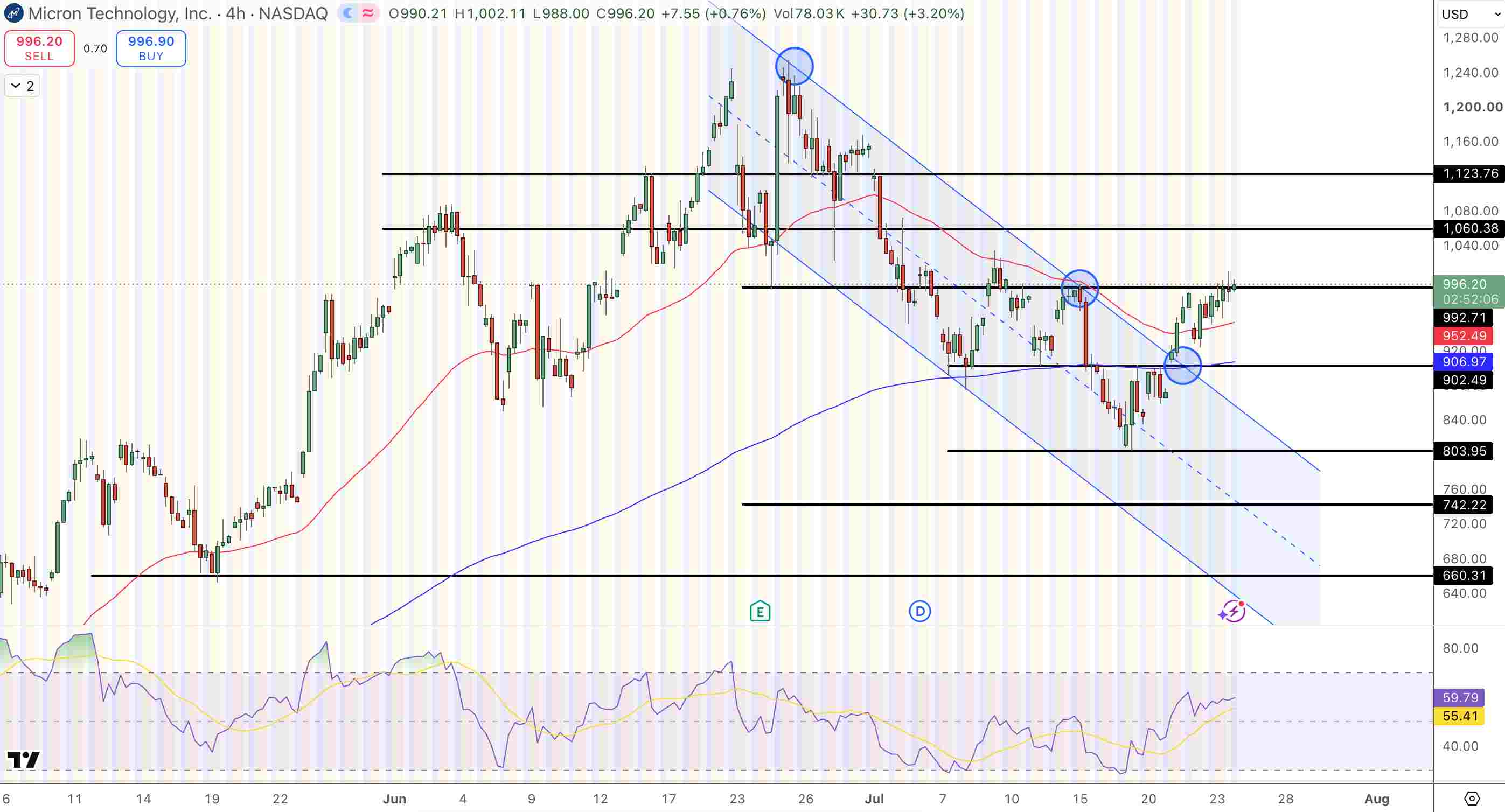
Micron Price Chart - Source: Tradingview
Key Levels
Today: Rose 4% to $1,000. Recovery from $848 July 17 low. 52-week range $103 to $1,255
Three catalysts:
- Google $44.9B capex + Tesla AI capex
- Nvidia Vera Rubin HBM demand
- NAND shortage warning
- Contracts: 16 non-cancelable HBM agreements, $22B+ committed. Supply sold out through 2026
- Resistance: $1,060.38, then $1,123.76
- Support: $952.49 (50 EMA), $906.97 (200 EMA)
- Analyst target: $1,486 average (45 analysts). Motley Fool projects $1,400 by 2027
Why Did Micron Rise 4% on July 23?
Three tailwinds coincidentally met head-on on Thursday. Alphabet disclosed $44.9 billion of capital expenditure for Q2 the evening before, twice last year's level, mostly for AI infrastructure. Tesla also alluded to aggressive capex on its earnings call. Both numbers suggest accelerating demand for the servers and the memory chips those servers need.
Nvidia's Vera Rubin platform, to succeed the Blackwell, increases the amount of HBM needed per-chip and thus extends the cycle of demand. TrendForce published a warning forecast that a shortage of NAND Flash supply could be in store through 2026 because server demand is running ahead of production capacity.
None of this is specific to Micron, but all of it adds to the strength of the company's order book and the backdrop for pricing.
What Is the Non-Cancelable Contract Structure and Why Does It Matter?
Micron has signed 16 "non-cancelable" customer agreements for HBM products, meaning customers are obliged to take and pay for the amount they have agreed to, no matter what happens. These contracts equal $22 billion of revenue or more in commitments, and supply for those volumes is sold out until the end of 2026. Non-cancelable contracts are fairly unique in the semiconductor business where orders are usually cancelable and prices are at market value.
For Micron investors, it provides earnings visibility that was absent for a company that has traditionally been subject to big swings in the memory cycle. Those are the contracts that allowed Morgan Stanley to argue a 20% plus pullback should be seen as an entry point for the stock rather than a warning signal of the cycle top.
Bottom Line
Micron returned to $1,000 on Thursday, with Google's $44.9 billion of Q2 capital expenditures, Nvidia's Vera Rubin driving HBM demand, and TrendForce's forecast warning of a NAND shortage, three positive catalysts to the stock. The stock had cleared $992.71 resistance in a clear indication that it has passed a major chart test. The RSI reading of 59.8 on the 4-hour chart at $996.20 is supportive, without being overextended, suggesting there are some more gains to be made on a short time frame in the days ahead. $1,060 is next in resistance and $952 is support at the 50-EMA.
A consensus analyst target for 45 analysts for the stock is $1,486 or 48% from current levels. And fundamentally there is no change in the picture: Micron has 16 non-cancelable contracts equaling $22 billion in revenue commitments, with HBM supply sold out through 2026. Only this week has Google and Tesla provided new evidence that the demand side of the equation is not slowing.
Recommended Articles







Comments (0)
Click the $ button, enter the symbol, and select to link a stock, ETF, or other ticker.