


Sam Altman Takes Rare Responsibility: OpenAI Underperformed in Past Year, Promises ‘Strongest 12 Months Ever’



AI Podcast


On July 17, Eastern Time, OpenAI CEO Sam Altman acknowledged recent performance shortfalls, pledging improved execution and product delivery amid growing external skepticism. Critics argue OpenAI’s business model represents a systemic risk to the AI sector, citing high inference costs, massive capital expenditures, and potential financing fragility. Analysts warn that if OpenAI fails to demonstrate profitability, infrastructure-dependent firms like Oracle and CoreWeave face significant repricing risks. While market participants remain divided on the existence of an AI bubble, investors are increasingly advised to adopt cautious, selective positioning, balancing immense technological potential against the realities of current commercialization and infrastructure scaling.
TradingKey - On July 17, Eastern Time, OpenAI CEO Sam Altman posted on social media platform X, stating that the company's performance over the past 12 months had fallen short of expectations. Taking primary responsibility for this, he promised that the coming year would be the company's best-performing period since its inception. He also stated that the ultimate goal of AI is to empower more people with freedom, autonomy, and wealth, rather than driving user choices through fear.
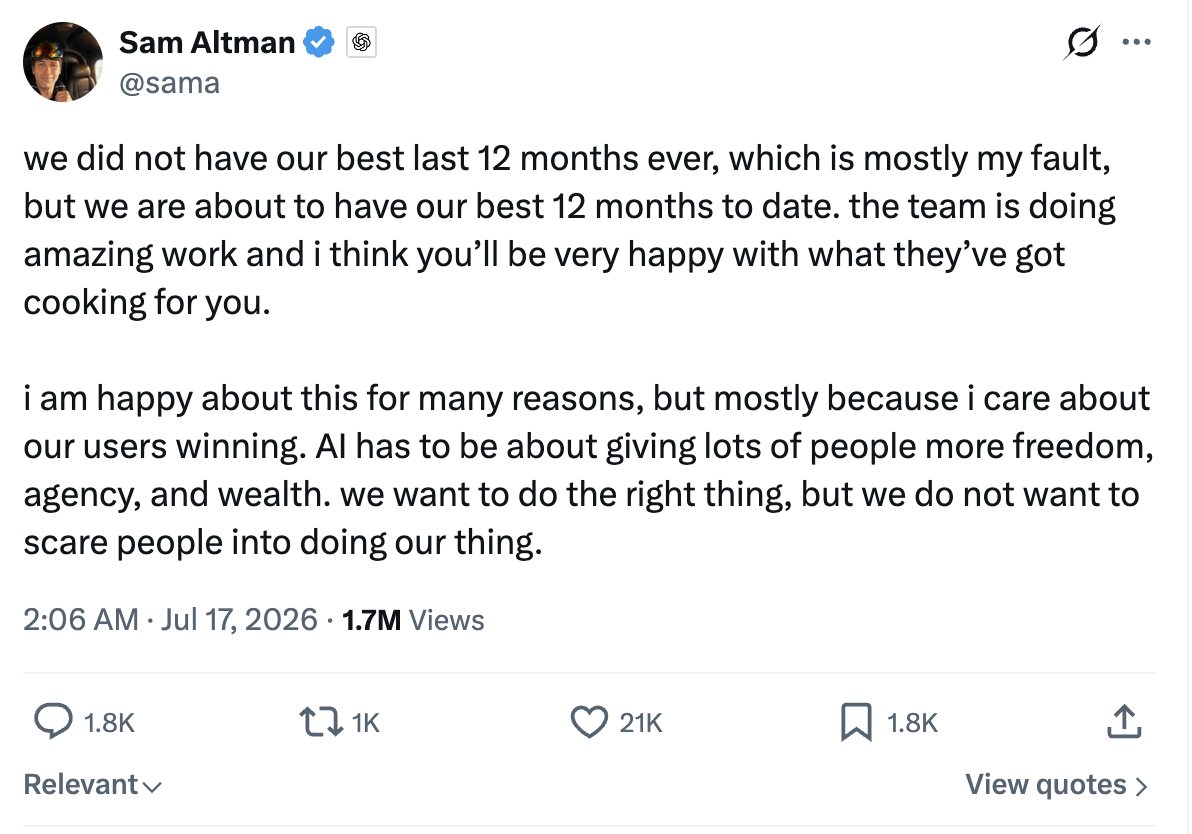
[Source: X]
Altman did not disclose specific details of the missteps, but his wording was quite direct. He revealed that the team is advancing 'amazing work' and hinted that upcoming new products will satisfy users. This statement comes as external skepticism regarding OpenAI's business model and the return on investment (ROI) of AI continues to heat up.
User reactions were mixed. While some appreciated his candor, others believed that the delivery of product quality, system stability, and commercialization efficiency is far more critical than public statements.
The background of Altman's post is a recent lengthy article published by Ed Zitron, a long-time AI skeptic, who put forward his most radical judgment yet: the real AI bubble is essentially the 'OpenAI bubble.'
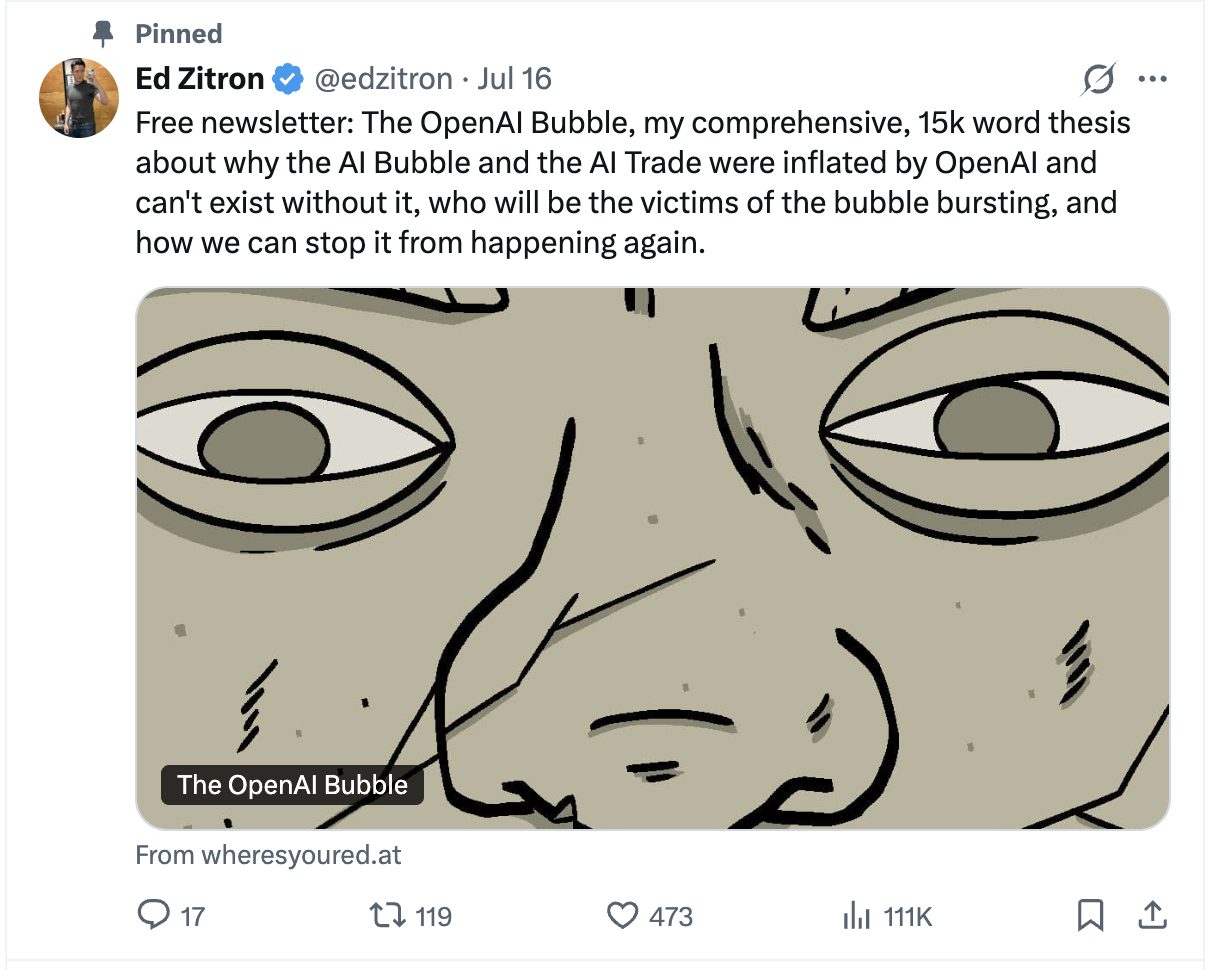
[Source: X]
Zitron referred to OpenAI as the 'anchor of credibility' for this round of the AI investment cycle, arguing that since ChatGPT's debut in late 2022, investors' confidence in hyper-scale data centers, GPU demand growth, and the profitability of AI companies has been built on the expectation of OpenAI's sustained high-speed growth.
His skepticism centers on three points: inference costs remain too high, meaning that expanding the user base could lead to concurrently widening losses; capital expenditures are expanding far faster than cash flow is improving, with many data center projects requiring years to recoup costs; and OpenAI will continue to rely on external financing for many years, leaving its business model under greater pressure if the financing environment tightens.
Zitron warned that if OpenAI fails, it could become the 'Lehman Brothers moment' of the AI bubble, with the shock waves spreading to data centers, AI infrastructure, and even global tech stocks. He specifically called out Oracle ( ORCL) and CoreWeave ( CRWV ), arguing that these companies, which rely on AI infrastructure demand, could bear the brunt of the impact. Anthropic faces similar risks; though its path is different, it also requires continuous, massive capital injections and remains dependent on external support.
Zitron's concerns are not limited to OpenAI itself but extend to the entire industry chain. Over the past two years, Microsoft ( MSFT ), Google ( GOOGL ), Meta ( META ), Amazon ( AMZN) and other hyper-scalers have continuously ramped up capital expenditures, with related projects heavily relying on debt and lease financing. If core customer demand falls short of expectations, or if capital markets re-evaluate AI returns, the highly valued AI infrastructure chain could face a repricing.
Meanwhile, Wall Street's debate over whether AI has entered a bubble phase has been ongoing for some time with no consensus. Oaktree Capital co-founder Howard Marks significantly raised his long-term assessment of AI in his latest memo, arguing that its potential is 'more likely to be underestimated than overestimated' and advising investors to adopt a strategy of 'moderate positioning, careful selection, and maintaining caution' rather than simply chasing or avoiding the theme.
This content was translated using AI and reviewed for clarity. It is for informational purposes only.
Recommended Articles




Comments (0)
Click the $ button, enter the symbol, and select to link a stock, ETF, or other ticker.