


Memory Giant Kioxia Tumbles 16% Today: Market Value Halved in a Month, Japan Stock Ranking Drops to Fifth



AI Podcast


As of Asian time July 17, Kioxia’s share price plunged 16% to 52,390 yen, marking a 52% decline from its June 22 peak. Formerly Japan’s most valuable company, its market capitalization has dropped to fifth. This sell-off, driven by profit-taking and sector-wide panic over potential AI memory oversupply, follows TSMC’s elevated 2026 capital expenditure outlook. While Kioxia’s fundamentals remain robust, broader industry concerns regarding cyclical peaks have triggered heavy liquidations. Given unresolved market uncertainty, the stock faces continued short-term downward pressure, with potential testing of the 50,000 yen psychological support level.
TradingKey - Kioxia's share price plunged 16% today, widening its decline over the past month to more than 50% and dropping its market capitalization ranking to fifth in the Japanese stock market.
On July 17 Asian time, Japanese AI memory giant Kioxia gapped down at the open this morning and continued to weaken, falling as much as 16% intraday to trade temporarily at 52,390 yen, with its market value dropping to 40 trillion yen and touching its lowest level since May 21 this year.
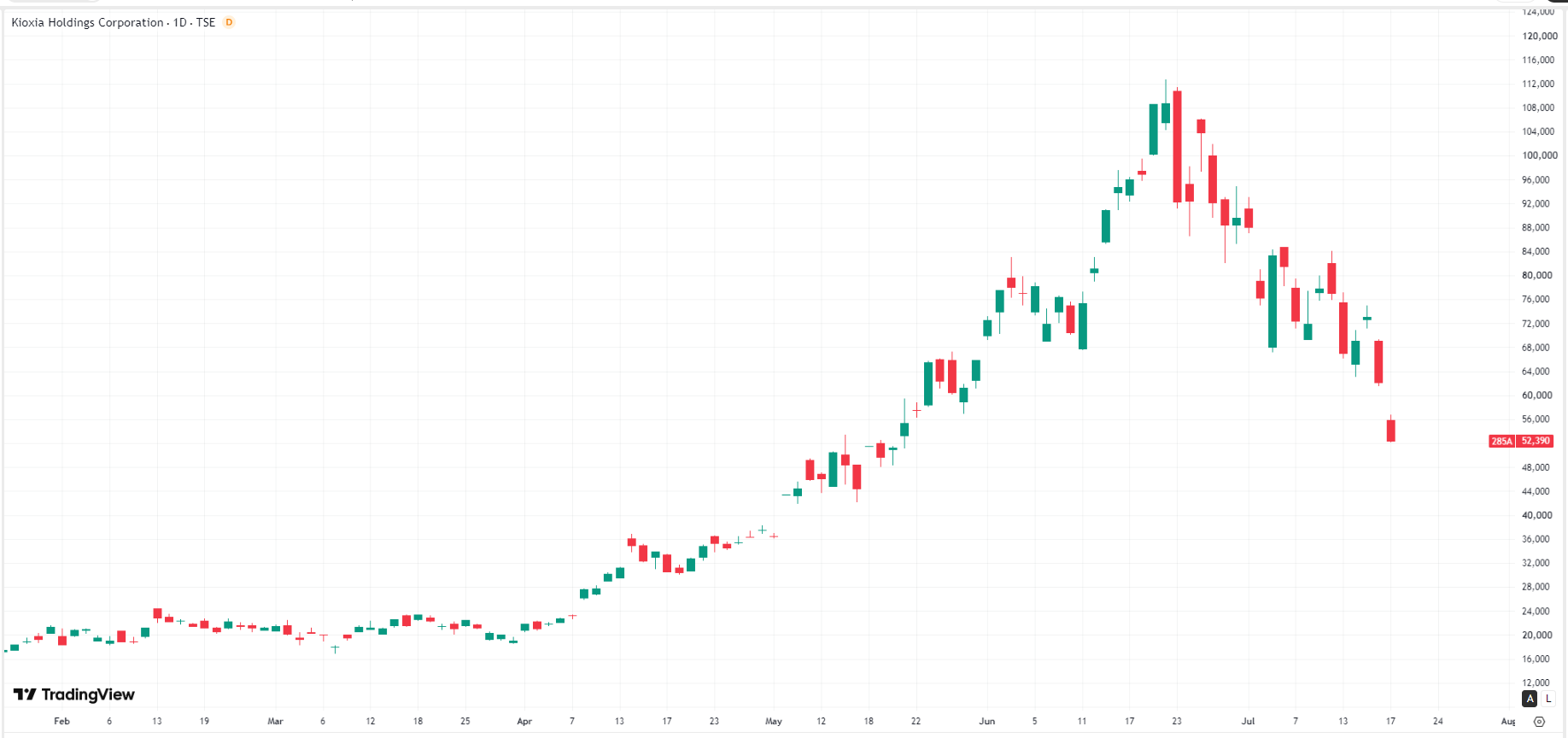 Kioxia stock price chart, Source: TradingView
This plunge has sent Kioxia straight into a historic dark moment: in just one month, this former 'new king of Japanese stocks' saw both its stock price and market value halved, plummeting 52% from its June 22 peak, with its market capitalization shrinking brutally by approximately 30 trillion yen (totaling $185 billion), and its market cap ranking in Japan rapidly slipping from first to fifth.
Since the beginning of this year, Kioxia, riding the super tailwind of AI data centers and high-capacity storage, saw its annual profit surge by nearly 93% year-over-year, with its share price skyrocketing by over 600% in just a few months, and its market cap temporarily surpassing Toyota to rank first in Japan. However, investors have recently begun to question whether the rally in AI-driven memory chips has overheated, leading to a sell-off in the sector, while Kioxia, fueled by a massive accumulation of profit-taking funds and retail margin trading, triggered an unresisted panic stampede.
Yesterday, TSMC announced it would raise its 2026 capital expenditure ceiling to $64 billion, further triggering concerns over oversupply and leading to a collective plunge in the US semiconductor and memory sectors, with SK Hynix ADR ( SKHY ), SanDisk ( SNDK ), Western Digital ( WDC ), Micron Technology ( MU) and other international memory giants plunging, a wave of panic that spread directly to Kioxia at the market open on the 17th.
It is evident that Kioxia's current decline is not due to a deterioration in its own fundamentals, but rather market concerns over the frenzy in the memory and even AI sectors, questioning whether the industry has reached a cyclical peak. As these doubts have not yet been resolved, this also means Kioxia's stock price may still continue to pull back and test the 50,000 yen mark in the short term.
This content was translated using AI and reviewed for clarity. It is for informational purposes only.
Recommended Articles






Comments (0)
Click the $ button, enter the symbol, and select to link a stock, ETF, or other ticker.