


US Stocks Close: Three Major Indexes All Rise, Nasdaq Gains for Three Straight Days; SK Hynix Closes at $168 in Debut, Below Opening Price of $170; Meta Weekly Gain Reaches 14.81%, Recording Best Weekly Performance in Nearly a Year and a Half



AI Podcast


Major US stock indices rose as market sentiment improved following continued US-Iran diplomatic talks and the successful listing of SK Hynix. Tech stocks drove market performance, with Meta surging nearly 6% amid positive analyst commentary on its cloud revenue potential and lower-than-expected AI infrastructure costs. Conversely, Morgan Stanley warned that semiconductor stocks appear significantly overbought, citing concerns over AI capital expenditure returns. Meanwhile, the Federal Reserve highlighted that AI-driven investment sustains economic growth, though geopolitical uncertainty persists. Additionally, the OCC granted Circle a national trust bank charter, marking a regulatory milestone for stablecoin reserve management.
TradingKey - The US agreed to continue talks with Iran, and SK Hynix listed today, both boosting market sentiment. The three major US stock indexes all closed higher, with the Nasdaq Composite Index rising for a third consecutive day, while the rally in tech stocks slowed.
At the close, the Dow Jones Industrial Average rose 0.29% to 52,637.01 points; the Nasdaq Composite Index rose 0.29% to 26,281.61 points; and the S&P 500 Index rose 0.42% to 7,575.39 points.
Tech Stock Performance
SK Hynix (SKHYV) closed at $168.01 on its trading debut, 12.76% above its offering price, but lower than its opening price of $170.
SK Hynix stated that the current memory chip shortage impacting the PC, automotive, and consumer electronics markets is highly likely to persist beyond 2030. Meanwhile, SK Group Chairman Chey Tae-won proposed a new business model concept of "Memory as a Service," which allows customers to rent the right to use memory chips rather than directly purchase physical semiconductors, thereby breaking through memory capacity bottlenecks. If implemented, this model could reshape the business logic of chip companies.
Meta (META) closed up 5.97% at $669.21, with a weekly gain of 14.81%, recording its best weekly performance in nearly a year and a half.
Deutsche Bank said the market may have overestimated the pressure of this expansion on Meta's balance sheet and profits, while underestimating the company's potential to convert idle computing power into third-party cloud revenue. Deutsche Bank assumed an incremental margin of 50% to 75% for the computing power rental business, taking into account relevant costs such as sales and customer support. Under this assumption, the incremental operating profits corresponding to the three scenarios would be $7.3 billion, $15.1 billion, and $27 billion, respectively.
Among large-cap tech stocks, Meta Platforms (META) rose 5.97%, Nvidia (NVDA) rose 4.03%, Tesla (TSLA) rose 0.30%, and Microsoft (MSFT) rose 0.19%; on the downside, SpaceX (SPCX) fell 4.51%, Amazon (AMZN) fell 0.69%, TSMC (TSM) fell 0.65%, Google (GOOGL) fell 0.48%, Apple (AAPL) fell 0.28%, and Broadcom (AVGO) fell 0.28%.
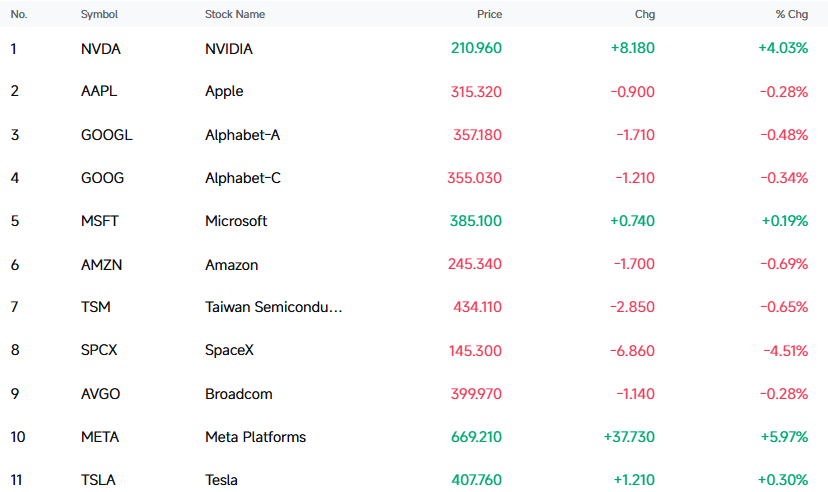
[Source: FutuBull]
The Philadelphia Semiconductor Index rose slightly by 0.06% to 12,967.16 points. Among its 30 constituents, 19 declined and 11 advanced.
Chinese concept stocks saw more gainers than losers, with Kingsoft Cloud (KC) rising 4.20%, Trip.com (TCOM) rising 3.31%, MINISO (MNSO) rising 2.70%, Zai Lab (ZLAB) rising 2.55%, KE Holdings (BEKE) rising 2.03%, and Atour (ATAT) rising 1.74%.
Corporate News
US OCC Approves Circle's National Trust Bank Charter
The US Office of the Comptroller of the Currency (OCC) has officially granted a national trust bank charter to leading stablecoin issuer Circle. The charter authorizes Circle to directly manage the reserve assets of its compliant stablecoins, with the core underlying asset being the USDC stablecoin, which has a circulating supply of over $73 billion. The new bank will operate under the name "Circle National Trust Bank." Prior to this, Circle relied on third-party banks and custodians to hold the cash and Treasury assets backing the value of USDC.
Meta's AI Infrastructure Construction Cost Far Lower Than Market Expectations
An internal memo shows that Meta's cost of building AI infrastructure is far lower than market expectations, with the cost per gigawatt of computing power close to $22 billion, well below the $45 billion expected by Wall Street. The significant cost savings address investors' doubts about the return on its massive capital expenditures. Zuckerberg recently stated in a media interview that the entire AI industry is currently facing a shortage of computing resources, and no company thinks it has "too much" computing resource; almost all of Meta's existing computing power is used for internal AI R&D and product training.
SK Hynix CEO: Memory Chip Shortage Could Last Beyond 2030
The CEO of SK Hynix said that the memory chip shortage currently plaguing the computer, automotive, and device markets could continue beyond 2030. Customers are signing long-term contracts because they "expect the shortage to last longer." The company and its peers—Samsung Electronics and Micron Technology—have become major beneficiaries of the AI boom. Massive spending by data center operators has driven demand for traditional memory as well as a new type of high-bandwidth memory. This scramble has made it harder to meet the broad demand for memory chips, leading to shortages in sectors such as computers, mobile phones, and automobiles. Kwak Noh-jung stated that SK Hynix's analysis shows the shortage could last into the next decade. Customer signals also indicate expectations that sufficient memory chips will not be available for some time.
SK Group Chairman Says Additional ADR Issuance Is Possible
SK Group Chairman Chey Tae-won said SK Hynix is open to issuing more US shares if returns are strong and the company's stock price remains stable. "It actually requires better returns," he said. "Once we have better returns, demand will naturally increase. Our top priority is to keep the stock price stable, and we hope there will be upside potential in the long run." Chey also pledged to increase the company's investment in the US. Chey stated, "We are now in the AI era, and the arrival of the AI era has actually significantly pushed up the demand for memory chips." Currently, the three top memory chip manufacturers are accelerating investments to expand capacity, racing to meet surging market demand. SK Hynix and Samsung announced last week that they will invest a combined 800 trillion won to build new chip manufacturing plants; this move is part of South Korea's ambitious plan to double the country's memory chip capacity within five years.
Industry & Macro News
Trump: US Agrees to Continue Talks with Iran
Trump said on Friday that the US agreed to continue talks with Iran, but would no longer abide by the ceasefire agreement. Trump's remarks came as regional mediators worked continuously over the past 48 hours to defuse tensions and prevent a complete collapse of the US-Iran agreement. A person familiar with the matter revealed that the US and Iran are expected to hold a new round of talks next week, likely in Switzerland. Qatari negotiators traveled to Iran on Friday in coordination with the US to meet with Iranian officials, aiming to ease tensions and pave the way for resuming talks. "It is clear that both sides want to return to the framework of the memorandum of understanding," the diplomat said.
Morgan Stanley Warns Chip Stocks Are Significantly Overbought
Morgan Stanley said that the semiconductor sector is significantly overbought, corporate pricing power is being continuously eroded, and stock price gains have overextended the optimistic expectations for AI spending, meaning investors need to be wary of correction risks. What is more alarming is the shift in expectations on the upstream demand side. Meta's first-ever statement that it is considering leasing out its AI infrastructure sends a clear signal: top tech giants have begun to scrutinize the return on investment of their massive AI capital expenditures, exploring paths for early monetization. This means that the high-growth cycle of AI capital expenditure is nearing its peak, and the growth slowdown has only just begun, which will directly shake the underlying support for the high valuations in the chip sector.
US Plans to Ease Export Restrictions on UAE
The Trump administration plans to ease export restrictions on the United Arab Emirates (UAE), clearing the way for its procurement of various advanced technologies, including commercial satellites and semiconductors used for artificial intelligence. In a notice to be released next week, the US Department of Commerce said the UAE now qualifies for more lenient treatment under US export control laws. The Department of Commerce also noted that the UAE supports the US position in the war against Iran. Easing the export restrictions will enable UAE companies to proceed with planned purchases of advanced AI chips from Nvidia, AMD, and Cerebras Systems. The deal, reached between the US and the UAE more than a year ago, stipulates that these companies will supply thousands of processors to G42, a state-backed tech leader in the UAE, for use in newly built AI data centers in the region.
Fed: AI-Related Investment Drives Strong Output Growth, Iran War Uncertainty Remains Major Risk
The Federal Reserve's semi-annual report shows that US economic activity overall maintained a steady expansion in 2026, primarily driven by high-tech investment and government spending. Factory output grew strongly due to investments in AI-related data centers, and productive capacity continued to improve. However, the housing market stalled, and the external economy faced sluggish growth, dragged down by the Middle East conflict and tariffs. The labor market was generally stable, with both wages and productivity rising, but a slowdown in immigration led to a decline in labor supply, while small businesses and households still faced tight credit conditions. Inflation remained elevated and moved further upward in the spring, with asset prices staying above historical norms. The financial system was overall resilient, bank reserves were ample, and the private credit market operated normally despite some redemption pressures. Long-term inflation expectations remained broadly anchored near the 2% target, but uncertainty stemming from the war in Iran remains a major risk.
This content was translated using AI and reviewed for clarity. It is for informational purposes only.
Recommended Articles







Comments (0)
Click the $ button, enter the symbol, and select to link a stock, ETF, or other ticker.