


Meta Rises 4% Pre-Market, Muse Spark 1.1 Release Boosts AI Narrative, EU Addictive Design Allegations Fester Simultaneously



AI Podcast


Meta Platforms rose over 4% in premarket trading on July 10, Eastern Time, fueled by the launch of the competitive Muse Spark 1.1 model and plans for self-developed "Iris" AI chips to reduce reliance on Nvidia. Despite $145 billion in planned AI infrastructure investment, regulatory headwinds persist. The European Commission ruled that Meta’s addictive design features violate the Digital Services Act, potentially risking fines up to 6% of global revenue. Investors remain focused on whether aggressive AI commercialization and strategic infrastructure expansion can effectively offset these significant regulatory challenges and compliance costs.

TradingKey - On July 10, Eastern Time, Meta Platforms ( META) rose more than 4% at one point in premarket trading. As of press time, the stock was trading around $655.45 premarket. On the previous day, Meta closed up 4.7%.
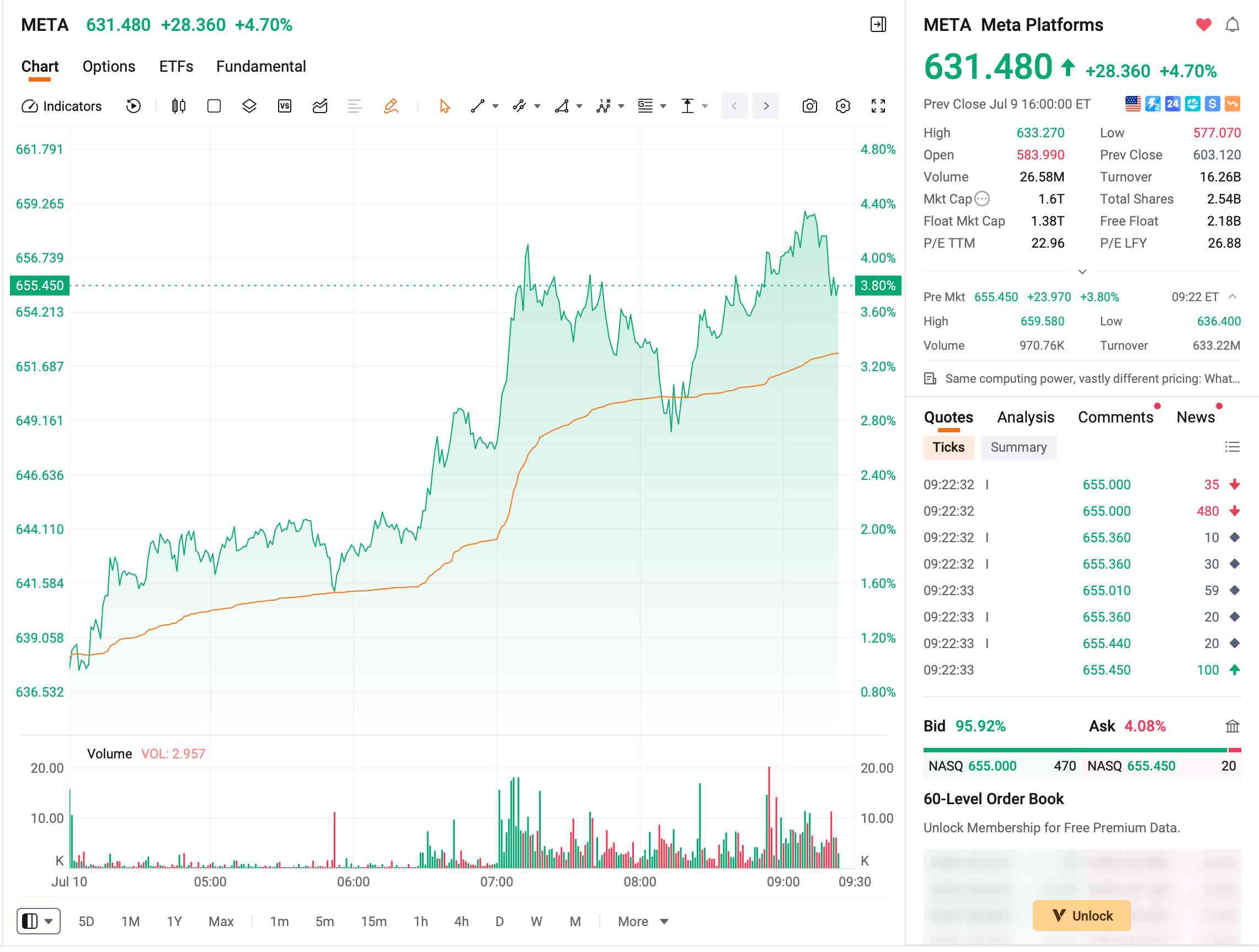
[Source: Futu]
The premarket share price gain was mainly driven by the AI narrative. On July 9, Meta released Muse Spark 1.1, which was dubbed by Meta's Chief AI Officer Alexandr Wang as the company's "most powerful model to date in the field of intelligent agents and programming." The API pricing for this model is $1.25 per million input tokens and $4.25 per million output tokens, which is far lower than the prices of OpenAI's GPT-5.5 and Anthropic's Claude Opus 4.8, leading investors to hold positive expectations for its AI commercialization prospects.
According to Reuters, Meta plans to start mass production of its self-developed AI chip, code-named "Iris," in September, designed in collaboration with Broadcom ( AVGO) and manufactured by TSMC ( TSM) to reduce reliance on Nvidia ( NVDA) GPUs. Meta plans to deploy 7 gigawatts of computing infrastructure this year, with AI infrastructure investment expected to reach as high as $145 billion. Meanwhile, Meta recently announced an investment of over C$13 billion (approximately $9.1 billion) to build an overseas AI data center in Alberta, Canada, with an installed capacity of 1 gigawatt.
Meanwhile, the European Commission released preliminary findings of an investigation on July 10, determining that features such as infinite scroll, autoplay, push notifications, and highly personalized recommendation systems on Meta's Instagram and Facebook violate the Digital Services Act. It ruled that they constitute "addictive design" and fail to fully assess the risks of such designs to users' physical and mental health, particularly for teenagers and vulnerable adults.
The European Commission stated that Meta's current mitigation measures fail to effectively address the risks of addictive features. It demanded that Meta adjust the design of Instagram and Facebook, including disabling key addictive features like autoplay and infinite scroll by default, introducing effective screen-time break mechanisms, and adjusting recommendation systems to reduce reliance on user engagement. If Meta fails to make the corresponding changes, it could face a fine of up to 6% of its global annual revenue.
A Meta spokesperson responded, saying, "We disagree with these preliminary findings, which fail to accurately take into account the significant measures we have already taken to protect teens." Meta emphasized that since the investigation began, it has launched a "Teen Accounts" feature that "automatically protects teens and hands control to parents," allowing parents to block their children's access to Instagram at night and limit daily screen time to 15 minutes.
Meta stated that it "shares the European Commission's commitment to providing teens with a safe and positive online experience" and is willing to maintain communication with regulators. The company can submit a written response to refute the allegations before a final decision is made.
Influenced by the mix of regulatory headwinds and positive AI tailwinds, Meta's premarket stock price generally maintained its upward trend, as the market assesses whether the prospects of AI commercialization can continue to outweigh regulatory risks.
This content was translated using AI and reviewed for clarity. It is for informational purposes only.
Recommended Articles










Comments (0)
Click the $ button, enter the symbol, and select to link a stock, ETF, or other ticker.