


AMD (AMD) Stock Price Forecast: Samsung’s Earnings Selloff Hit $516 - Goldman Says $640



AI Podcast


AMD shares fell 8% following Samsung’s preliminary Q2 2026 earnings. While Samsung reported a 19-fold profit increase, the 6% beat relative to consensus triggered a sector-wide correction, as investors reacted to high valuations. Despite the pullback, Goldman Sachs maintains a $640 price target, citing the "agentic AI" thesis—where multi-step AI workflows increase demand for AMD’s EPYC server CPUs. Technically, AMD remains above its $457 EMA200 support. Investors are now focused on AMD’s August 4 earnings, with consensus revenue projected at $11.2 billion and a 56% gross margin.
TradingKey - Shares of Advanced Micro Devices (NASDAQ: AMD) were changing hands at $516.55, down 8% from Monday’s closing level of $552.05, following Samsung Electronics’ preliminary second quarter earnings for 2026. Samsung reported preliminary second-quarter 2026 operating profit of $58 billion, surging 19 times from the year-ago period and beating out Wall Street estimates.
Despite the strong report, chip stocks slumped after a strategist at Deutsche Bank commented that the figure just exceeded consensus by about 6%, leading to speculation by some investors that chipmakers that bet big on artificial intelligence won’t be able to exceed already lofty expectations. In the US, chip maker Intel dropped 10%, while AMD slumped 8% and Applied Materials lost 10%.
On the 4-hour chart, the RSI is at 45.79, suggesting room for recovery. AMD has held above its 200-period exponential moving average (EMA200) of $457.04 but broke down below its short-term moving average trendline. Goldman Sachs raised its AMD price target to $640 on July 5, saying it has a long-term buy-out upside due to its adoption of agentic AI with CPUs. AMD is set to announce second quarter earnings on August 4.
The Samsung Selloff; Why a 19-Fold Profit Increase Still Pressured Chip Stocks
Samsung reported preliminary second quarter 2026 operating profit of $58 billion, up 19 times on year, on higher earnings per unit of HBM and rising DRAM prices, among others. Though the reported second quarter profit exceeded analyst expectations, Samsung shares slid as much as 10% in Seoul, triggering a temporary trading halt under the Korea Exchange circuit breaker rules. The figure just exceeded consensus by about 6%, Deutsche Bank said, prompting investors to take a step back on chip stocks. The same sentiment was reflected in the US, where Intel fell 10%, AMD dropped 8% and Applied Materials shed 10%.
The stock market’s broader sentiment has remained strong as the Dow Jones Industrial Average climbed to a new high earlier this week, while the CBOE Volatility Index (VIX) held in its 15.81 levels. Rather than an adverse shift in overall market sentiment, the correction could be part of a broad reset for chip stocks where valuations have already been priced in strong results. AMD is up more than 100% this year and stood at an all-time high market capitalization of $900 billion at its peak before yesterday’s sell-off.
Even a correction after Samsung’s earnings, as the South Korean tech giant is not a direct competitor of AMD for AI chips like GPUs or CPUs, demonstrated just how closely chip stocks trade as a group as earnings expectations have reached extremely high across the sector. Earnings growth alone is now not enough to boost chip stocks’ valuations, if any expectations were not already met. AMD will announce second quarter earnings on August 4 after the market closes. The stock is currently trading at consensus estimates of revenue of $11.2 billion, up 46% on year. AMD is expected to post a non-GAAP gross margin of 56%. The semiconductor industry in general is expected to post 131% earnings growth in the second quarter on year-on-year, marking its largest share of growth in the information technology sector’s overall projected earnings growth of 63.3%. The stock is likely to remain highly sensitive to changes in sentiment of chip stocks until then.
Goldman’s $640 Target and the Agentic AI CPU Thesis
On July 5, Goldman Sachs’s James Schneider upgraded his AMD price target to $640 from $450 while maintaining a Buy rating. The firm’s rationale centers on the notion that the rise of agentic AI will necessitate a much larger CPU load in data centers than currently assumed. As an AI agent performs multi-step reasoning, interacts with external tools and calls APIs, and maintains the state of user sessions, it needs the CPU to orchestrate those operations; it cannot be accomplished using only a stack of GPUs.
Schneider views AMD as the main winner of this trend, citing the EPYC Venice 2nm server CPU as a key product that is now shipping since Q2. Server CPU revenue in Q1 jumped more than 50% year over year and is projected to increase by more than 70% in Q2. Furthermore, due to its performance-per-watt benefit to Intel Xeon for AI orchestration workloads, seven out of the ten largest model builders use AMD accelerators in production.
Schneider’s take is that the GPU market and AMD’s CPU market are not competing, but in fact the GPU market complements the overall CPU narrative. The company has signed a multi-year agreement to secure six gigawatts of AMD Instinct MI450 series GPUs, the largest public GPU supply deal outside of Nvidia. Earlier this year, as the company ramped up its MI350 series (CDNA4), AMD announced gains in AI inference performance up to 35 times faster than the previous generation, along with the ability to offer 288GB of its best-end HBM3E memory.
AMD plans to introduce its MI400 series later in H2 as part of its Helios rack-scale solution which will integrate EPYC Venice server CPUs with MI400 GPUs and networking, and it is expected to be the firm’s first-ever rack-scale system directly challenging Nvidia’s DGX architecture. AMD stock is now trading at an earnings multiple of 73x as of $516 after the Samsung price cut, compared with trailing earnings at 136x, as Q2’s $5.8 billion data center growth (+57% year over year) is already priced in.
AMD Technical Analysis: Trendline Breakout at $516, RSI 45.79, Target $557.70
AMD stock is continuing to move above trendline resistance in the four-hour timeframe, recording its second higher-low in a row above $457.04 on the EMA200. Its RSI is at 45.79; it does not look oversold or overbought and shows no bearish divergence, though the recent pullback following the price cut on Samsung leaves the stock right below its breakout zone, with immediate support sitting at $497 and the next level below at $478. Should AMD be able to close above $529.30, the next upside target is $557.70 through channel extension with a stop-loss order at $497.60.
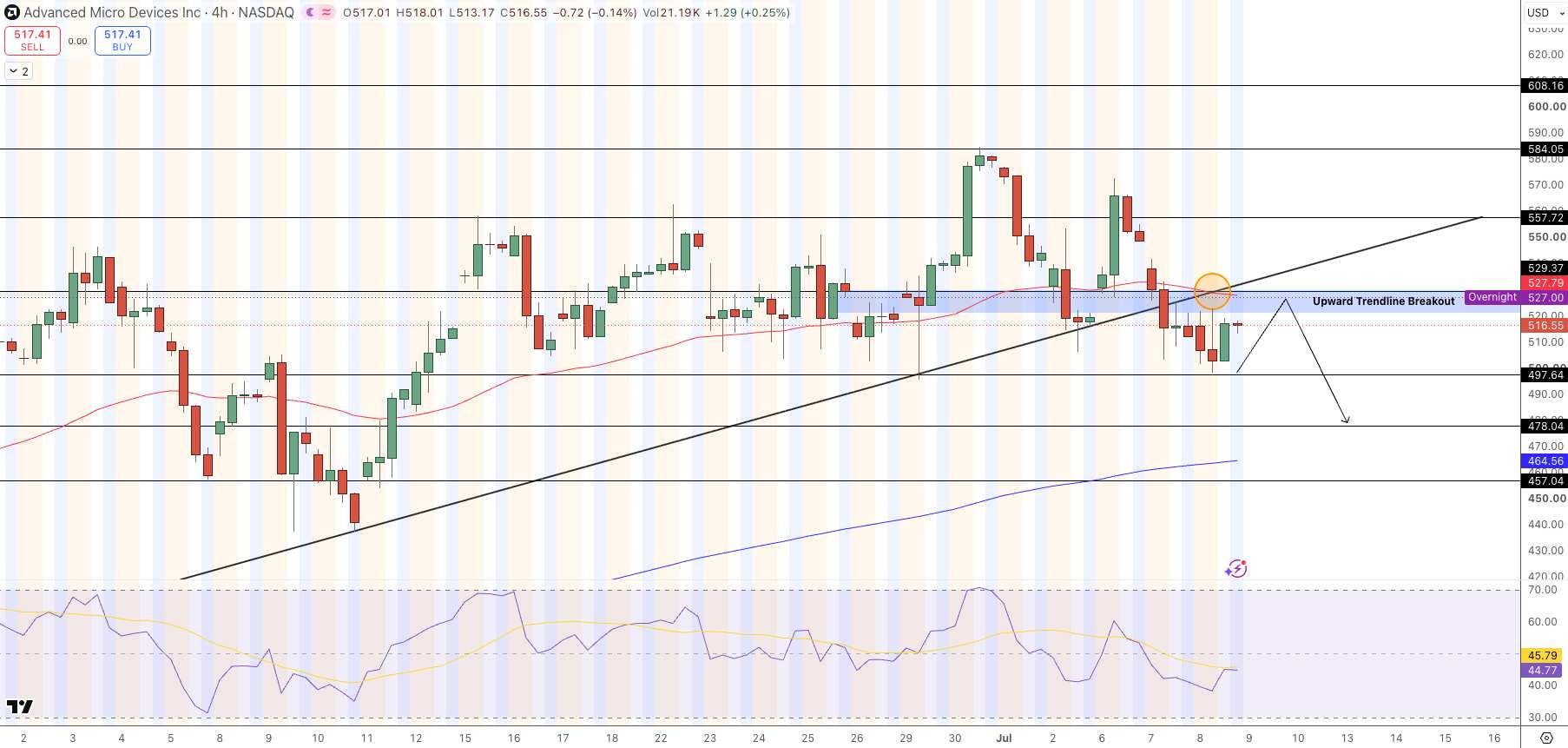
AMD (AMD) Stock Price Chart - Source: Tradingview
- Data Center revenue growth will be 57% year over year with $5.8 billion, and EPS of $1.37, ahead of the $1.27 consensus.
- Revenue of $11.2 billion is expected to reach $11.2 billion (46% year over year) in Q2, and gross margins are expected to hold steady at 56%.
- August 4 is the date for AMD to publish Q2 results.
- Goldman: $640 (Buy); thesis is that Agentic AI will need significantly more CPU resources in data centers.
Why Was AMD's Stock Down 8% When Samsung's 2Q26 Earnings Showed A 19X Operating Profit Beat?
Samsung just shared its preliminary 2Q26 operating profit of ~$58 billion, a 19x YoY beat and above-consensus outperformance. However, according to a report by Deutsche Bank, Samsung only posted a beat of 6% above consensus. The outperformance was less than expected given how up 100-150% AMD has been in 2026 YTD, resulting in selling and a sector-wide spillover. AMD was off 8%, Intel was down 10% and Applied Materials was off 10% despite the Dow posting a new record. This was very much a chip-sector specific sell-off, and not a market-wide risk-off move.
What Is The Goldman Sachs Agentic AI CPU Thesis For AMD?
On July 5, Goldman's James Schneider raised AMD's price target to $640 from $450 following the thesis of agentic AI. Agentic AI refers to the concept of AI agents having multi-step instructions and making tool calls and executing long-running workflows. These workflows result in more server CPU use in data center data centers, and specifically within the data center servers, as the architecture has a central coordination layer in which you require the use of high core count CPUs. AMD's EPYC Venice (2nm) will be the CPU that fills that demand. AMD has guided for greater than 70% year-over-year growth in its server CPUs in Q2, and seven of the top 10 model builders are utilizing AMD's GPU in its data centers.
Conclusion
AMD was down 8% in reaction to Samsung's 2Q26 earnings beat that was better than expected but still a 6% beat, with the chip sector selling-off despite the Dow making a new record high. The trendline above its long-term average at $457 remains unbroken. RSI at 45.79 has room to grow further. Goldman Sachs' price target was set at $640 as the result of the potential of agentic AI CPUs: the EPYC chips are uniquely suited to data center orchestration. Server CPU is 70% Y/Y or higher, and MI400 Helios will launch in the rack scale H2 2026. 1Q delivered revenue of $10.3 billion. Data Center was 57% Y/Y at $5.8 billion. EPS was 1.37 and it was a beat. Q2 guidance was set at a top line of $11.2 billion with gross profit margins of 56%. A rally above 529.30 will lead targets at 557.70. Stop losses are placed at 497.60.
Recommended Articles









Comments (0)
Click the $ button, enter the symbol, and select to link a stock, ETF, or other ticker.