


$4.67 Billion Fine Settled. EU’s Highest Court Upholds Android Antitrust Ruling, Google Loses Appeal



AI Podcast


On July 2 local time, the European Court of Justice issued a final ruling rejecting Alphabet’s appeal, upholding a 4.1 billion euro antitrust fine regarding its Android operating system. The court confirmed Google abused its market dominance by forcing pre-installations and restricting competitors. While Google claims compliance since 2018, the ruling marks a significant regulatory victory for the EU. This case highlights the bloc's tightening oversight of Big Tech, with cumulative fines against Google nearing 11 billion euros. Future risks remain as the EU escalates enforcement through the Digital Markets Act to ensure fair competition in the digital economy.
TradingKey - On July 2 local time, the European Court of Justice, the EU's highest court, issued a legally binding final ruling, rejecting the appeals of Google and its parent company Alphabet ( GOOGL )( GOOG) against the Android antitrust penalty, and upholding the fine of 4.1 billion euros (approximately $4.67 billion).
This eight-year legal tug-of-war ended with Google's defeat, marking a key victory for EU regulators in the antitrust field.
Affected by this news, Google's share price fell more than 1.5% at one point in pre-market trading on Thursday.
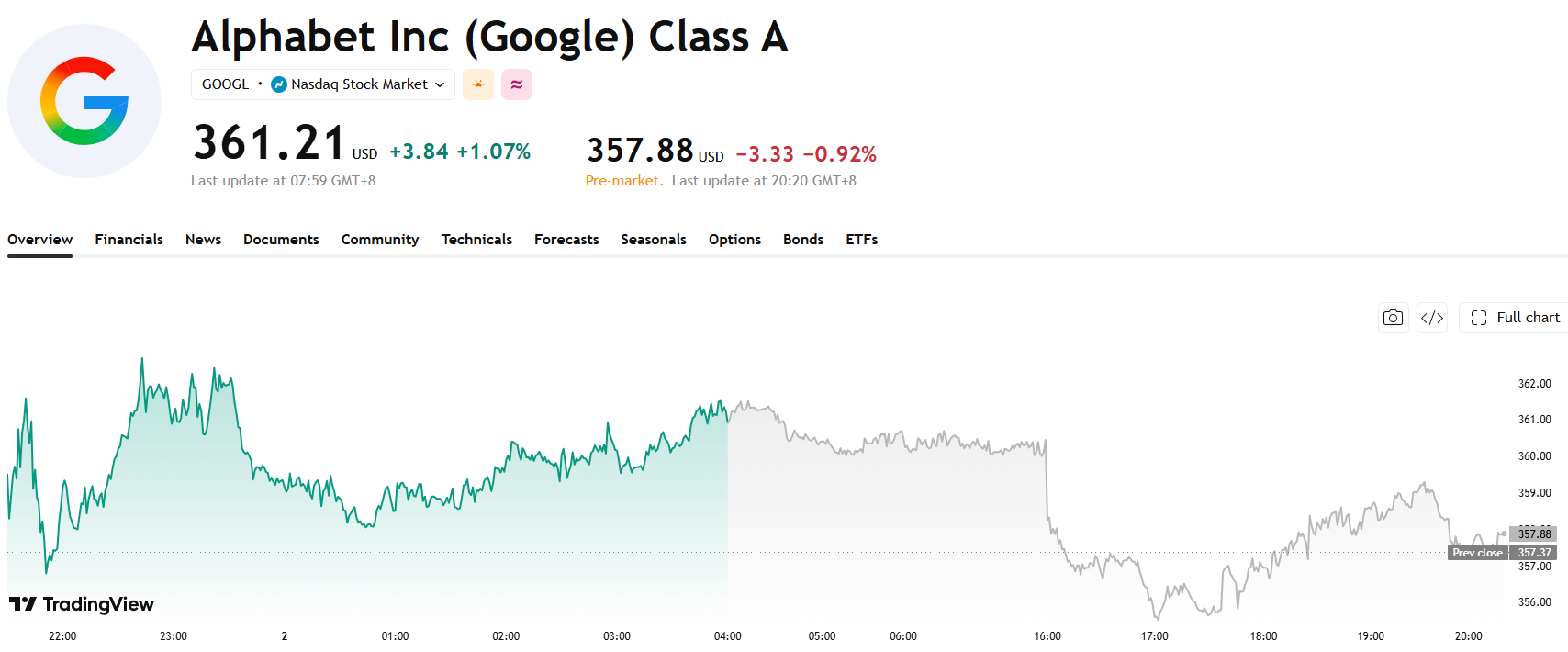
Source: TradingView
The penalty dates back to 2018, when the European Commission imposed a record fine of 4.34 billion euros on the grounds that Google had abused the market dominance of its Android operating system.
Regulators accused Google of consolidating the monopoly of its search engine through three anti-competitive practices: first, forcing phone manufacturers to pre-install Google Search and the Chrome browser as a condition for licensing Google's app store; second, paying large manufacturers and mobile network operators to secure the exclusive pre-installation of Google Search; and third, restricting manufacturers from selling devices running non-approved Android forks.
Google immediately initiated the appeal process. Although the General Court of the European Union upheld the finding of monopolistic behavior in 2022, it reduced the fine to 4.1 billion euros.
Google did not stop there, continuing to appeal to the European Court of Justice in an attempt to overturn the ruling. The final judgment explicitly rejected all of Google's appeals and confirmed its abuse of market dominance through the Android system, bringing this eight-year antitrust dispute to an official close.
Google Responds, Emphasizing It Has Complied with Regulations
Responding to the loss, a Google spokesperson said the ruling failed to consider the massive costs the company incurred to keep the Android system open, compatible, and free. However, the spokesperson also noted that as early as 2018, following the initial ruling, the company had already adjusted its partnership agreements to ensure compliance, and will continue to focus on innovation and maintain the open nature of the ecosystem.
Indeed, while Android's free business model has contributed to the global adoption of smartphones, EU regulators argue that this model should not serve as a tool to exclude competition.
FairSearch, the complainant group that first brought the case to the European Commission in 2013, welcomed the ruling, calling it "a major victory before Europe's highest court against Google’s anti-competitive behavior in the mobile market." The group believes that Google's conduct not only harmed consumer choice but also restricted room for competitors to grow.
EU Normalizes Antitrust Regulation of Tech Giants
This is not the first time Google has faced heavy antitrust penalties in the EU; over the past decade, the European Commission's antitrust investigations into the company have been continuous, with cumulative fines already nearing 11 billion euros.
In addition to the Android case, the EU had previously fined Google 2.95 billion euros for anticompetitive behavior in its advertising technology business.
Ongoing investigations cover multiple allegations, including favoring its own products in search results, regulatory violations in its app store operations, and allegedly downgrading news search rankings. Google is expected to face more penalties in the near term.
As the scale of the digital economy continues to expand, the EU's regulatory oversight of Big Tech has steadily escalated. In addition to traditional antitrust enforcement, the Digital Markets Act (DMA) is becoming an important tool for regulating the behavior of tech giants.
Earlier this year, Google was required to remove technical barriers for rival AI search assistants on its Android system and open up key data to other search engine providers. Meanwhile, it also faces the risk of new penalties for allegedly violating DMA regulations.
This final ruling by the EU's highest court not only demonstrates the EU's determination to safeguard market competition but also serves as an important reference for digital antitrust regulation globally.
This content was translated using AI and reviewed for clarity. It is for informational purposes only.
Recommended Articles











Comments (0)
Click the $ button, enter the symbol, and select to link a stock, ETF, or other ticker.